
 Worksheets
UM Medex posttest 2025
Total questions: 30
Worksheet time: 30mins
1. Diastolic phase of the cardiac cycle can be divided into a few stages.
Which stage contributes to the least volume of blood into the ventricle?
Isovolumetric ventricular relaxation.
Rapid ventricular filling.
Slow ventricular filling.
Atrial contraction.
2. Which of the following ECG findings is consistent with left atrial enlargement?
Increased P-wave amplitude
Increased P-wave duration
Increased P-wave amplitude and duration
Terminal P negativity in lead I
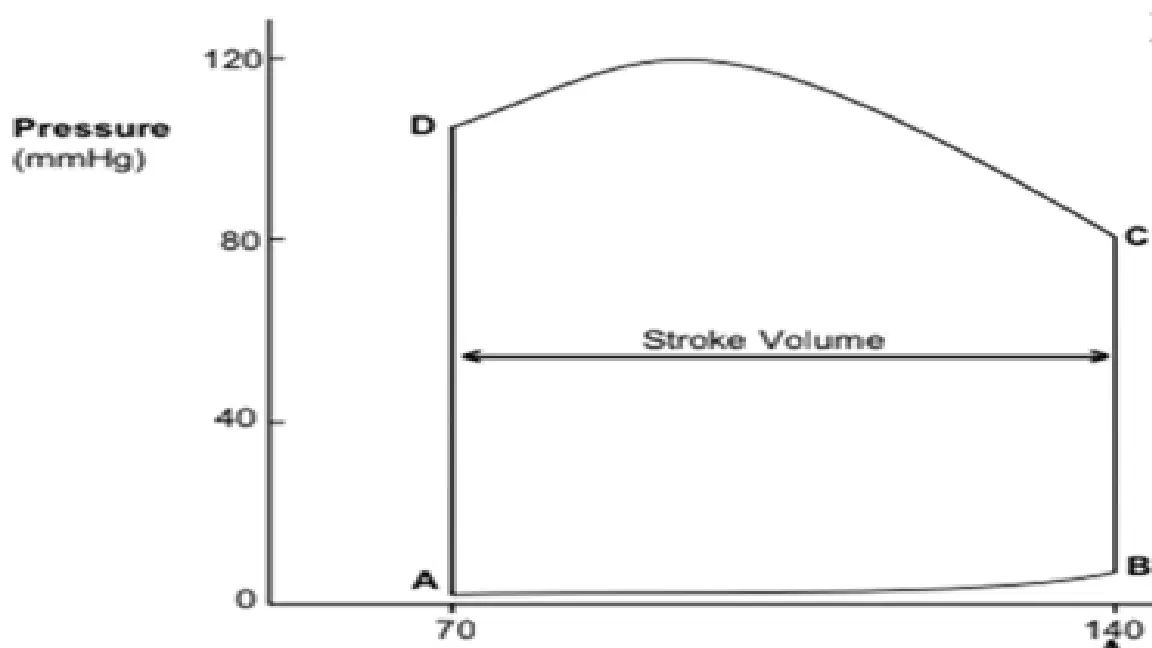
3. Which point on the pressure-volume loop below corresponds to the peak of the R wave on the ECG?
A
B
C
D
4. A 44-year-old woman is undergoing free flap surgery for breast reconstruction. The
surgeons are concerned about microvascular perfusion in the donor tissue. The
blood pressure decreases to 85/44mmHg.
What is the most important variable to consider in order to optimise flap perfusion according to Hagen–Poiseuille equation?
Blood pressure
Heart rate
Blood viscosity
Vessel calibre
5. A 67-year-old man has a laryngectomy and neck dissection for laryngeal cancer. At the end of the operation, the surgeon asks you to perform a Valsalva manoeuvre in order to look for bleeding points.
Decrease in blood pressure in phase 1.
Bradycardia in phase 1.
Baroreceptor activation in phase 2.
Reflex bradycardia in phase 4.
6. During the spirometry test, the physician plans to identify the maximal volume of gas that can be expelled after maximal inspiration.
What is the type of lung volume that best describes the above explanation?
Total lung capacity.
Functional residual capacity.
Inspiratory reserve volume.
Vital capacity.
7. A 29 y.o. obstetric patient is pre-oxygenated before general anaesthesia for EMLSCS.
Which physiological factors are likely to leave obstetric patients prone to desaturations?
Increased cardiac output.
Increased lung compliance.
Decreased functional residual capacity.
Decreased haemoglobin level.
8. Hypoxic pulmonary vasoconstriction (HPV) in the lungs is a compensatory
mechanism to improve ventilation-perfusion matching. In which of the following
would a decrease most likely trigger HPV?
Partial pressure of oxygen in the pulmonary artery.
Partial pressure of oxygen in the pulmonary veins.
Partial pressure of oxygen in the alveoli.
Oxygen saturation of hemoglobin in the pulmonary artery.
9. You are inducing a child for toilet training and suturing a laceration wound on the forehead
via inhalation induction. Which of the following speeds up the induction of
anaesthesia with volatile anaesthetics?
Use of nitric oxide
Increased cardiac output
Agents with a high blood/gas solubility coefficient
Increased alveolar ventilation
10. The oxygen dissociation curve is a sigmoid-shaped curve that describes the percentage of oxygen saturation in hemoglobin (Hb) at different partial pressures of oxygen. One of the important points is the ICU point.
What is the best value of PaO2 at this point?
100 mmHg.
90 mmHg.
80 mmHg.
60 mmHg.
11. Cerebral autoregulation is the ability of the cerebral vasculature to maintain stable
blood flow despite changes in blood pressure. The cerebral blood flow
is normally 50 ml/100gm/hr.
Increases with hypoxaemia.
Increases with hyperventilation.
has the autoregulatory curve shifted to the left in chronic hypertension.
12. The blood-brain barrier is a special barrier that protects the brain by separating the cerebral blood vessels from the brain parenchyma.
All of the following substrates can pass through freely, except
Carbon dioxide
Glucose
Oxygen
Water
13. According to the Monro–Kellie doctrine, which of the following will not compensate for a rising intracranial volume?
Reduction in CSF volume
Reduction in cerebral blood volume
Herniation of brain tissue
Shrinkage of brain parenchyma
14. Which of the following is not a component of Cushing’s triad?
Hypertension
Bradycardia
Irregular respiration
Tachycardia
15. The filtration at the glomerulus is important in the formation of the urine.
What is the main factor that affect the filtration?
The oncotic pressure of the capillaries.
The hydrostatic pressure of the Bowman space.
The hydrostatic pressure of the capillaries.
The oncotic pressure of the Bowman space.
16. The changes in the acid-base balance in the body is compensated partly by the buffer system.
Which is the most important extracellular component of it?
Plasma protein.
Phosphate.
Haemoglobin.
Bicarbonate.
17. The normal glomerular filtration rate (GFR) in adults is approximately:
60 mL/min
90 mL/min
125 mL/min
200 mL/min
18. Which of the following most effectively autoregulates renal blood flow?
Renin–angiotensin–aldosterone system
Myogenic and tubuloglomerular feedback
Sympathetic nervous system
Atrial natriuretic peptide
19. This drug is a weak acid and forms alkaline solution when dissolved in H2O with pH of 10.8. It causes marked reduction of cerebral metabolic rate of oxygen consumption.
Which induction agent is the best described by the above statement?
Propofol.
Midazolam.
Thiopentone.
Etomidate.
20. A 68-year-old female with a history of severe aortic stenosis is scheduled for a hip replacement. The anaesthetic consultant has chosen an intravenous induction agent that has minimal cardiovascular depressant effects. Which of the following is the most likely agent being used?
Methohexital.
Midazolam.
Ketamine.
Etomidate.
21. A 25-year-old woman with a history of acute intermittent porphyria requires a general anesthetic for an appendectomy. Which of the following intravenous induction agents is contraindicated in this patient?
Ketamine.
Propofol.
Thiopentone.
Midazolam.
22. A 34-year-old parturient at 38 weeks gestation is scheduled for an emergency Caesarean section due to a massive antepartum hemorrhage. On arrival to the operating theatre, her blood pressure is 85/45 mmHg and her heart rate is 130 bpm. Which intravenous induction agent is the most appropriate choice for this patient?
Midazolam.
Ketamine.
Etomidate.
Thiopentone.
23. A 45-year-old patient with well-controlled asthma is scheduled for a laparoscopic cholecystectomy. Which inhalational agent is most appropriate for this patient due to its bronchodilatory properties?
Desflurane
Nitrous oxide
Isoflurane
Sevoflurane
24. Which of the following inhalational agents has the lowest blood:gas partition coefficient, leading to the most rapid induction and emergence from anaesthesia?
Isoflurane.
Desflurane.
Sevoflurance.
Halothane.
25. A neurosurgical patient requires anaesthesia for the clipping of a cerebral aneurysm. The primary goal is to maintain cerebral perfusion pressure (CPP) and avoid increases in intracranial pressure (ICP). Which agent, when used at concentrations >1 MAC, is most likely to cause a significant increase in ICP?
Sevoflurane.
Desflurane.
Isoflurane.
Nitrous oxide.
26. A patient with myasthenia gravis is undergoing a thymectomy. How would you expect their response to a non-depolarizing neuromuscular blocking agent like rocuronium to differ from a healthy patient?
There will be no difference in their response.
They will be resistant to its effects.
They will be highly sensitive to its effects.
They will experience a shorter duration of action.
27. A patient has been given neostigmine to reverse a deep neuromuscular block. Which of the following is a potential unwanted muscarinic side effect of this medication?
Dry mouth.
Bronchodilation.
Tachycardia.
Bradycardia.
28. The speed of onset of a local anaesthetic is primarily determined by which of its physicochemical properties?
Molecular weight.
pKa.
Protein binding.
Lipid solubility.
29. A patient is undergoing spinal anaesthesia. Which type of nerve fibre is blocked first?
A-alpha fibres.
B fibres.
C fibres.
A-delta fibres.
30. A patient is started on a patient-controlled analgesia (PCA) pump with morphine following major abdominal surgery. Which parameter is the most important safety feature to prevent overdose?
The dosage of the bolus dose.
The presence of a background infusion.
The 4-hour dose limit.
The lockout interval.

