
 Worksheets
Engine Repair and Diagnostics Quiz
Total questions: 30
Worksheet time: 15mins
Why are proper diagnosis methods important to engine repair?
They increase the cost of repairs.
They help in accurately identifying issues.
They are only necessary for new engines.
They are not important for minor issues.
What is one of the objectives related to engine noises?
Ignore abnormal engine noises.
Discuss how to identify and locate abnormal engine noises.
Increase the volume to mask engine noises.
Replace the engine without diagnosing noises.
What should be summarized regarding engine compression testing?
Procedures for gasoline and diesel engine compression testing.
How to avoid engine compression testing.
The cost of engine compression testing.
The history of engine compression testing.
What is one of the objectives related to determining the mechanical condition of engine parts?
Perform an initial inspection, pressure tests, and electronic tests
Conduct a visual inspection only
Use only electronic tests
Rely solely on pressure tests
What type of test questions should be correctly answered according to the objectives?
ASE certification test questions
General knowledge test questions
Basic math test questions
History test questions
Why is it important for a technician to properly diagnose engine problems?
To save time, effort, and money
To increase the complexity of repairs
To ensure all parts are replaced
To avoid using diagnostic tools
What might an untrained technician do if they cannot properly diagnose an engine issue?
Rebuild the entire engine assembly unnecessarily
Use advanced diagnostic tools effectively
Perform only necessary minor repairs
Improve the engine's performance

Which issue is associated with worn cam lobes in an engine?
Do not open valves fully
Cause high-pitched clatter sound
Increase engine efficiency
Reduce oil consumption
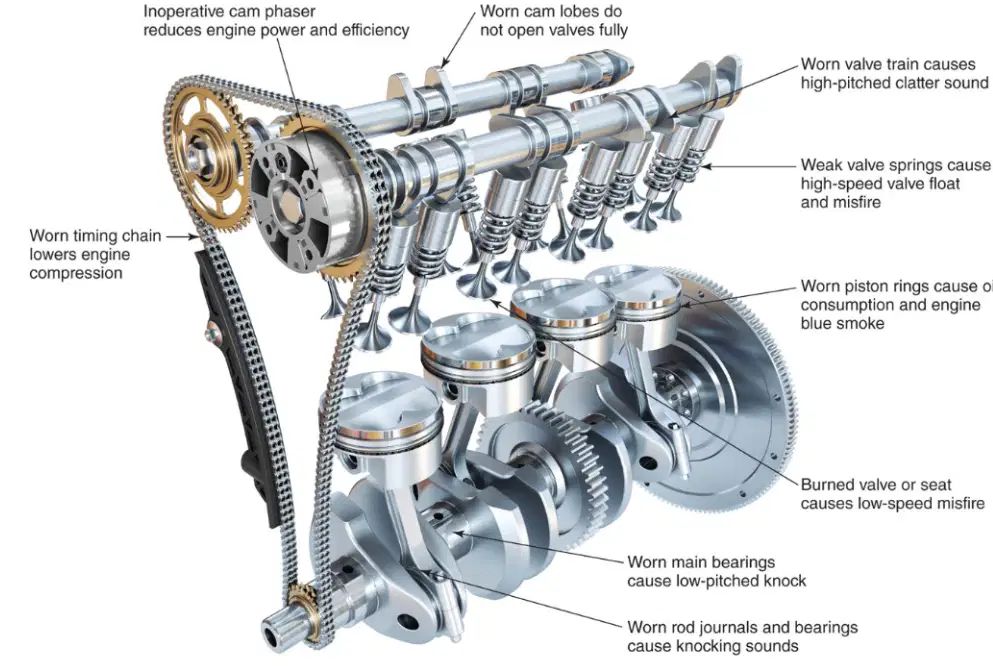
What is a consequence of worn piston rings in an engine?
Increase engine power
Cause oil consumption and engine blue smoke
Improve valve operation
Reduce knocking sounds

What sound is caused by a worn valve train in an engine?
Low-pitched knock
High-pitched clatter sound
No sound
Whistling noise
Which of the following is a possible cause of white engine smoke in a gasoline engine?
Engine oil is entering combustion chambers
Extremely rich air-fuel mixture
Coolant leaking into cylinders
Faulty spark plugs
What is a possible cause of black diesel smoke in a diesel engine?
Engine oil entering combustion chambers
Injection system problem
Coolant leaking into combustion chambers
Cold engine
What might white diesel smoke indicate in a diesel engine?
Engine oil entering combustion chambers
Injection system problem
Unburned fuel, cold engine, or coolant leaking into combustion chambers
Low compression
What is one of the first steps in an engine pre-teardown inspection?
Disassemble the engine completely
Inspect engine using your senses
Replace all engine fluids
Check the tire pressure
Which of the following is an external problem to look for during an engine inspection?
Tire wear
Oil leaks
Battery charge
Brake pad thickness
If a leak is found during an engine inspection, what should you do next?
Ignore it
Smell the fluid
Replace the engine
Check the tire pressure

What mechanical problem can cause coolant to leak into the engine crankcase?
Faulty fuel injectors
Leaking engine coolant
Broken timing belt
Clogged air filter
Which of the following is NOT a cause of oil-fouled spark plugs?
Worn rings
Worn or scored cylinder walls
Bad valve seals
New spark plugs
What does the presence of engine oil in the coolant usually indicate?
A major engine problem
A minor engine problem
Only rarely indicates an engine problem
A common engine issue
What might cause external coolant leaks?
New hoses
Rusted freeze plugs
Freshly installed parts
Tightened fasteners
What is a common cause of engine blowby?
Combustion pressure blowing past piston rings
Loose header nuts
Warped exhaust manifold
Ruptured exhaust manifold gasket
What tool can be used to find internal sounds in an engine?
Pressure gauge
Automotive stethoscope
Thermometer
Multimeter
What can a section of hose be used to locate in an engine?
Fuel leaks
Vacuum leaks and air pressure leaks
Electrical faults
Oil levels
During a Cranking Balance Test, what is monitored through the complete crankshaft rotation?
Fuel pressure
Oil temperature
Amount of current drawn by the starter motor
Engine noise levels
What should the tachometer indicate when each cylinder is disabled during the Cylinder Balance Test?
Increase in engine temperature
Increase in fuel consumption
RPM drop
Increase in oil pressure
What should be disabled during testing to ensure engine speed drops when an injector or ignition coil is disabled?
Fuel pump
Engine cooling system
Idle speed control solenoid or motor
Exhaust system
What should be checked if there is an engine misfire code for a cylinder with low compression?
Fuel pump and battery
Radiator and coolant level
Ignition coil and spark plug
Air filter and oil filter
Which of the following is a cause of low engine compression?
Clogged air filter
Burned valve seat(s)
Overfilled oil
Faulty spark plug
What problem can result from a blown head gasket?
Increased fuel efficiency
Low engine compression
Enhanced engine power
Improved cooling system
Which component, if broken, can lead to low engine compression?
Fuel injector
Valve spring
Radiator
Alternator

