
 Worksheets
Cosmos
Total questions: 81
Worksheet time: 59mins


What is the smallest terrestrial planet?
The farther a planet is from the sun, the
less time it will take to revolve around the sun
more time it will take to revolve around the sun
distance does not play a role
One astronomical unit (1 AU) is the
average distance from the sun to Earth
average distance from the sun to Earth's moon
average distance from the sun to Mars
A random number made up by astronomers

If we are able to obtain orbital period from transit data, we can calculate _____ using Kepler's 3rd Law.
Orbital eccentricity
Average distance between the planet and its host star
Percentage of water vapor in the planet's atmosphere
The probability for advanced life
Even though Pluto's average distance from the Sun is much farther than Neptune's, Pluto is sometimes located closer to the Sun than Neptune because ____.
Neptune is more affected by the Gravitational pull of Jupiter
Pluto is traveling at a faster orbital velocity
Pluto's orbital eccentricity is greater than Neptune's
Pluto's orbital eccentricity is less than Neptune's
What will result in the most eccentric elliptical orbit
when the focal points are closest together
when the focal points are on top of one another
then the focal points are farthest apart

Which point is a FOCUS?
A
B
C
D
E
According to Kepler's Second Law, where in it's path does a planet move the fastest?
At the perihelion
At the aphelion
At the top of the semi-minor axis
The speed is constant.
In a circular orbit, the speed/velocity ___ change.
does
does not
where are you coming up with this information?
When a planet appears to move backwards, it is called...
impossible
retrograde motion
we never talked about this
an illusion

Kepler's First Law states
objects attract other objects with a force that is directly proportional to the product of their masses
the square of the ratio of the periods of any two planets revolving around the Sun is equal to the cube of the ratio of their average distance from the Sun
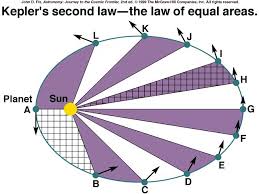
An imaginary line joining a planet and the sun sweeps out an equal area of space in equal amounts of time.
Planets move about the Sun in an elliptical orbit with the Sun at one of the foci.

Kepler's Second Law states
objects attract other objects with a force that is directly proportional to the product of their masses
the square of the ratio of the periods of any two planets revolving around the Sun is equal to the cube of the ratio of their average distance from the Sun
An imaginary line joining a planet and the sun sweeps out an equal area of space in equal amounts of time.
Planets move about the Sun in an elliptical orbit with the Sun at one of the foci.

Kepler's Third Law states
objects attract other objects with a force that is directly proportional to the product of their masses
the square of the ratio of the periods of any two planets revolving around the Sun is equal to the cube of the ratio of their average distance from the Sun
An imaginary line joining a planet and the sun sweeps out an equal area of space in equal amounts of time.
Planets move about the Sun in an elliptical orbit with the Sun at one of the foci.

Which of the following most accurately describes the movement of the Earth around the Sun?
The Earth moves at a constant speed around the Sun.
The Earth moves faster when it is closest to the Sun.
The Earth moves slowest when it is closest to the Sun.
The Earth's speed varies dependent upon the phase of the moon.
Each planet's orbit about the Sun is an ellipse. The Sun's center is always located at one focus of the orbital ellipse.
Kepler's 1st Law
Kepler's 2nd Law
Kepler's 3rd Law
A planet moves in its ellipse so that the line between it and the Sun placed at a focus sweeps out equal areas at equal times.
Kepler's 1st Law
Kepler's 2nd Law
Kepler's 3rd Law
The square of a planet's orbital period is proportional to the cube of the length of the semi-major axis of its orbit.
Kepler's 1st Law
Kepler's 2nd Law
Kepler's 3rd Law
The mean distance from the center of the earth to the center of the sun.
Astronomical Unit
Heliocentric Theory
Kepler's 1st Law
Planetary Revolution
The path of the earth around the sun, which is one complete cycle of an orbit, is approximately 365.2425 days in length.
Astronomical Unit
Heliocentric Theory
Kepler's 1st Law
Planetary Revolution
There are two points inside of an ellipse. The sun is one point in our solar system.
Astronomical Unit
Heliocentric Theory
Foci
Planetary Revolution
Planets revolving around a fixed point, the sun.
Astronomical Unit
Heliocentric Theory
Foci
Geocentric Theory
Planets revolving around a fixed point, the earth.
Astronomical Unit
Heliocentric Theory
Foci
Geocentric Theory
The combining of several small nuclei into one large nucleus with the subsequent release of huge amounts of energy.
Astronomical Unit
Nuclear Fusion
Foci
Nuclear Fission
The splitting of an atom into smaller parts.
Astronomical Unit
Nuclear Fusion
Foci
Nuclear Fission
Energy that is transferred by electromagnetic radiation, such as light, X-rays, gamma rays, and thermal radiation, which may be described in terms of either discrete packets of energy, called photons, or continuous electromagnetic waves.
Astronomical Unit
Nuclear Energy
Radiant Energy
Nuclear Fission
The northern lights, one of several astronomical phenomena called polar lights (aurora polaris), are shafts or curtains of colored light visible on occasion in the night sky.
Astronomical Unit
Nuclear Energy
Aurora Borealis
Nuclear Fission
A change in the orientation of the rotational axis of a rotating body.
Nutation
Precession
Barycenter
Nuclear Fission
Is the center of mass of two or more bodies that orbit one another and is the point about which the bodies orbit.
Nutation
Precession
Barycenter
Nuclear Fission
A periodic oscillation of the earth's axis that causes the precession of the poles to follow a wavy rather than a circular path.
Nutation
Precession
Barycenter
Nuclear Fission
Earth's spin around its own axis. Causes day and night.
Nutation
Rotation
Barycenter
Revolution
The Earth's orbital motion around the sun. Takes 365 days.
Nutation
Rotation
Barycenter
Revolution
A tide just after the first or third quarters of the moon when there is least difference between high and low water.
Neap
Rotation
Spring
Revolution
A tide just after the new or full moon when there is the greatest difference between high and low water.
Neap
Rotation
Spring
Revolution
The orbits of the planets are ellipses with the Sun at one focus, though all except Mercury are very nearly circular.
Planetary Orbit
Kepler's 3rd Law
Neap Tide
Rotation
The innermost planets have what type of physical composition?
gaseous
terrestrial
liquid
What divides the inner planets from the outer planets?
Kuiper Belt
Oort Cloud
Asteroid Belt
What 4 planets make up the outer planets?
mercury, venus, earth, mars
jupiter, saturn, uranus, venus
mercury, venus, earth, saturn
jupiter, saturn, uranus, neptune
What 4 planets make up the inner planets?
mercury, venus, earth, mars
jupiter, saturn, uranus, neptune
mercury, venus, earth, the moon
mercury, venus, earth, jupiter
What characteristics of inner planets are correct?
terrestrial and larger
gaseous and smaller
gaseous and larger
terrestrial and smaller
If you are in a space ship flying from Venus to Saturn, what planets would you pass?
Mercury, Earth, Jupiter
Mars, Earth, Jupiter
Jupiter, Uranus, Neptune
Mercury, Jupiter
Which two planets are on either side of Earth?
Venus and Mars
Venus and Mercury
Mercury and Mars
Jupiter and Saturn
Where does the Asteroid Belt fall in the picture?
between venus and earth
between earth and mars
between mars and jupiter
between jupiter and saturn
Which planet is the student studying?
Saturn
Uranus
Jupiter
Mars
Which statement about the planets in the solar system is correct?
All the planets in the solar system have moons
All the planets in the solar system revolve around the sun
All the planets in the solar system are about the same size
All the planets in the solar system revolve at the same speed
The solar system has eight planets and one sun. What is the correct order of these planets, starting from closest to the Sun?
Mercury, Venus, Earth, Mars, Saturn, Uranus, Neptune, Jupiter
Mars, Venus, Earth, Mercury, Jupiter, Saturn, Uranus, Neptune
Venus, Mercury, Jupiter, Earth, Saturn, Neptune, Mars, Uranus
Mercury, Venus, Earth, Mars, Jupiter, Saturn, Uranus, Neptune
Which of the following accurately compares the positions of Jupiter and Earth from the Sun?
Earth is positioned closer to the Sun than Jupiter
Jupiter is positioned closer to the Sun than Earth
Jupiter's orbit is shorter than Earth's orbit around the Sun
Earth's orbit is longer than Jupiter's orbit around the Sun
Which planet is known as the 'Red Planet'?
Mercury
Venus
Mars
Jupiter
What is the largest planet in our solar system?
Earth
Mars
Jupiter
Saturn
Which planet is closest to the Sun?
Mercury
Venus
Earth
Mars
Where was Gustav Holst born?
Canada
Italy
England
Sweden
When did Holst write "The Planets"
1814-1816
1914-1916
!600-1610
2000-2005
Which Planet had not been discovered when Holst wrote "The Planets"
Venus
Mars
Jupiter
Pluto
What type of work is "The Planets"?
Concerto
Symphonic Suite
String Quartet
Piano Sonata
Which planet is the "Bringer of Jollity"?
Neptune
Venus
Mars
Jupiter
The theme for Darth Vader is based on the music from which planet?
Venus
Jupiter
Mars
Saturn
What instrument did Gustov Holst play professionally?
Trumpet
Trombone
Violin
Piano
What job did Holst do as well as performing as a musician?
Chef
Astronomer
Doctor
Teacher
Holst, his Grandfather and his Great-Grandfather were all:
Composers
Conductors
Violinists
Lawyers
What two movements from "The Planets" have become the most popular, and are played most frequently?
Mars and Jupiter
Venus and Neptune
Pluto and Goofy
Mercury and Jupiter

