
Font size
 Worksheets
Foundations of the United States Government Review
Total questions: 40
Worksheet time: 28mins
The Constitution is organized into which of the following parts?
Preamble, Articles, Amendments
Introduction, Chapters, Clauses
Preamble, Sections, Schedules
Articles, Chapters, Codes
Amending the Constitution of the United States involves which of the following processes?
Proposal by two-thirds of both Houses of Congress and ratification by three-fourths of the state legislatures
Approval by the President and a majority of the Supreme Court justices
A national referendum followed by approval from the Senate
Proposal by the House of Representatives and ratification by the President
According to the Preamble of the U.S. Constitution, one of the purposes is to ________ Justice.
establish
destroy
ignore
delay
According to the Preamble of the U.S. Constitution, one of the purposes is to insure ________ Tranquility.
domestic
international
public
universal
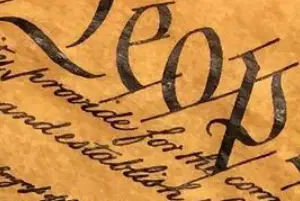
According to the Preamble of the U.S. Constitution, one of the purposes is to provide for the common ________.
defence
wealth
education
prosperity
According to the Preamble of the U.S. Constitution, one of the purposes is to promote the general ________.
Welfare
Happiness
Liberty
Justice
According to the Preamble of the U.S. Constitution, one of the purposes is to secure the Blessings of Liberty to ourselves and our ________.
Posterity
Ancestors
Neighbors
Leaders
Article I of the U.S. Constitution is about the ________.
Legislative Branch
Executive Branch
Judicial Branch
Bill of Rights
Article II of the U.S. Constitution is about the ________.
Executive Branch
Legislative Branch
Judicial Branch
Bill of Rights
Article III of the U.S. Constitution is about the ________.
Judicial Branch
Legislative Branch
Executive Branch
Bill of Rights
Article IV of the U.S. Constitution is about ________.
States Rights
The Presidency
The Bill of Rights
The Supreme Court
Article V of the U.S. Constitution is about the ________.
Amendment Process
Election of the President
Judicial Review
Impeachment Proceedings
Article VI of the U.S. Constitution is about ________.
Supremacy
Elections
Taxation
Impeachment
Article VII of the U.S. Constitution is about ________.
Ratification
Impeachment
Amendments
The Executive Branch
Which group defended the Constitution and argued that a strong central government was needed?
Federalists
Anti-Federalists
Who were the authors of the Federalist Papers?
John Jay, Alexander Hamilton, and James Madison
Thomas Jefferson, George Mason, and Patrick Henry
Which group was concerned about the absence of a bill of rights protecting personal freedoms?
Federalists
Anti-Federalists
The Anti-Federalists argued that the proposed Constitution betrayed the ideas of the American Revolution.
True
False
The Federalists supported the principles of separation of powers, checks and balances, and ________.
federalism
monarchy
isolationism
communism
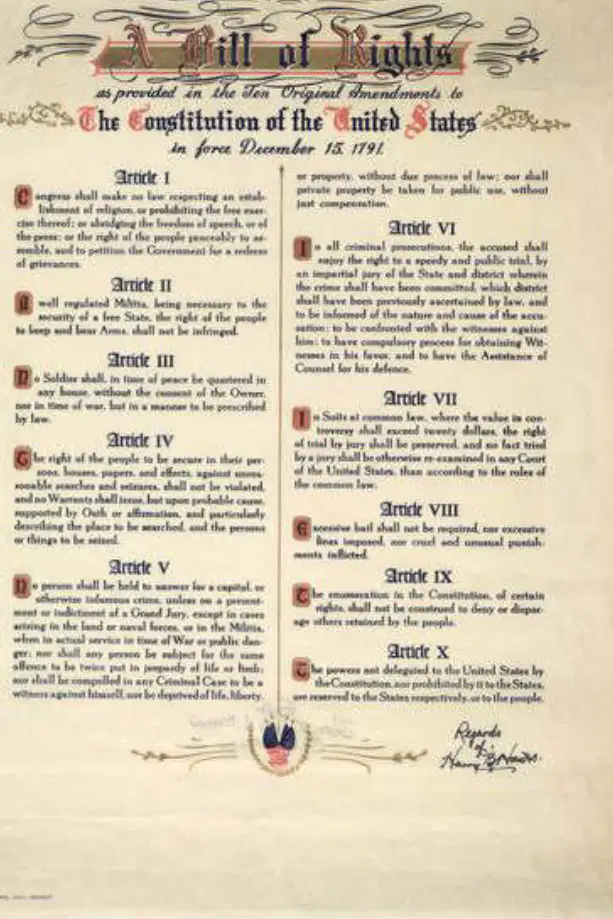
Which document contains the first ten amendments to the U.S. Constitution?
The Bill of Rights
The Declaration of Independence
The Federalist Papers
The Emancipation Proclamation
How many out of 13 states needed to ratify the Constitution in order to make it the governing document?
7
9
10
13
Which state was the first to ratify the Constitution?
Virginia
Massachusetts
Delaware
New York
Some states opposed the Constitution because it did not provide for the protection of _______.
rights
taxes
borders
trade
What was the Massachusetts Compromise of February 1788?
A trade agreement
A military alliance
An agreement to propose amendments protecting rights
A tax law
Eventually, how many states ratified the Constitution, allowing a new government to begin on March 4, 1789?
7
9
10
13
A government that has a division of power between different levels of government.
Limited Government
Federalism
Checks and Balances
Separation of Powers
The government is not allowed to just do whatever it wants. There are laws, rules, and guidelines in place to keep any one person or group from becoming too powerful.
Limited Government
Federalism
Checks and Balances
Separation of Powers
The act of dividing government powers between different groups of people.
Limited Government
Federalism
Checks and Balances
Separation of Powers
Accountability measures put in place to ensure that no one group becomes too powerful.
Limited Government
Federalism
Checks and Balances
Separation of Powers
The people hold the power in the government.
Limited Government
Popular Soverignty
Republicanism
Federalism
The idea that leaders are elected to make laws and lead the government for the benefit of everyone.
Limited Government
Popular Soverignty
Republicanism
Federalism
How many amendments have been proposed by Congress?
32
33
26
27
How many amendments have been ratified by the States?
32
33
26
27
If any dangerous and unnecessary powers be given to the general legislature, let them be plainly demonstrated,. . . .But, sir, by this government, powers are not given to any particular set of men—they are in the hands of the people—delegated to their representatives chosen for short terms—to representatives responsible to the people, and whose situation is perfectly similar to their own: as long as this is the case we have no danger to apprehend…Those who wish to become federal representatives, must depend on their credit with that class of men who will be the most popular in their counties, who generally represent the people in the state governments: they can, therefore, never succeed in any measure contrary to the wishes of those on whom they depend. It is almost certain, therefore, that the deliberations of the members of the federal house of representatives, will be directed to the interests of the people of America. As to the other branch, the senators will be appointed by the legislatures, and though elected for six years, I do not conceive they will so soon forget the source from whence they derive their political existence.
Federalist
Anti-Federalist
There is no Declaration of Rights, and the laws of the general government being paramount to the laws and constitution of the several States, the Declarations of Rights in the separate States are no security. Nor are the people secured even in the enjoyment of the benefit of the common law…
There is no declaration of any kind, for preserving the liberty of the press, or the trial by jury in civil causes; nor against the danger of standing armies in time of peace.
Federalist
Anti-Federalist
Describe the debates that occurred over the Great Compromise
Describe the debates that occurred over the Electoral College at the Constitutional Convention.
Describe the debates over slavery that occurred at the Constitutional Convention.
Which was not one of the 5 philosophers that influenced the American Government?
John Locke
Jean-Michel
Basquiat
Charles Montesquieu
Jean-Jacques Rousseau

