
NEW
Font size
 Worksheets
Food Safety Review
Total questions: 20
Worksheet time: 10mins
What is a foodborne illness? Fill in the blank: A ________ is a disease transmitted to people by food.
foodborne illness
respiratory infection
genetic disorder
waterborne disease
A foodborne illness outbreak is when ______ or more people get the same illness after eating the same food.
two
five
ten
twenty
Which of the following groups are at higher risk of getting a foodborne illness?
Elderly people
Preschool-age children
People with compromised immune systems
All of the above
All high-risk populations for foodborne illness have weakened ________ systems.
immune
digestive
respiratory
circulatory
What does contamination mean? Fill in the blank: Contamination means that harmful things are present in food, making it ______ to eat.
unsafe
delicious
colorful
expensive
List the three forms of contamination mentioned in the image.
Biological, Chemical, Physical
Thermal, Radiological, Mechanical
Organic, Inorganic, Synthetic
Microbial, Elemental, Radioactive
What are pathogens?
Microorganisms that cause illness
Chemicals that clean food
Nutrients in food
Types of food containers
What is cross-contamination?
The process of cleaning food thoroughly
The transfer of pathogens from one surface or food to another
The purchase of food from safe sources
The process of cooking food at high temperatures
Fill in the blank: Microorganisms are small, living organisms that can be seen only through a _________
microscope
telescope
binoculars
magnifying glass
Which of the following is a type of microorganism?
Virus
Plant
Animal
Mineral
Viruses cannot grow in food but once eaten, they grow inside a person's ________.
intestines
lungs
skin
bones
Which of the following are examples of foodborne viruses?
A) Hepatitis A and norovirus
B) Influenza and measles
C) Salmonella and E. coli
D) Rabies and polio
To prevent viruses, what should you do if you are vomiting or have diarrhea or jaundice?
Stay home
Go to work as usual
Ignore the symptoms
Share food with others
To prevent viruses, you should avoid using bare hands to handle what type of food?
Ready-to-eat food
Frozen food
Raw meat
Canned food
If conditions are right, bacteria can grow; doubling their number every 20 seconds!
True
False
In the context of bacterial growth, what does the 'F' in FAT TOM stand for?
Food
Fungi
Fermentation
Frost
In the context of bacterial growth, what does the 'M' in FAT TOM stand for?
Moisture
Minerals
Molecules
Maturity
What does TCS stand for in food safety?
A) Time and Temperature Control for Safety
B) Temperature Control for Storage
C) Time Control for Serving
D) Temperature and Cooking Safety
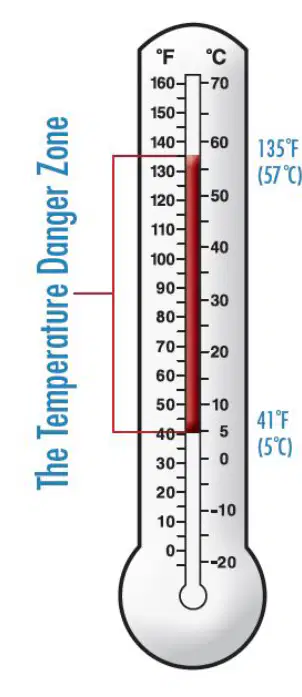
What is the Temperature Danger Zone (TDZ) for foods?
41–135°F
32–40°F
136–165°F
166–212°F
Fill in the blank: Ready-to-eat food is food that can be eaten without further ________, washing, or cooking.
preparation
freezing
packaging
fermentation

