
 Worksheets
Matter, Measurement, and Properties Quiz
Total questions: 20
Worksheet time: 10mins
Name
Class
Date
1.
What does the precision of a measurement reflect?
a)
The size of the measuring instrument
b)
The skill of the person measuring
c)
The accuracy of the measurement
d)
The number of digits reported
2.
In a reported measurement, which digit is typically estimated?
a)
The first digit
b)
All digits
c)
The last digit
d)
The middle digit
3.
What is the most convenient unit to express the size of a tardigrade (0.0015 m)?
a)
nm
b)
cm
c)
µm
d)
mm
4.
According to particle theory, what are all atoms always doing?
a)
Expanding
b)
Bonding
c)
Moving
d)
Contracting
5.
What is a compound?
a)
A pure substance that cannot be separated
b)
A combination of two or more pure substances not chemically combined
c)
A mixture of two or more elements
d)
A pure substance composed of two or more different elements joined by chemical bonds
6.
When reading a meniscus, where should your eye level be?
a)
At the top of the curve
b)
Above the liquid level
c)
At the middle of the curve
d)
At the bottom of the curve
7.
Why does oil float on water?
a)
Oil is less dense than water
b)
Oil and water have the same density
c)
Oil has a higher boiling point
d)
Oil is more dense than water
8.
What happens to the arrangement of atoms in a solid as it is heated?
a)
They immediately turn into a gas
b)
They stop moving completely
c)
They become more tightly packed
d)
They start to vibrate more
9.
Which state of matter has particles that vibrate in fixed positions?
a)
Gas
b)
Solid
c)
Plasma
d)
Liquid
10.
What property do liquids have that solids do not?
a)
High density
b)
Fixed volume
c)
Flow to take the shape of their container
d)
Definite shape
11.
What does the Kinetic Molecular Theory state about atoms?
a)
They stop moving at absolute zero
b)
They only move when heated
c)
They are always stationary
d)
They are in constant motion
12.
What is the difference between boiling and evaporation?
a)
Boiling occurs only at the surface, evaporation throughout the liquid
b)
Evaporation occurs at all temperatures, boiling only at the boiling point
c)
Evaporation is faster than boiling
d)
Boiling produces cooling, evaporation does not
13.
In the compound H₂SO₄, how many different elements are present?
a)
5
b)
3
c)
4
d)
2
14.
How many total atoms are in one molecule of C₆H₁₂O₆?
a)
30
b)
12
c)
24
d)
18
15.
How does the kinetic energy of particles relate to the state of matter?
a)
Kinetic energy is highest in solids and lowest in gases
b)
Kinetic energy increases from solid to liquid to gas
c)
Kinetic energy only affects liquids, not solids or gases
d)
Kinetic energy is the same in all states of matter
16.
What is the primary difference between an element and a compound at the atomic level?
a)
Compounds always have more atoms than elements
b)
Elements have more protons than compounds
c)
Elements consist of one type of atom, compounds have multiple types
d)
There is no difference at the atomic level
17.
How does the arrangement of particles in a gas differ from that in a liquid?
a)
Gas particles are closer together than liquid particles
b)
There is no difference in particle arrangement between gases and liquids
c)
Gas particles have more space between them than liquid particles
d)
Gas particles have a fixed arrangement, liquid particles do not
18.
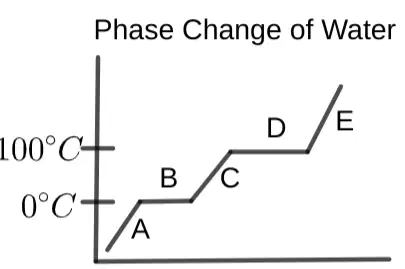
What is happening at point B?
a)
Water is melting
b)
Water is warming up
c)
Water is boiling
19.
What is happening at point C?
a)
Water is melting
b)
Water is warming up
c)
Water is boiling
20.
What phase is water in at point C?
a)
Solid
b)
Liquid
c)
Gas
d)
Plasma
100 %

