
 Worksheets
Food Chains & Food Webs Study Guide
Total questions: 74
Worksheet time: 42mins
Fill in the blank: A ________ is a linear sequence of organisms where energy is transferred from one to the next.
Food Chain
Habitat
Ecosystem
Population
Fill in the blank: A ________ is a complex network of interconnected food chains in an ecosystem.
Food Web
Food Chain
Habitat
Population
Fill in the blank: ________ are organisms (usually plants or algae) that make their own food using photosynthesis.
Producers
Consumers
Decomposers
Herbivores
Fill in the blank: ________ are herbivores that eat producers.
Primary Consumers
Decomposers
Secondary Consumers
Tertiary Consumers
Fill in the blank: ________ are carnivores/omnivores that eat herbivores.
Secondary Consumers
Producers
Decomposers
Primary Consumers
Fill in the blank: ________ are carnivores/omnivores that eat secondary consumers.
Tertiary Consumers
Producers
Decomposers
Primary Consumers
Fill in the blank: ________ are top predators with no natural enemies.
Apex Predators
Herbivores
Decomposers
Primary Consumers
Fill in the blank: ________ break down dead material into nutrients (fungi, bacteria, worms).
Decomposers
Producers
Consumers
Predators
What do scavengers eat?
Only plants
Only animals
Dead animals but do not fully decompose them
Both plants and animals
Which of the following is a herbivore?
Eats only animals
Eats only plants
Eats both plants and animals
Eats dead animals
Which feeding type eats both plants and animals?
Herbivores
Carnivores
Omnivores
Scavengers
Photosynthesis is the process by which plants use _______, carbon dioxide, and water to make glucose and release oxygen.
sunlight
oxygen
nitrogen
chlorophyll
What is the correct equation for photosynthesis?
CO₂ + H₂O + sunlight → C₆H₁₂O₆ + O₂
C₆H₁₂O₆ + O₂ → CO₂ + H₂O + ATP
O₂ + H₂O → CO₂ + C₆H₁₂O₆
CO₂ + O₂ → H₂O + C₆H₁₂O₆
Cellular respiration is the process by which organisms break down glucose in the presence of _______ to release energy (ATP).
oxygen
carbon dioxide
nitrogen
hydrogen
What is the correct equation for cellular respiration?
CO₂ + H₂O + sunlight → C₆H₁₂O₆ + O₂
C₆H₁₂O₆ + O₂ → CO₂ + H₂O + ATP
O₂ + H₂O → CO₂ + C₆H₁₂O₆
CO₂ + O₂ → H₂O + C₆H₁₂O₆
Match the trophic level to the correct organism type:
1st trophic level
Producers
2nd trophic level
Primary consumers
3rd trophic level
Secondary consumers
4th trophic level
Tertiary consumers
Highest trophic level
Apex predators
What is a trophic level?
A) A type of decomposer
B) The position an organism has in a food chain or food web
C) The amount of energy available in an ecosystem
D) The process of photosynthesis
Organisms that make their own food through photosynthesis are called ___________.
Producers
Consumers
Decomposers
Herbivores
Which process allows plants to make glucose from sunlight, water, and carbon dioxide?
Respiration
Photosynthesis
Fermentation
Decomposition
A primary consumer is an organism that eats:
Other carnivores
Producers (plants)
Decomposers
Scavengers
Organisms that eat both plants and animals are called ___________.
Omnivores
Herbivores
Carnivores
Detritivores
Which of the following is a decomposer?
Mushroom
Vulture
Grasshopper
Snake
Scavengers differ from decomposers because scavengers:
Recycle nutrients into the soil
Break down matter at a microscopic level
Eat dead organisms but don't fully decompose them
Create their own food
Which type of organism is at the top of a food chain with no natural predators?
Apex Predator
Herbivore
Decomposer
Primary Consumer
Only about _____% of energy is passed from one trophic level to the next.
10%
50%
25%
90%
All living things — plants, animals, fungi, and bacteria — perform which process to release energy?
Cellular respiration
Photosynthesis
Fermentation
Transpiration
Which of the following is a decomposer?
Vulture
Mushroom
Which of the following is a producer?
Vulture
Grass
Crab
Hawk
Which of the following is a scavenger?
Bacteria
Worm
Fungi
Vulture
Decomposers eat (break down):
Living plants and animals
Rocks and minerals
Dead plants, dead animals, and waste
Sunlight and water
4. Worms, fungi, and bacteria are all examples of ___________.
Decomposers
Producers
Carnivores
Herbivores
A raccoon finds and eats garbage scraps. This makes it a:
Producer
Decomposer
Scavenger
Herbivore
A grasshopper eats grass. It is a:
Producer
Primary Consumer
Secondary Consumer
Decomposer
A rabbit eats lettuce. The rabbit is a:
Primary Consumer
Producer
Secondary Consumer
A snake eats a frog that ate a grasshopper. The snake is a:
Primary Consumer
Secondary Consumer
Tertiary Consumer
Producer
A hawk eats a snake, which ate a frog, which ate a grasshopper. The hawk is a:
Secondary Consumer
Tertiary Consumer
Apex Predator
Producer
15. A vulture feeding on a dead deer is an example of a ___________.
Scavenger
Producer
Herbivore
Parasite
16. Mushrooms growing on a fallen tree are examples of ___________.
Decomposers
Producers
Herbivores
Carnivores
In a desert food chain: cactus → rabbit → coyote. If the cactus has 5,000 J of energy, how much does the coyote receive?
500 J
50 J
5 J
5,000 J
In an ocean food chain: phytoplankton → zooplankton → small fish → shark. If the zooplankton has 2,000 J, how much energy does the shark receive?
2,000 J
200 J
20 J
2 J
In a forest food chain: grass → deer → wolf. If the grass has 12,000 J, how much energy is available to the wolf?
120 J
1,200 J
12 J
12,000 J
In a pond food chain: algae → insect larvae → frog → heron. If the insect larvae have 600 J, how much energy does the heron get?
6 J
60 J
600 J
0.6 J
In a savanna food chain: grass → zebra → lion. If the zebra receives 1,000 J, how much energy did the grass originally have?
100 J
1,000 J
10,000 J
100,000 J
In an Arctic food chain: phytoplankton → krill → fish → seal → polar bear. If the fish has 800 J, how much energy does the polar bear get?
80 J
8 J
0.8 J
0.08 J
In a swamp food chain: algae → snail → fish → alligator. If the algae has 20,000 J, how much does the alligator receive?
200 J
2,000 J
20 J
20,000 J
According to the energy pyramid, how much energy does Grass (Producer) have?
10,000 J
1,000 J
100 J
10 J
According to the energy pyramid, how much energy does Grasshopper (Primary Consumer) have?
1,000 J
10,000 J
100 J
10 J
According to the energy pyramid, how much energy does Frog (Secondary Consumer) have?
100 J
10 J
1 J
1000 J
According to the energy pyramid, how much energy does Snake (Tertiary Consumer) have?
10 J
1 J
100 J
1000 J
According to the energy pyramid, how much energy does Hawk (Apex Predator) have?
1 J
10 J
100 J
1000 J
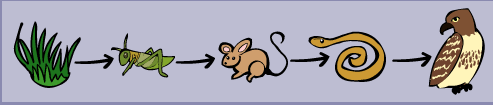
Explain the flow of energy in this food chain (who passes energy to who).
The hawk gives energy to the snake. The snake gives energy to the mouse. The mouse gives energy to the grasshopper who gives energy to the grass.
The mouse gives energy to the hawk. The snake gives energy to the grasshopper. The grass gives energy to the snake.
The grass gives energy to the grasshopper. The grasshopper gives energy to the mouse. The mouse gives energy to the snake who gives energy to the hawk.


What do lizards eat?
mice
grasshoppers
hawks
grass


If a disease strikes the snake population in the food chain shown, what will be the initial effect on the populations of hawks and rabbits?
The populations of hawks and rabbits will decrease.
The populations of hawks and rabbits will increase.
The population of hawks will increase. The population of rabbits will decrease.
The population of hawks will decrease. The population of rabbits will increase.

In the food chain Carrots--->Rabbit--->Fox. The fox is a
Producer
First level consumer
Second level consumer
Decomposer

The diagram represents a simple food chain. The arrows in the diagram indicate the
return of chemical substances to the environment
order of importance of the various organisms.
direction of energy flow through a series of organisms
direction in which organisms move in the environment.
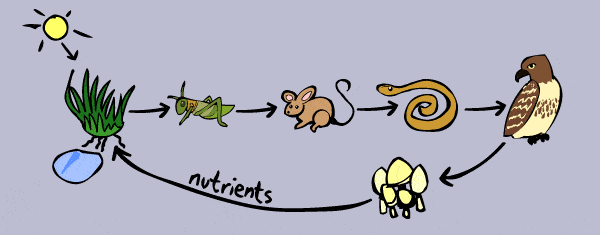


True/False
Food webs show you everything an animal eats. Food chains show you one thing.
True
False

In the stable food chain shown here, what would you expect to happen initially if you were to suddenly double the population of rabbits?
The populations of the other three species would also increase.
The populations of the other three species would decrease.
The grass population would decrease. The snake population and hawk population would increase.
The grass population and hawk population would decrease. The snake population would increase.

What is the first organism in a food chain?
Herbivore
Carnivore
Producer


The animals at the top of a food chain are always ___.
Prey
Predator
Producer

Look at the food chain. How do foxes get energy?
from eating rabbits
from eating grass
from the sun
from eating other foxes

What is missing in this simple food chain?
Consumer
Producer
Decomposer
Herbivore

What is eating the grasshopper? Choose all that apply.
Owls
Birds
grains

The Mayfly is a food source for which 3 organisms?

Animal that feeds only on the flesh of other animals.
Herbivore
Omnivore
Carnivore

Which of the following is a herbivore?
shrew
hawk
frog
cricket

A food chain in an ecosystem includes blackberry bushes, deer, and wolves.
• Deer eat blackberries.
• Wolves eat deer.
If the population of wolves decreases, how will this affect the population of blackberry bushes?
It will decrease because there will be fewer deer.
It will increase because there will be fewer deer.
It will decrease because there will be more deer.
It will increase because there will be more deer.

A food chain is different than a food web. A food chain...
How all living organisms within a habitat are connected.
All of the things that a particular animal eats
How plants create their own food.
A single path of energy transfer within a habitat.

