
 Worksheets
7U2: Stars and Their Light Unit Test
Total questions: 23
Worksheet time: 12mins
Name
Class
Date
1.
When we look at a distant star through a telescope...
a)
We see the star as it was in the past.
b)
We see the star as it is at the present moment.
c)
We see the star as it will be in the future.
d)
Whether we see the star as it was in the past or as it is at the present moment depends on the type of telescope used.
2.
A light year is...
a)
the distance light travels in a year
b)
the amount of time light takes to pass one year
c)
the amount of space from the Sun to the Earth
3.
We can measure how far stars and other galaxies are in light-years because ...
a)
light travels faster than anything else in the universe
b)
light travels slower than anything else in the universe
c)
light can get from one point to another instantaneously
d)
Other stars and galaxies are very close, and light reaches them after sound waves
4.
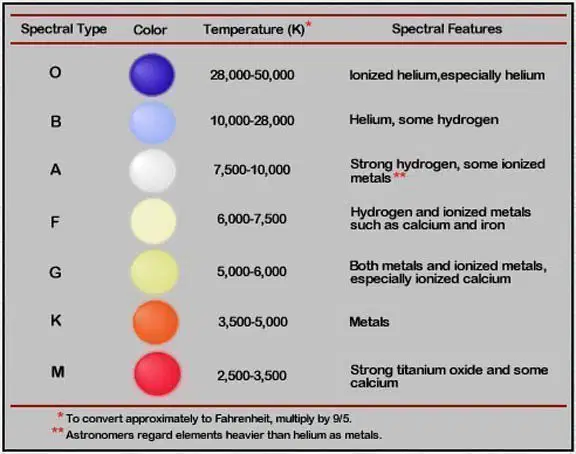
Which of the following statements IS SUPPORTED by the the information in the chart below?
a)
blue stars are larger than red stars
b)
blue stars are hotter than red stars
c)
our Sun is a K-type star
d)
A-type stars are brighter than M-type stars
5.
What is the general term given to star configurations that appear to create an image in the night sky?
a)
supernova
b)
nebula
c)
constellations
d)
black holes
6.

Which statement about galaxies is TRUE?
a)
there are elliptical, spiral, and irregular shaped galaxies
b)
there are many, many galaxies in addition to our own
c)
a galaxy is made of dust, gas, planets and stars
d)
all of these statements are true
7.
In our galaxy, are there more stars or planets?
a)
Planets
b)
Stars
8.
What is our Cosmic Address, in order of most local to most distant?
a)
Local Group, Earth, Solar System, Virgo Supercluster
b)
Earth, Solar System, Milky Way Galaxy, Local Group, Virgo Supercluster, Observable Universe
c)
Solar System, Earth, Observable Universe, Milky Way Galaxy, Local Group, Virgo Supercluster
9.
If the entire history of the universe was scaled to an Earth Calendar, about when would humans appear?
a)
In the first minutes of the first day (January 1st)
b)
In the first three months (Around March 15th)
c)
In the first nine months (Around September 14th)
d)
In the last 14 seconds (Around December 31st)
10.
What is the fastest thing in the universe?
a)
Light
b)
Sound
c)
Nuclear Explosions
11.
How long does it take light from our own sun to reach the Earth?
a)
It is instantaneous
b)
About 22 minutes
c)
About 8 minutes
d)
Less than 60 seconds
12.
What is true about the distant stars we see?
a)
The light we see is instantaneous and reflects what is happening in the current moment
b)
The light we see is not really light, it is a reflection caused by space dust
c)
The light we see could have left the star hundreds, thousands, or even millions of years ago
d)
The light we see is actually ancient gods and heroes who have been trapped in the cosmos
13.
What are stars mostly made of?
a)
Hydrogen and Helium
b)
Heavy metals
c)
Super heated platinum in plasma form
d)
They are the same composition as Earth, but at a different temperature
14.
How are stars formed?
a)
They burst forth from black holes
b)
From large clouds of dust and gas in nebulas
c)
Stars divide into two at the end of their lives, creating a new star
15.
Which of the following happens before a black hole comes into existence?
a)
Gravity ceases to exist in a certain region of space.
b)
An old, super massive star collapses in on itself.
c)
The fabric of spacetime is ripped by a star or planet
16.
Why do some stars become white dwarfs while others become neutron stars or black holes?
a)
If the star burns white hot then it will become a white dwarf but if it is much cooler then it will become a neutron star or a black hole.
b)
Where the star is located in the universe determines what it will become later in its 'life'.
c)
The mass and size of the original star determines what it will become later in its 'life'.
17.
What will be the next phases of our Sun's life cycle?
a)
supernova to supermassive black hole
b)
red supergiant to supernova to neutron star
c)
red giant to planetary nebula to white dwarf to black dwarf
18.
What was Annie Jump Cannon famous for?
a)
Creating a star categorization system that is still used today
b)
Engineering the first telescope to be sent into orbit
c)
Coding the first electronic computers
d)
Being the first woman in space
19.
What was unique about Edward Pickering's team at Harvard?
a)
It included women such as Cecilia Payne at a time when women were not often welcomed in science
b)
It included people with disabilities such as Annie Jump Cannon who was deaf
c)
He gave credit to both Annie Jump Cannon and Cecilia Payne when he knew they were right
d)
All of these answers are true
e)
None of these answers are true
20.
Light-years measure distances to objects that are (a) the solar system.
Choose from the below words
outside
inside
21.
A light year is a measurement of:
a)
Time
b)
Distance
c)
Gravity
d)
None of the Above
22.

Where is the best place to put a telescope to get the clearest images of deep space?
a)
Near a city
b)
In space
c)
Top of a mountain
d)
In a desert
23.

The sun is one of hundreds of billions of stars located within the Milky Way galaxy.
Why does the sun appear so much larger on Earth than other stars in the Milky Way galaxy?
4 lines
100 %

