
 Worksheets
Chapter 8 Sections 8.1 and 8.2 Part One CP Biology Online Portion
Total questions: 15
Worksheet time: 8mins
Name
Class
Date
1.
Which of the following is NOT a principal of the cell theory?
a)
Cells are the basic units of life.
b)
All living things are made of cells.
c)
Very few cells are able to reproduce.
d)
All cells come from preexisting cells.
2.
Looking at a cell under a microscope, you note that it is a eukaryote. How do you know?
a)
The cell lacks cytoplasm.
b)
The cell lacks a cell membrane
c)
The cell has a nucleus.
d)
The cell lacks genetic material.
3.
Which of the following enclose their DNA in a nucleus?
a)
prokaryotes
b)
bacteria
c)
eukaryotes
d)
viruses
4.
Not all cells are alike. Which of the following is NOT a true statement about differences between cells?
a)
Some cells have a nucleus, some do not.
b)
Most cells have a membrane, but some do not.
5.

Which of the following conclusions could you draw about this cell shown.
a)
The cell is eukaryotic because it has a nucleus.
b)
The cell is prokaryotic because it has a nucleus.
c)
The cell is an eukaryotic because it does not have a nucleus.
d)
The cell is prokaryotic because it does not have a nucleus.
6.
Looking at a cell under a microscope, you note that it is a prokaryote. How do you know?
a)
The cell lacks cytoplasm.
b)
The cell lacks a cell membrane
c)
The cell lacks a nucleus.
d)
The cell lacks genetic material.
7.
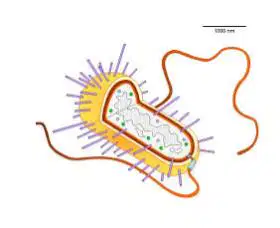
Which of the following conclusions could you draw about this cell shown.
a)
The cell is eukaryotic because it has a nucleus.
b)
The cell is prokaryotic because it has a nucleus.
c)
The cell is an eukaryotic because it does not have a nucleus.
d)
The cell is prokaryotic because it does not have a nucleus.
8.
The primary function of the cell wall is to
a)
support and protect the cell.
b)
store DNA.
c)
direct the activities fo the cell.
d)
help the cell move.
9.
Unlike the cell membrane, the cell wall is
a)
found in all organisms.
b)
composed of a lipid bilayer.
c)
selectively permeable.
d)
rigid.
10.
You will NOT find a cell wall in which of these kinds of organisms?
a)
plants
b)
animals
c)
fungus
d)
bacteria
11.
Which of the following is a function of the cell membrane?
a)
breaks down lipids, carbohydrates, and proteins from foods
b)
stores water, salts, proteins, and carbohydrates
c)
keeps the cell wall in place
d)
regulates the movement of materials into and out of the cell
12.
True and False Prokaryotic and eukaryotic cells are surrounded by a thin, flexible barrier called the cell membrane.
a)
True
b)
False
13.
These types of cells form large multicellular organisms like plants and animals.
a)
Prokaryotes
b)
Eukaryotes
14.
What kind of cells make up the human body?
a)
Prokaryotic
b)
Eukaryotic
15.
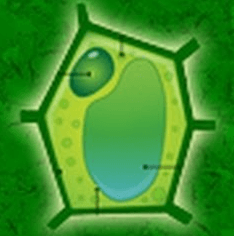
A rigid layer that lies outside the cell's membrane is...
a)
Cytoskeleton
b)
Cilia
c)
Cell Wall
d)
Flagella
100 %

