
 Worksheets
It 4
Total questions: 109
Worksheet time: 1hrs 4mins
Components of a computer system
(a)
CPU
(a)
CU
(a)
ALU
(a)
RAM
(a)
ROM
(a)
- It is a volatile type of memory
- refers to as Main Memory or Primary
Memory
Random access memory (RAM)
Read only memory (ROM)
Secondary memory
– contains permanently stored
instructions that cannot be changed
Random access memory (RAM)
Read only memory (ROM)
Secondary memory
- Also known as Auxiliary Memory.
- It is a non-volatile type of memory that is responsible foe keeping files permanently.
Random access memory (RAM)
Read only memory (ROM)
Secondary memory
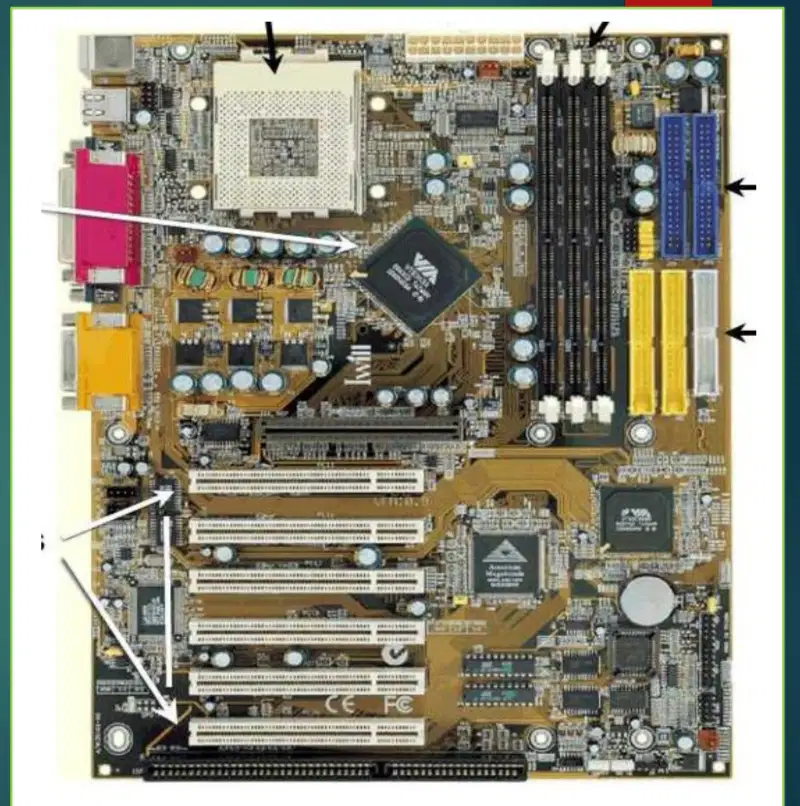
- It is an electronic circuit that sends data and messages between the other components.
Bus
Parts
Expansion slots
Registers
- It attach input and output devices to the computer.
Bus
Parts
Expansion slots
Registers
- It allow the addition of extra features.
Bus
Parts
Expansion slots
Registers
- Are special temporary storage which quickly accepts, stores, and transfers data and instructions for immediate use.
Bus
Parts
Expansion slots
Registers
(a)
Components of the external hardware (IPSOC)
(a)
refers to the physical and tangible
components of the computer system.
Hardware
CPU
Input and output unit
Memory
executes all the instructions and it is considered the brain of the computer system.
The parts are control unit (CU) and
arithmetic/logic unit (ALU). Other parts that go
along with the processor are bus, ports,
expansion slots, and registers.
Hardware
CPU
Input and output unit
Memory
It stores data and instructions before the execution and the processed data as well
Hardware
CPU
Input and output unit
Memory
it allows communication between the computer and its outside world via input and output devices.
Hardware
CPU
Input and output unit
Memory
It is the most commonly used input device.
Keyboards
Terminals
Dumb
Smart
Intelligent
It consists of keyboard, video display screen and a communication line to a mainframe computer
Keyboards
Terminals
Dumb
Smart
Intelligent
can be used only to input data to and receive information from a computer system.
Keyboards
Terminals
Dumb
Smart
Intelligent
can do input and output and has some limited processing capability.
Keyboards
Terminals
Dumb
Smart
Intelligent
a full fledge microcomputer with a
communication link
Keyboards
Terminals
Dumb
Smart
Intelligent
a pointing device that allows you to control an on-screen cursor.
Mouse
Trackball
Joystick
the upside-down version of the mouse. A ball mounted in box is rolled with the fingers to move the cursor.
Mouse
Trackball
Joystick
a video display screen that picks up input from the user through the touch of a finger.
Mouse
Trackball
Joystick
it is a point and draw input device that
allows you to draw directly on screen.
Light pen
Digitizing tablet
Pen based systems
a pen-like device with which the
user “sketches” an image or puck
Light pen
Digitizing tablet
Pen based systems
a pen like stylus to enter handwriting and marks into a computer.
Light pen
Digitizing tablet
Pen based systems
MICR
(a)
OMR
(a)
OCR
(a)
It translates images of text, drawing, and
photos and the like into forms of data that can be understood by
the computer.
Scanning device
Bar code readers
MICR (magnetic-ink character recognition)
OMR (optical mark recognition)
OCR (optical character recognition)
photoelectric scanner that translate the
bar code symbols into digital forms.
Scanning device
Bar code readers
MICR (magnetic-ink character recognition)
OMR (optical mark recognition)
OCR (optical character recognition)
it reads the strange-looking numbers printed at the bottom of bank checks
Scanning device
Bar code readers
MICR (magnetic-ink character recognition)
OMR (optical mark recognition)
OCR (optical character recognition)
it reads pencil marks
Scanning device
Bar code readers
MICR (magnetic-ink character recognition)
OMR (optical mark recognition)
OCR (optical character recognition)
it reads special preprinted
characters
Scanning device
Bar code readers
MICR (magnetic-ink character recognition)
OMR (optical mark recognition)
OCR (optical character recognition)
Fax machine
(a)
it scans an image and sends it as an electronic signals over telephone
lines
Fax machine (fascimile transmission machine)
Image systems/image scanner/graphics scanner
Smart cards
Optical cards
it converts text, drawings, and photographs into forms
Fax machine (fascimile transmission machine)
Image systems/image scanner/graphics scanner
Smart cards
Optical cards
it contain a microprocessor and a
memory chip.
Fax machine (fascimile transmission machine)
Image systems/image scanner/graphics scanner
Smart cards
Optical cards
it s a plastic, laser-recordable card used
with an optical card reader.
Fax machine (fascimile transmission machine)
Image systems/image scanner/graphics scanner
Smart cards
Optical cards
they convert human
speech into digital code.
Voice recognition systems
Audio input device
Video input devices
Electronic cameras
Sensors
they record or play analog sounds
Voice recognition systems
Audio input device
Video input devices
Electronic cameras
Sensors
signals that come from VCR o r a
camera recorder
Voice recognition systems
Audio input device
Video input devices
Electronic cameras
Sensors
they capture images in electronic
form
Voice recognition systems
Audio input device
Video input devices
Electronic cameras
Sensors
it collects specific kinds of data directly from the environment
Voice recognition systems
Audio input device
Video input devices
Electronic cameras
Sensors
it contains electrical components that make the computer works
Power supply
Motherboard
System unit
is a device that converts AC to DC power to run the computer.
Power supply
Motherboard
System unit
is the main circuit board in the system unit.
Power supply
Motherboard
System unit
the microprocessor chip.
CPU
Specialized processor chips
System clock
used to speed up your computer system
CPU
Specialized processor chips
System clock
it controls how fast all operations within a computer are performed.
CPU
Specialized processor chips
System clock
chips that temporarily hold data and instructions
RAM chips
ROM chips
Cache memory
Expansion slots and boards
chips containing programs that are built into the computer
RAM chips
ROM chips
Cache memory
Expansion slots and boards
is the special high-speed memory that the CPU can access quickly.
RAM chips
ROM chips
Cache memory
Expansion slots and boards
are sockets on the motherboard into
which you can plug expansion cards or boards.
RAM chips
ROM chips
Cache memory
Expansion slots and boards
the electrical pathways through which nits are transmitted within the CPU and between the CPU and other
devices in the system unit.
Bus line
Port
PCMICIA slots and cards
the sockets on the outside of the system unit that each connected to an expansion board on the inside of the system unit.
Bus line
Port
PCMICIA slots and cards
it represents a new bus standard for
notebooks, subnotebooks and pocket computers.
Bus line
Port
PCMICIA slots and cards

(a)
refers to main memory (RAM)
Primary storage
Secondary storage
Optical storage
Magnetic tapes
Magnetic disk
refers to storage devices that retain data
and instruction in a relatively permanent (non-volatile) form.
Primary storage
Secondary storage
Optical storage
Magnetic tapes
Magnetic disk
use a laser beam to pack information
densely on are movable disk
Primary storage
Secondary storage
Optical storage
Magnetic tapes
Magnetic disk
a sequential file storage represented by
various arrangements of magnetized spots along the width of
the tape
Primary storage
Secondary storage
Optical storage
Magnetic tapes
Magnetic disk
a metal plotter where data is represented by magnetized spots on the tracks.
Primary storage
Secondary storage
Optical storage
Magnetic tapes
Magnetic disk
a recording of a data cell device
capable of storing 400 million of data
Magnetic strip
Power tape
Drum
Continous forms
Computer output microfilm (COM)
a continuous strip of paper wound on a
reel where data is represented by holes punched on the paper.
Magnetic strip
Power tape
Drum
Continous forms
Computer output microfilm (COM)
a recording medium of data represented by magnetized spots that is coated with a magnetically sensitive material divided into tracks.
Magnetic strip
Power tape
Drum
Continous forms
Computer output microfilm (COM)
a long sheets of paper where data
is represented thru print out.
Magnetic strip
Power tape
Drum
Continous forms
Computer output microfilm (COM)
stores large volume of information printed or photographed as a very small
images on sheets or roll of film called Microfiche.
Magnetic strip
Power tape
Drum
Continous forms
Computer output microfilm (COM)
COM
(a)
It is when an information has been recorded in a tangible medium, such as paper or microfilm
Hardcopy
Softcopy
Printer
Impact printer
Non impact printers
it is when an output is temporarily displayed on the screen
Hardcopy
Softcopy
Printer
Impact printer
Non impact printers
it is capable of printing characters, symbols and graphics.
Hardcopy
Softcopy
Printer
Impact printer
Non impact printers
it has contact with papers like daisy wheel printers, dot-matrix printers and line printers
Hardcopy
Softcopy
Printer
Impact printer
Non impact printers
it has no contact with the paper like
laser printer, ink-jet printers and thermal printers.
Hardcopy
Softcopy
Printer
Impact printer
Non impact printers
they are specialized output devices that can produce high quality graphics in a variety of colors.
Plotter
Pen plotter
Electrostatic plotter
Thermal plotter
the most popular type of plotter
Plotter
Pen plotter
Electrostatic plotter
Thermal plotter
electrostatic charges create tiny dots
on specially treated paper
Plotter
Pen plotter
Electrostatic plotter
Thermal plotter
its pins are electronically heated and are
used with heat-sensitive paper to produce images.
Plotter
Pen plotter
Electrostatic plotter
Thermal plotter
the most popular softcopy output
device used on microcomputers
Cathode ray tube (CRT)
Flat panel displays
they are used with portable computers.
Cathode ray tube (CRT)
Flat panel displays
it converts digital signals to analog signals
Modems
Cable
Fax modems
commonly used in networking, to facilitate the communication between those computers.
Modems
Cable
Fax modems
a modem with fax capability installed as a circuit board in the motherboard of a computer
Modems
Cable
Fax modems
CRT
(a)
it combines several low-speed transmission into one high-speed transmission
Multiplexers
Concentrator
Front end processor
it collects data in a temporary storage area, then send it forward when enough has been accumulated
Multiplexers
Concentrator
Front end processor
a computer that handles
communications for mainframes
Multiplexers
Concentrator
Front end processor
refers to a group of related programs that supervise the execution of an application program
Operating system
Operating environment
Utilities
Programming damages
Language processor
refers to programs that sit on top of OS
Operating system
Operating environment
Utilities
Programming damages
Language processor
a single term for all types of programming aids
Operating system
Operating environment
Utilities
Programming damages
Language processor
the programs used to write other
programs
Operating system
Operating environment
Utilities
Programming damages
Language processor
used to convert source program into a form suitable for execution
Operating system
Operating environment
Utilities
Programming damages
Language processor
it accept or collect data and convert it into a form suitable for processing
Input hardware
Processing hardware
Storage hardware
Output hardware
Communication hardware
It is used to retrieve and execute the instructions provided by the computer
Input hardware
Processing hardware
Storage hardware
Output hardware
Communication hardware
It temporarily or permanently store data used for processing and the output of such processing
Input hardware
Processing hardware
Storage hardware
Output hardware
Communication hardware
It provide a means for the user to view
information produced by the computer system
Input hardware
Processing hardware
Storage hardware
Output hardware
Communication hardware
It facilitate the connection between computers connected with a
network of computers over phone lines and other channels
Input hardware
Processing hardware
Storage hardware
Output hardware
Communication hardware
facilitating applications programs
System software
Application software
Package program
Custom program
Peopleware
use program designed to solve problem
System software
Application software
Package program
Custom program
Peopleware
commonly called application
package
System software
Application software
Package program
Custom program
Peopleware
specifically written for an
organization
System software
Application software
Package program
Custom program
Peopleware
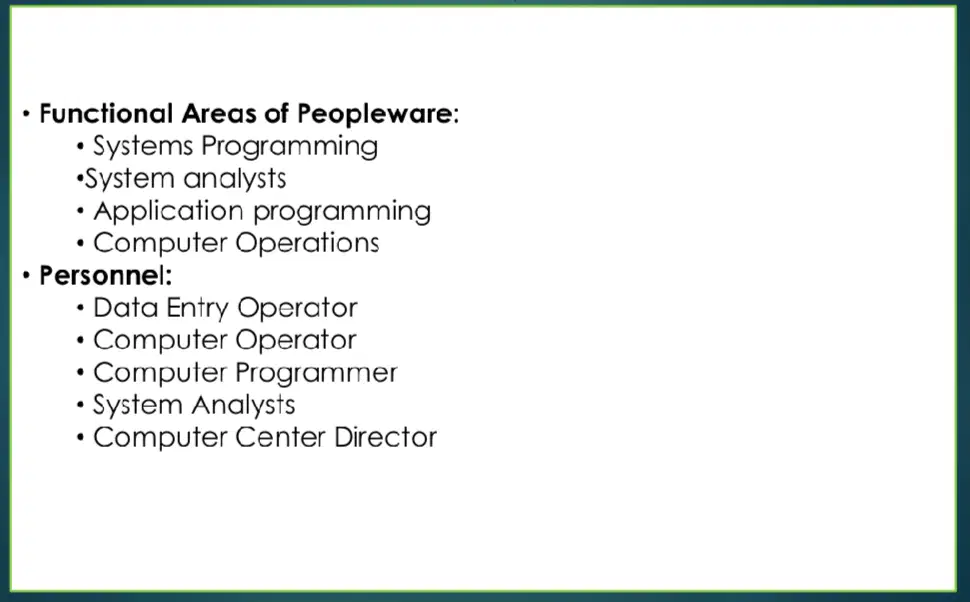
refers to the personnel involved in data processing operations
System software
Application software
Package program
Custom program
Peopleware
(a)

(a)

(a)