
NEW
Font size
 Worksheets
Covalent and Ionic Bonding Concepts_I
Total questions: 29
Worksheet time: 15mins
The three states of matter are:
Solid, liquid, gas
Solid, plasma, vapor
Liquid, vapor, plasma
Gas, vapor, crystal
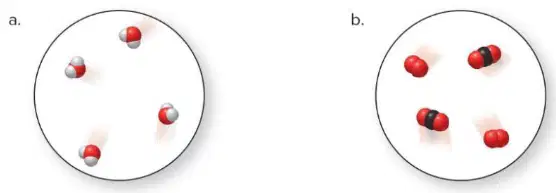
Classify each example of molecular art as a pure substance or a mixture.
(a) Mixture, (b) Pure substance, (c) Pure substance
(a) Pure substance, (b) Mixture, (c) Mixture
(a) Pure substance, (b) Pure substance, (c) Mixture
(a) Mixture, (b) Mixture, (c) Pure substance
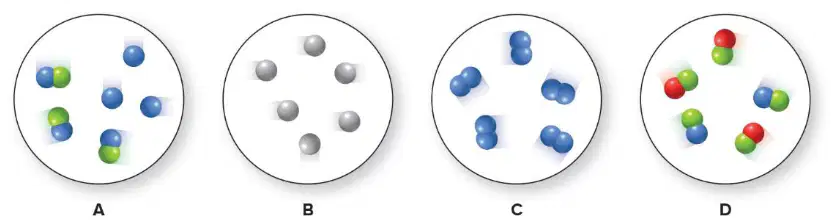
Which representation(s) of molecular art illustrate pure elements? Which representation(s) illustrate a mixture of a compound and an element? Which representation(s) illustrate a mixture of two compounds?
(a) B, C; (b) D; (c) A
(a) A; (b) B; (c) C
(a) D; (b) A; (c) B
(a) C; (b) A; (c) D
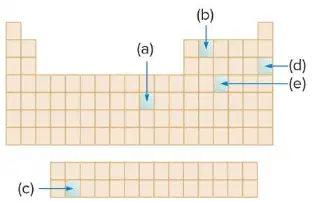
Identify each highlighted element in the periodic table and give its element name and symbol; type of element (i.e., metal, non-metal, and metalloid); and classification (i.e., main group element, transition element, or inner transition element).
(a) Bromine (Br), non-metal, main group element; (b) Lithium (Li), metal, main group element; (c) Aluminum (Al), metal, main group element; (d) Sulfur (S), non-metal, main group element; (e) Neon (Ne), non-metal, main group element.
(a) Bromine (Br), metalloid, transition element; (b) Lithium (Li), non-metal, main group element; (c) Aluminum (Al), metalloid, transition element; (d) Sulfur (S), metal, inner transition element; (e) Neon (Ne), metal, transition element.
(a) Bromine (Br), metal, inner transition element; (b) Lithium (Li), metalloid, transition element; (c) Aluminum (Al), non-metal, main group element; (d) Sulfur (S), metalloid, transition element; (e) Neon (Ne), metalloid, main group element.
(a) Bromine (Br), non-metal, transition element; (b) Lithium (Li), metal, transition element; (c) Aluminum (Al), metal, inner transition element; (d) Sulfur (S), non-metal, transition element; (e) Neon (Ne), non-metal, inner transition element.
The basic features of the periodic table include:
Arrangement of elements in order of increasing atomic number
Grouping of elements by alphabetical order
Random placement of elements
Arrangement based on atomic mass only
Give the electron-dot symbol for each element: (a) bromine; (b) lithium; (c) aluminum; (d) sulfur; (e) neon.
(a) Br: 7 dots, (b) Li: 1 dot, (c) Al: 3 dots, (d) S: 6 dots, (e) Ne: 8 dots.
(a) Br: 5 dots, (b) Li: 2 dots, (c) Al: 1 dot, (d) S: 8 dots, (e) Ne: 6 dots.
(a) Br: 8 dots, (b) Li: 3 dots, (c) Al: 2 dots, (d) S: 7 dots, (e) Ne: 5 dots.
(a) Br: 6 dots, (b) Li: 1 dot, (c) Al: 2 dots, (d) S: 5 dots, (e) Ne: 7 dots.
7) The basic features of ionic and covalent bonds are:
Ionic bonds involve the transfer of electrons, while covalent bonds involve the sharing of electrons.
Ionic bonds involve the sharing of electrons, while covalent bonds involve the transfer of electrons.
Both ionic and covalent bonds involve the transfer of protons.
Both ionic and covalent bonds involve the sharing of neutrons.
Write the ion symbol for an atom with the given number of protons and electrons.
c. V2+
e. Cl+
b. Br-
d. Na2+
a. K+
How many protons and electrons are present in each ion?
a. Ni2+: 28 protons, 26 electrons b. Se2-: 34 protons, 36 electrons c. Fe3+: 26 protons, 23 electrons
a. Ni2+: 28 protons, 28 electrons b. Se2-: 34 protons, 32 electrons c. Fe3+: 26 protons, 29 electrons
a. Ni2+: 26 protons, 28 electrons b. Se2-: 36 protons, 34 electrons c. Fe3+: 23 protons, 26 electrons
a. Ni2+: 28 protons, 24 electrons b. Se2-: 34 protons, 38 electrons c. Fe3+: 26 protons, 21 electrons
The octet rule states that atoms tend to have how many electrons in their outermost shell?
8
6
4
2
Ionic compounds have which of the following physical properties?
High melting and boiling points
Low melting and boiling points
Poor electrical conductivity when dissolved in water
Soft and flexible structure
The bonding characteristics of covalent compounds are:
Sharing of electron pairs between atoms
Transfer of electrons from one atom to another
Formation of ions with opposite charges
Presence of metallic bonds
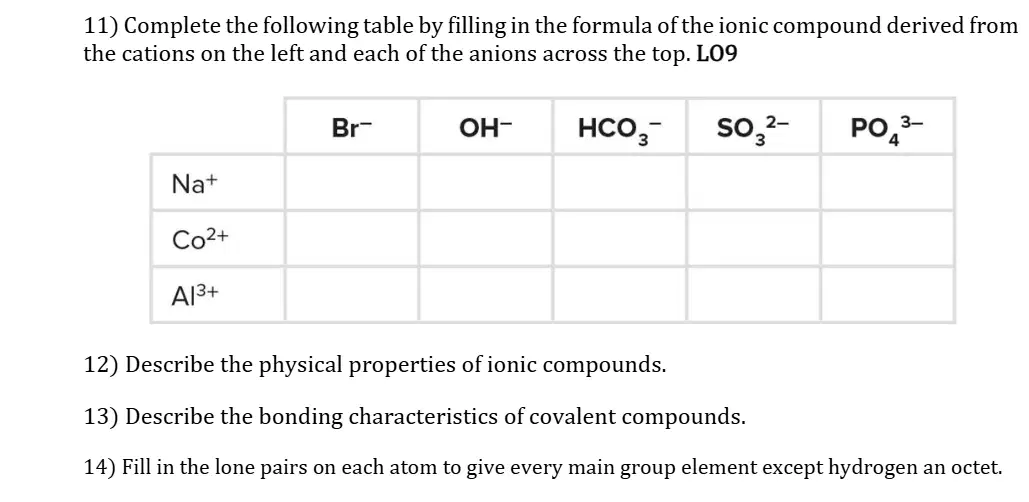
14) Fill in the lone pairs on each atom to give every main group element except hydrogen an octet.
a. Cl has 3 lone pairs, C has none, H has none
b. Cl has 2 lone pairs, C has 1 lone pair, H has none
c. Cl has 1 lone pair, C has 2 lone pairs, H has none
d. Cl has 4 lone pairs, C has none, H has none
Draw a Lewis structure for each molecule.
a. H-Br: H single bonded to Br with 3 lone pairs on Br b. CH3F: C single bonded to 3 H and 1 F (F has 3 lone pairs) c. H2O2: H-O-O-H, each O has 2 lone pairs d. N2H4: H2N-NH2, each N has 1 lone pair e. C2H6: H3C-CH3, no lone pairs on C f. CH2Cl2: C single bonded to 2 H and 2 Cl (each Cl has 3 lone pairs)
a. H-Br: H double bonded to Br with 2 lone pairs on Br b. CH3F: C single bonded to 2 H and 2 F (each F has 2 lone pairs) c. H2O2: H-O=O-H, each O has 1 lone pair d. N2H4: H2N=NH2, each N has 2 lone pairs e. C2H6: H2C=CH2, each C has 2 lone pairs f. CH2Cl2: C double bonded to 2 Cl and 2 H (each Cl has 2 lone pairs)
a. H-Br: H single bonded to Br with 2 lone pairs on Br b. CH3F: C double bonded to 2 H and 1 F (F has 2 lone pairs) c. H2O2: H-O-O-H, each O has 3 lone pairs d. N2H4: H2N-NH2, each N has 2 lone pairs e. C2H6: H3C-CH3, each C has 1 lone pair f. CH2Cl2: C single bonded to 3 H and 1 Cl (Cl has 2 lone pairs)
a. H-Br: H triple bonded to Br with 1 lone pair on Br b. CH3F: C single bonded to 4 H (no F) c. H2O2: H-O-O-H, each O has 1 lone pair d. N2H4: H2N-NH2, each N has 3 lone pairs e. C2H6: H3C-CH3, each C has 2 lone pairs f. CH2Cl2: C double bonded to 2 Cl and 2 H (each Cl has 1 lone pair)
Select the correct Lewis structure for formic acid with the given arrangement of atoms.
A structure with H-C(=O)-O-H, where the carbon is double bonded to one oxygen and single bonded to another oxygen (which is bonded to hydrogen), and the remaining valences are filled with lone pairs.
A structure with H-C-O-H, where both oxygens are single bonded to carbon and each has two lone pairs.
A structure with H-C(=O)-O-H, but both oxygens are double bonded to carbon.
A structure with H-C(=O)-H, where the carbon is double bonded to oxygen and single bonded to two hydrogens.
What is the shape around the indicated atom in each molecule? Note: Don’t forget to draw in all needed lone pairs before determining molecular shape.
a. Bent
b. Tetrahedral
c. Trigonal pyramidal
d. Trigonal planar
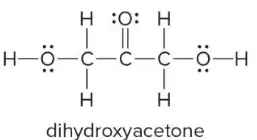
How many tetrahedral carbons does dihydroxyacetone contain? How many trigonal planar carbons does it contain?
(a) 1 tetrahedral carbon (b) 2 trigonal planar carbons
(a) 2 tetrahedral carbons (b) 1 trigonal planar carbon
(a) 0 tetrahedral carbons (b) 3 trigonal planar carbons
(a) 3 tetrahedral carbons (b) 0 trigonal planar carbons
Use electronegativity values to classify the bond(s) in each compound as nonpolar, polar covalent, or ionic. a. HF b. MgO c. F2 d. ClF e. H2O f. NH3
a. Polar covalent b. Ionic c. Nonpolar covalent d. Polar covalent e. Polar covalent f. Polar covalent
a. Nonpolar covalent b. Polar covalent c. Ionic d. Nonpolar covalent e. Ionic f. Nonpolar covalent
a. Ionic b. Polar covalent c. Polar covalent d. Nonpolar covalent e. Nonpolar covalent f. Ionic
a. Nonpolar covalent b. Nonpolar covalent c. Nonpolar covalent d. Nonpolar covalent e. Nonpolar covalent f. Nonpolar covalent
Label the polar bonds in each molecule and then decide if the molecule is polar or nonpolar.
a. H-Cl is polar, molecule is polar; b. No polar bonds, molecule is nonpolar; c. C-F is polar, molecule is polar; d. C≡N is polar, molecule is polar; e. C-Cl is polar, molecule is nonpolar.
a. H-Cl is nonpolar, molecule is nonpolar; b. No polar bonds, molecule is polar; c. C-F is nonpolar, molecule is nonpolar; d. C≡N is nonpolar, molecule is nonpolar; e. C-Cl is nonpolar, molecule is polar.
a. H-Cl is polar, molecule is nonpolar; b. No polar bonds, molecule is polar; c. C-F is polar, molecule is nonpolar; d. C≡N is polar, molecule is nonpolar; e. C-Cl is polar, molecule is polar.
a. H-Cl is nonpolar, molecule is polar; b. No polar bonds, molecule is nonpolar; c. C-F is nonpolar, molecule is polar; d. C≡N is nonpolar, molecule is polar; e. C-Cl is nonpolar, molecule is nonpolar.
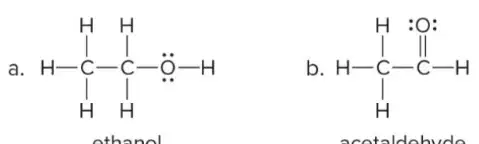
In each compound: [1] determine the shape around each carbon; [2] label each bond as polar or nonpolar.
a. Ethanol: Each carbon is tetrahedral; C-H and C-C bonds are nonpolar, C-O is polar b. Acetaldehyde: One carbon is tetrahedral, one is trigonal planar; C-H and C-C bonds are nonpolar, C=O is polar
a. Ethanol: Each carbon is trigonal planar; C-H and C-C bonds are polar, C-O is nonpolar b. Acetaldehyde: Both carbons are tetrahedral; all bonds are nonpolar
a. Ethanol: One carbon is linear, one is tetrahedral; all bonds are polar b. Acetaldehyde: Both carbons are linear; C-H and C-C bonds are polar, C=O is nonpolar
a. Ethanol: Each carbon is trigonal planar; C-H and C-C bonds are nonpolar, C-O is polar b. Acetaldehyde: One carbon is tetrahedral, one is trigonal planar; all bonds are nonpolar
What types of intermolecular forces are present in each molecule?
a. London dispersion b. Dipole-dipole, London dispersion c. Hydrogen bonding, dipole-dipole, London dispersion d. Dipole-dipole, London dispersion e. London dispersion
a. Only hydrogen bonding b. Only ionic bonding c. Only metallic bonding d. Only covalent bonding
Which compound in each pair has the higher boiling point? a. CH4 or C2H6
CH4 has a higher boiling point than C2H6.
C2H6 has a higher boiling point than CH4.
Both have the same boiling point.
Neither has a boiling point.
Which compound in each pair has the higher boiling point? C2H6 or CH3OH
CH3OH has the higher boiling point because it can form hydrogen bonds.
C2H6 has the higher boiling point because it is a hydrocarbon.
Both have the same boiling point because they have similar molar masses.
C2H6 has the higher boiling point because it has more carbon atoms.
Which compound in each pair has the higher boiling point? HBr or HCl.
HBr has the higher boiling point.
HCl has the higher boiling point.
Both have the same boiling point.
Neither has a boiling point.
Which compound in each pair has the higher boiling point? d. C2H6 or CH3Br
CH3Br has the higher boiling point because it has stronger intermolecular forces than C2H6.
C2H6 has the higher boiling point because it is a larger molecule than CH3Br.
Both C2H6 and CH3Br have the same boiling point because they have similar molecular weights.
C2H6 has the higher boiling point because it has hydrogen bonding.
Identify which species has stronger intermolecular forces: CO2 or H2O.
CO2
H2O
Both have equal intermolecular forces
Neither has intermolecular forces
Which species in each pair has stronger intermolecular forces? CO2 or HBr.
CO2 has stronger intermolecular forces than HBr.
HBr has stronger intermolecular forces than CO2.
Both CO2 and HBr have equal intermolecular forces.
Neither CO2 nor HBr has significant intermolecular forces.
Identify which species has stronger intermolecular forces: HBr or H2O.
H2O has stronger intermolecular forces than HBr.
HBr has stronger intermolecular forces than H2O.
Both HBr and H2O have equal intermolecular forces.
Neither HBr nor H2O has significant intermolecular forces.
Identify which species has stronger intermolecular forces: He atoms or Ne atoms.
He atoms
Ne atoms
Both have equal forces
Neither has intermolecular forces

