
 Worksheets
GCs Refresh
Total questions: 15
Worksheet time: 15mins
Which GC best describes the following scenario? Before a group activity, Ms. W said to students: “Listening to peers, respecting peers’ ideas, talking one at a time, refraining from interrupting others, avoiding hogging conversations, giving others time to think and respond, inviting others to talk.”
Asset-oriented Beliefs
Multilingual and Multicultural Classroom Norms
Contextualized Science Inquiry
Multilingual and Multimodal Resources
Science Discourse
Which GC is best illustrated in the following lesson scenario? “A 7th grade science teacher provides students with a biodiversity problem, “is the green turtle an endangered species?” Using PowerPoint slides, the teacher explains a Claim-Evidence-Reason framework to teach students how to use it in collaborative discussion to support their claims with evidence and advance their reasons (Infante & Licona, 2021). The teacher circulated the classroom and asked probing questions of individual students and groups. Students interacted with peers and the teacher as they carried out the investigation in small groups.”
Asset-oriented Beliefs
Multilingual and Multicultural Classroom Norms
Contextualized Science Inquiry
Multilingual and Multimodal Resources
Science Discourse

Select all two GCs that are illustrated in the following picture.
Asset-oriented Beliefs
Multilingual and Multicultural Classroom Norms
Contextualized Science Inquiry
Multilingual and Multimodal Resources
Science Discourse
Which GCs is best illustrated in the following lesson scenario? “Alex, a bilingual veteran teacher, designs an engineering challenge related to medical technologies and techniques used for treating broken bones. Alex gives bones of turkeys’ legs to students who use lab equipment to break the bones. Given the unique nature of each break, students use rods and screws to design scaffolds to treat broken bones. Students ask their families for folk recipes typically used to treat broken bones inspired by a folk recipe from Peru (Wilson-Lopez & Acosta-Feliz, 2022)
Asset-oriented Beliefs
Multilingual and Multicultural Classroom Norms
Contextualized Science Inquiry
Multilingual and Multimodal Resources
Science Discourse
Which GCs is best illustrated in the following lesson scenario? “To investigate the Anchoring Phenomena: Why does the sun ‘disappear’ sometimes during daytime? The teacher shows class images and news report of a solar eclipse that happened last year in the city. In small groups of 3, have one student be the “sun”, one be the “moon”, and one be “Earth.” Ask the class to explore the possible positions that can make the sun disappear in the eyes of the people on the earth.”
Asset-oriented Beliefs
Multilingual and Multicultural Classroom Norms
Contextualized Science Inquiry
Multilingual and Multimodal Resources
Science Discourse
Which GCs is best illustrated in the following lesson scenario? “In the creating energy pyramids activity, the 7th grade teacher encourages students to complete the work using visuals and all their linguistic resources. Students’ products include 3-dimensional pyramid models that display their understanding of the energy flow in the ecosystem using drawing and linguistic features from different named languages. Students are also invited to come to the front and present the work using gestures and their multilingual resources.”
Asset-oriented Beliefs
Multilingual and Multicultural Classroom Norms
Contextualized Science Inquiry
Multilingual and Multimodal Resources
Science Discourse
Which GC is best illustrated in the following lesson scenario? “Students work on a project called “Scientists like Me” to answer two testable questions: Who can become a scientist? and What do scientists do? Students research about the lives and work of scientists who look like themselves.”
Asset-oriented Beliefs
Multilingual and Multicultural Classroom Norms
Contextualized Science Inquiry
Multilingual and Multimodal Resources
Science Discourse
Which SEPs are is best featured in the lesson description? “Students are given a mini-lamp, a switch, and conductive ink to build circuits. Then the circuit is reflected on the paper using symbols that are self-created by students. Suárez (2020).”
Constructing Explanations
Developing and Using Model
Analyzing and Interpreting Data
Planning and Carrying Out Investigation
Using mathematics and computational thinking
Which SEP is best featured in the lesson description? “Two, then joined by another two, 7th-grade BLs used a worksheet and plastic cubes to create a numerical physical model that presented the migration of 400,000 Puerto Ricans to Florida (which received 43% of them) and New York (which received 9%) after Hurricane María. Students discussed the numerical value of three differently sized cubes (1%, 5%, 10%) to assess the number of cubes needed for each state and their location on a map using both Spanish and English.”
A. Asking Questions and Defining Problems
B. Developing and Using Model
C. Planning and Carrying Out Investigations
D. Analyzing and Interpreting Data
Using mathematics and computational thinking
Which SEP is best featured in the lesson description? “Chesa is a Burmese bilingual (Burmese and Zomi) 10th-grade student in an adolescent newcomer program in Central Ohio. She is placed in a Somali-dominant group and charged with delivering a presentation on a desert biome in her home language to a group of Somali students, followed by a peer interpreting the presentation into English. Students were encouraged to use Google Translate. Despite serious challenges in translating information she gathered from online sources, Chesa delivers the presentation alongside her peers (Seilstad, et al., 2021).”
Developing and Using Models
Planning and Carrying Out Investigations
Constructing Explanations and Designing Solutions
Engaging in Argument from Evidence
Obtaining, Evaluating, and Communicating Information

Type in the GC (GC number) that matches the following definition:
"Lesson elicits students’ funds of knowledge (FoK) and lived experiences to frame lessons in relevant cultural contexts and connect science inquiry to real-world problems".
(a)
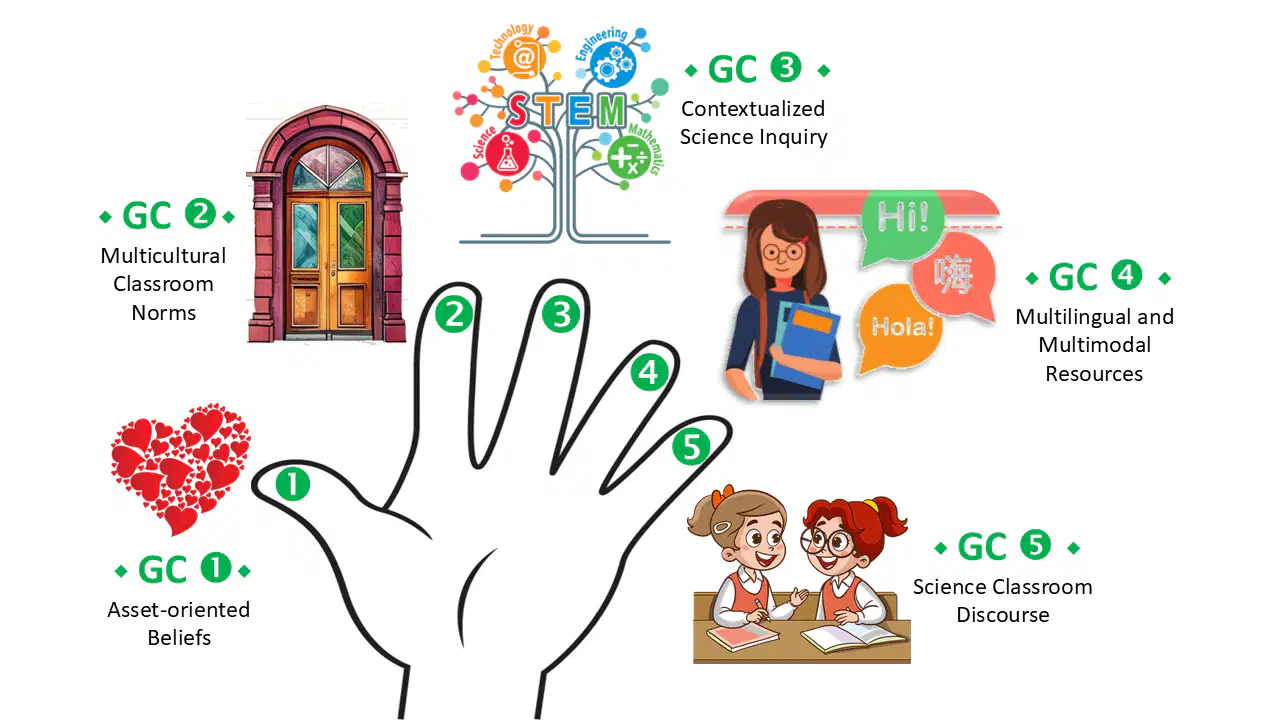
Type in the GC that matches the following definition: "Teachers integrate scientific discourse with everyday practices in response to students’ ideas and language needs to enhance opportunities for science sense-making".
(a)

Type in the GC (GC number) that matches the following definition: "Lesson explores ways to incorporate students’ diverse language practices and cultural assets into science lessons".
(a)

Type in the GC (GC number) that matches the following definition: "Lesson builds a classroom community and creates norms and routines that legitimize students' various language and cultural practices, and foster student collaboration for sense-making and cultural exchange".
(a)
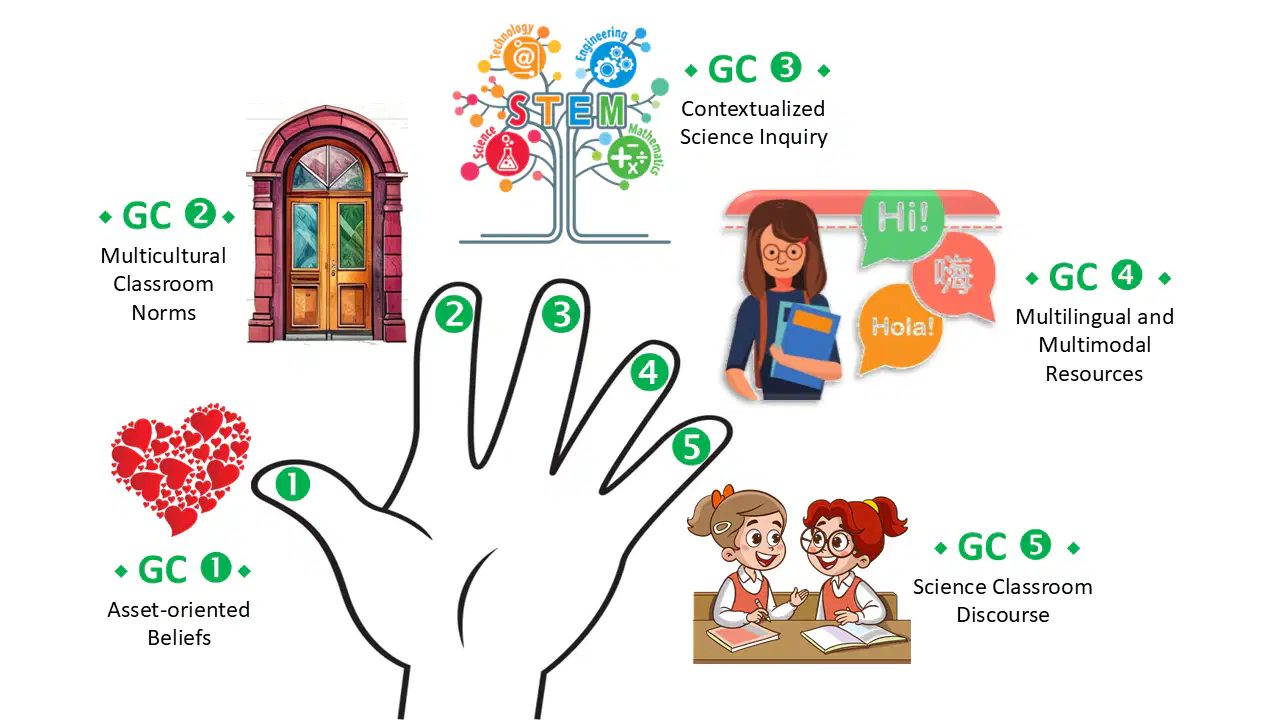
Type in the GC (GC number) that matches the following definition: "Lesson uses multiple languages, modalities, pedagogical strategies, and instructional resources to engage students in science practices and learning for understanding".
(a)

