Wayground logo

Free Printable Worksheets

Font size

S
M
L
XL
Worksheets

Kepler's Laws and Newton's Law of Universal Gravitation

Total questions: 20

Worksheet time: 29mins
Name
Class
Date
1.
Planets orbit the Sun in a shape called a(n)
a)
circle
b)
ellipse
c)
focus
d)
perihelion
2.
An ellipse is drawn around two points called
a)
aphelion
b)
perihelion
c)
foci
d)
axis
3.
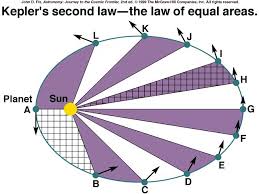
Where is the planet moving faster
a)
Position A to B
b)
Position B to C
c)
Position H to I
d)
Position I to J
4.
What is true about the area between points A, B and the Sun, and the area between points H, I and the Sun?
a)
The area between A, B and the Sun is the largest.
b)
The area between H, I and the Sun is the largest
c)
Both areas are equal in size
d)
There is not enough information to determine the areas
5.
Kepler's 2nd Law deals with 
a)
the shape of the planets' orbits
b)
the speed/area the planet travels 
c)
the length of time it takes the planet to orbit the sun
6.
Who created the Universal Law of Gravitation?
a)
Copernicus
b)
Newton
c)
Kepler
d)
Galileo
7.
Complete the following statement: The farther away two planets are the _______ the gravitational force between them.
a)
greater
b)
same
c)
zero
d)
less
8.
What are the standard units for the strength of the gravitational interaction? 
a)
N
b)
s
c)
m/s/s
d)
J
9.
An apple is hangs on a tree on the earth, Which of the following statements is correct about the interaction between the apple and the earth? 
a)
The force on the apple is greater that the force on the Earth.
b)
The force on the apple is equal to the force on the earth
c)
The force on the Earth is larger than the force on the apple.
d)
The forces on the apple and the earth are zero because they are not touching each other. 
10.

Which configuration will result in the greatest gravitational force?

a)

small masses far apart

b)

large masses far apart

c)

small masses close together

d)

large masses close together

11.

The number 6.67408 x 10 -11 N* m^2 / kg^2 is called the _______________.

a)

universal speed constant

b)

the speed force

c)

universal gravitational constant

d)

Earth's gravitational constant

12.

Gravity depends on ____________ and ____________

a)

Mass

b)

Weight

c)

Distance

d)

Velocity

13.

According to Kepler's 2nd Law; when a planet is nearest to the Sun the distance of the planet to the Sun (r) is _________ and it will move _______ around the Sun.

a)

Shorter; Slower

b)

Shorter; Faster

c)

Longer; Slower

d)

Longer; Faster

14.

When a planet is at the perihelion position to the Sun, the linear momentum will be at its ________ in value.

a)

Largest

b)

Smallest

c)

Equal

d)

Different

15.

When a planet is at the aphelion position to the Sun, the linear momentum will be at its _______ in value.

a)

Largest

b)

Smallest

c)

Equal

d)

Different

16.
An ellipse is drawn around two points called
a)
aphelion
b)
perihelion
c)
foci
d)
axis
17.
When a planet orbits the Sun, one of the foci of the elliptical orbit is 
a)
the axis
b)
the perihelion
c)
the center
d)
the Sun
18.
What has an eccentricity of zero
a)
a straight line
b)
a large ellipse
c)
a circle
d)
a small ellipse
19.
The farther away a planet is from the sun, the _______ it takes it to orbit the sun once. 
a)
longer
b)
shorter
20.

What does the eccentricity of an ellipse indicate?

a)

The speed of the planet in its orbit

b)

The distance from the Sun to the planet

c)

The degree of flattening of the ellipse

d)

The number of foci in the ellipse