
Font size
 Worksheets
Early Christian Church History Quiz
Total questions: 100
Worksheet time: 50mins
What significant event marked the beginning of the Christian Church around 33 AD?
The Council of Nicaea
The Pentecost
The Edict of Milan
The Great Schism
During which period did the spread of the Christian message throughout the Roman Empire, particularly by Paul, occur?
100-150 AD
33-60 AD
70-90 AD
10-30 AD
What was the consequence of the destruction of the Jewish Temple in Jerusalem in 70 AD?
The beginning of the Protestant Reformation
The spread of Christianity to Asia
The shift of the center of Christianity to Antioch, Alexandria, and Rome
The writing of the New Testament
When was the last of the New Testament books written?
c. 50 AD
c. 70 AD
c. 100 AD
c. 150 AD
During which period did Christianity separate from Judaism and face persecution from the Roman Empire?
100-300 AD
312-313 AD
400-500 AD
50-100 AD
What significant event happened in 312 AD concerning Roman Emperor Constantine?
He declared Christianity illegal.
He experienced a vision leading to his conversion.
He started a new war against Christians.
He abolished the Roman Empire.
What was the outcome of the Edict of Milan in 313 AD?
Christianity was declared the state religion.
Christianity was made illegal.
Christianity became legal and rights were restored.
Christians were exiled from the Roman Empire.
In which year did the Edict of Milan grant religious tolerance to Christians?
313 AD
324 AD
325 AD
380 AD
What significant event happened in 325 AD concerning Christian doctrine?
Edict of Milan
First Council of Nicaea
Fall of the Roman Empire
Christianity becomes the official religion
When did Christianity become the official religion of the Roman Empire?
313 AD
324 AD
380 AD
476 AD
What event marked the fall of the Roman Empire in 476 AD?
Edict of Milan
First Council of Nicaea
Deposition of Romulus Augustulus
Establishment of New Rome
In what year did the Great Schism occur, dividing the Western and Eastern Churches?
313 AD
1054 AD
1453 AD
1500 AD
What significant event happened in 1453 AD?
The Great Schism
The fall of the Eastern Roman Empire
The beginning of Christendom
The First Crusade
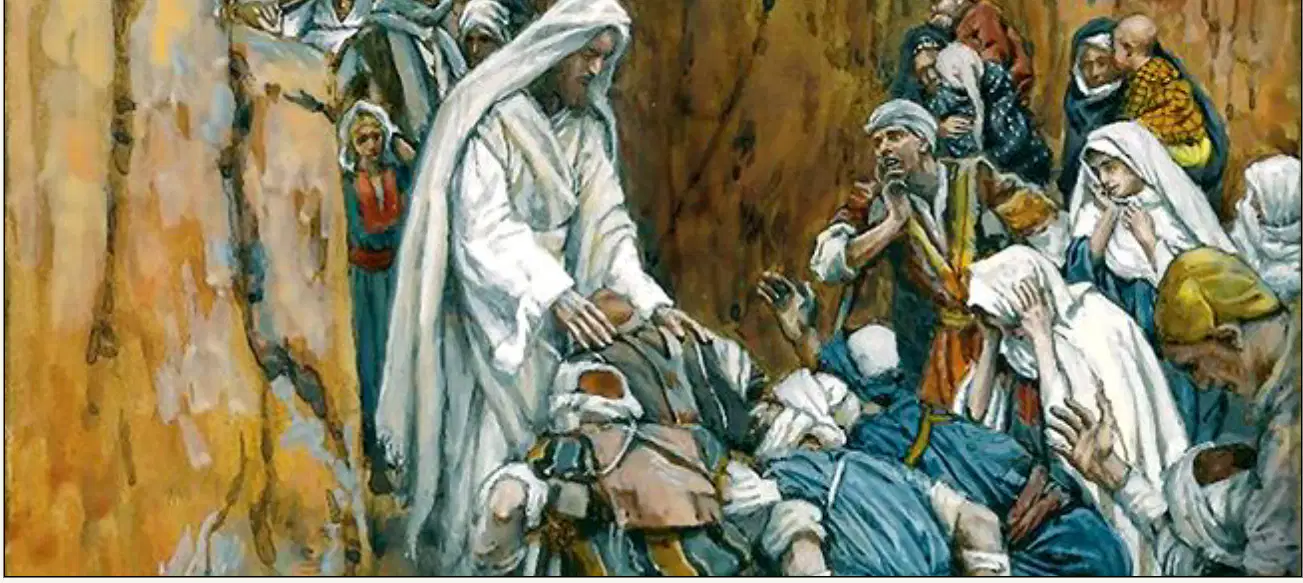
In what ways do Catholics present Christ to the world according to the text?
Through works of justice and charity
By attending church services
By reading religious texts
Through personal meditation
What duty does the Church have according to the basic ideas in "Centesimus Annus"?
To promote economic growth
To defend people from evil
To establish political systems
To accumulate wealth
According to "Centesimus Annus," what should the social order be based on?
Competition and rivalry
Cooperation and solidarity
Hierarchy and control
Wealth and power
What is considered wrong regarding people's living conditions in "Centesimus Annus"?
Living in luxury
Living in poverty unnecessarily
Living in isolation
Living without ambition
What types of goods do human beings need according to "Centesimus Annus"?
Material, spiritual, and religious goods
Only material goods
Only spiritual goods
Only religious goods
What role did St. Basil play in addressing poverty during the 4th century in Caesarea?
He organized a system to bring food to the needy.
He led military campaigns to expand the empire.
He focused solely on religious teachings.
He built palaces for the wealthy.
Which of the following facilities did St. Basil construct to aid the poor?
A library and a university
A soup kitchen and a homeless shelter
A marketplace and a theater
A fortress and a barracks
How did St. Basil contribute to the development of social justice?
By writing philosophical texts
By constructing facilities for the needy
By leading political reforms
By organizing sports events
What did the citizens of Caesarea call the complex of buildings due to its vastness?
The Great City
The New City
The Old City
The Grand Place
What was the significance of Basil's deeds for new Christians?
They were ignored by new Christians
They provided a great example
They were considered irrelevant
They discouraged conversion
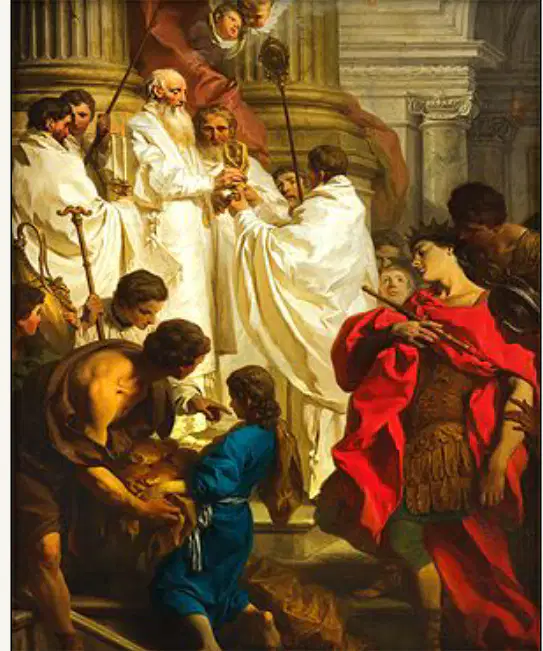
What was Basil involved in regarding the Church's early actions?
Writing religious texts
Building massive public works
Leading military campaigns
Establishing trade routes
What is the role of the Magisterium in the Catholic Church?
To create new doctrines
To interpret Scripture and Tradition
To replace the Pope
To write new religious texts
Who is entrusted with the interpretation of the Magisterium?
The local parish priest
The Pope and the bishops in union with him
The congregation
The choir director
Why has Catholic Social Doctrine become more important in the last century?
Due to technological advancements
Because of radical changes that threw society into upheaval
As a result of increased church attendance
Due to the decline of other religions
What was one of the effects of the Protestant Reformation on European societies?
Strengthened the bonds within societies
Weakened the bonds within societies
Unified aristocracies and monarchies
Increased the power of the Catholic Church
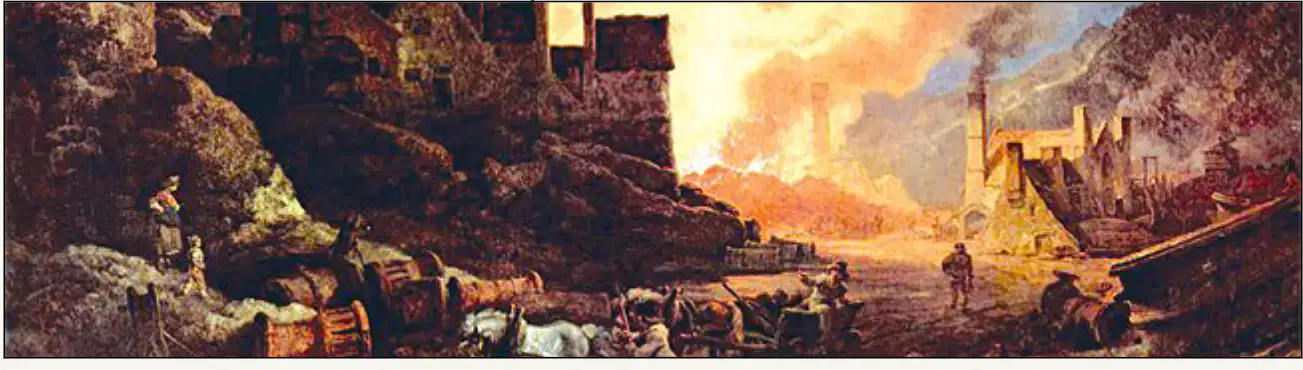
How did the Protestant Reformation contribute to political changes in Europe?
It led to the strengthening of monarchies
It caused the overthrowing of aristocracies and monarchies
It resulted in the unification of European countries
It increased the influence of the Catholic Church
What was one of the initial improvements during the Industrial Revolution?
Increased agricultural production
Improved efficiency in the methods of mining
Development of the steam engine
Expansion of the textile industry
How did the Industrial Revolution affect the availability of metals and energy sources?
It decreased the availability
It had no effect
It increased the availability
It made them obsolete
What was a significant social change caused by the Industrial Revolution?
People moved from cities to the countryside
People moved from the country to the cities
People stopped working outside the home
People worked fewer hours per day
What was one impact of powered machinery during the Industrial Revolution?
It decreased production rates
It was used for mass production
It was only used in agriculture
It replaced manual labor in homes
How did the Industrial Revolution change views of work, home, and family?
It reinforced traditional roles
It had no impact
It changed views significantly
It made family life more important
Which of the following ideologies emerged as new revolutionary ideas during the Age of Revolutions?
Capitalism, Liberalism, Conservatism
Socialism, Communism, Anarchism
Feudalism, Monarchy, Imperialism
Nationalism, Fascism, Totalitarianism
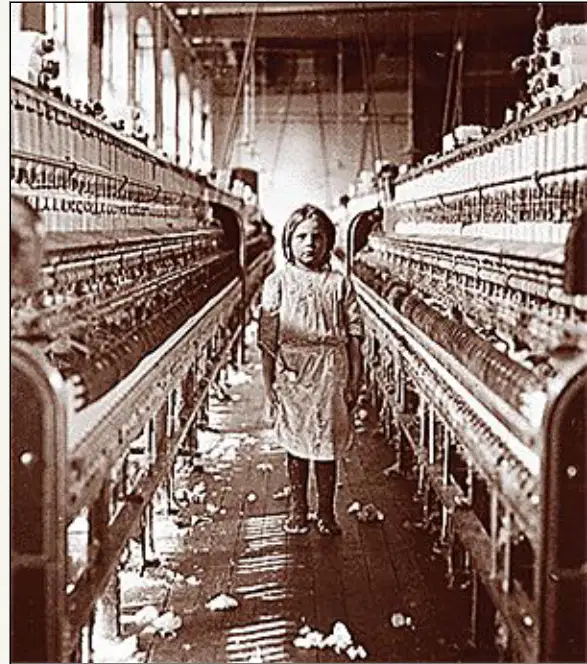
What methods did some activists use to promote change during the Age of Revolutions?
Peaceful protests and negotiations
Civil unrest, terrorism, repression
Diplomatic discussions and treaties
Economic reforms and trade agreements
What did Karl Marx believe about democracy's ability to create an orderly, just society?
It was fully capable of creating such a society.
It was not capable of creating an orderly, just society.
It was the best system for achieving equality.
It was only effective in small communities.
According to Karl Marx, what would a "bloody revolution" lead to?
A capitalist government
A democratic government
A socialist government
An anarchist government
What did Karl Marx believe would result from a socialist government?
A capitalist society
A stateless and voluntary workers' paradise
A monarchy
A dictatorship
What term is used to describe the beliefs of Karl Marx?
Capitalism
Socialism
Marxism or communism
Anarchism
In the late 19th century, what was considered the only reliable source of authority that transcended nations and ideologies?
The monarchy
The Church
The military
The government
Who was elected Pope in 1878, taking the name Leo the XIII?
Bishop von Ketteler
Cardinal Gibbons
Bishop Pecci
Bishop Smith
Which groups provided the Church’s response to social revolutions in the late 19th century?
Political parties
Saints, institutional charities, and religious orders
Military organizations
Educational institutions
Which bishops advocated for the Church during the late 19th century?
Bishop von Ketteler, Cardinal Gibbons, and Bishop Pecci
Bishop Smith, Cardinal Newman, and Bishop Brown
Bishop Johnson, Cardinal Lee, and Bishop White
Bishop Green, Cardinal Black, and Bishop Grey
During which years did Pope Leo XIII reign?
1878-1903
1850-1875
1900-1925
1825-1850
How many encyclicals did Pope Leo XIII issue during his pontificate?
50
85
100
120
Which of the following was a focus of Pope Leo XIII's encyclicals?
Technological advancements
Social issues like marriage and family
Environmental conservation
Space exploration
What was one of the roles of Pope Leo XIII as described in the text?
A military leader
An industrious teacher
A famous artist
A renowned scientist
In what year was "Rerum Novarum" issued?
1881
1891
1901
1911
What is "Rerum Novarum" often called in relation to Catholic social doctrine?
The last document
A minor document
The first of the great documents
An irrelevant document
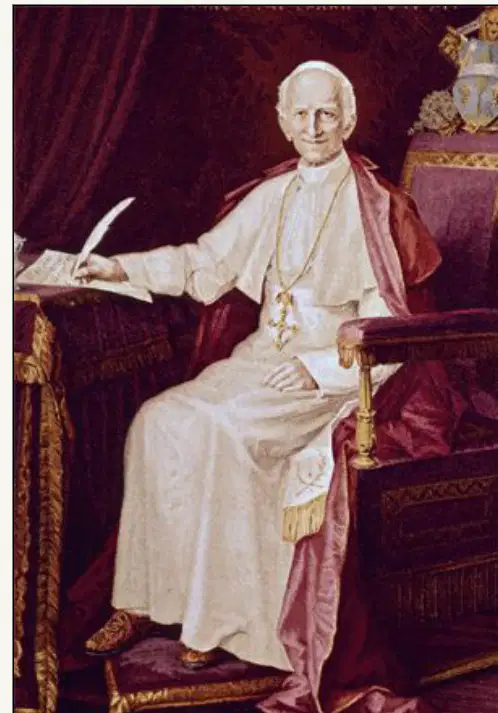
What does the title "Rerum Novarum" mean?
Of Old Things
Of New Things
Of All Things
Of Some Things
What social issue did Pope Leo XIII address regarding the working class?
The need for technological advancement
Unfair treatment of the working class
The importance of education
The rise of urbanization
What economic systems did Pope Leo XIII denounce in his teachings?
Socialism and feudalism
Capitalism and socialism
Laissez-faire capitalism and communism
Mercantilism and capitalism
What did Pope Leo XIII affirm as a right in his social teachings?
The right to free education
The right to private property
The right to free healthcare
The right to vote
What is the significance of the document "Rerum Novarum" in Catholic history?
It is known as the "Magna Carta" of Catholic social teaching
It introduced the concept of papal infallibility
It established the Vatican City as an independent state
It initiated the first Crusade
What role did "Rerum Novarum" serve in the context of Catholic social doctrine?
It was a historical document unrelated to social doctrine.
It served as a charter of principles guiding future Catholic social doctrine.
It was a scientific text on Catholic teachings.
It was a personal letter from the Pope.
What does the document mention about papal documents on Catholic Social teaching?
They are limited to a few key documents.
There is a vast body of papal documents on Catholic Social teaching.
They are only relevant to the 19th century.
They are primarily focused on economic issues.
What is included in the next slide according to the document?
A detailed analysis of "Rerum Novarum."
A short list of major social encyclicals marking critical moments in Catholic social doctrine.
A list of unrelated historical events.
A summary of economic theories.
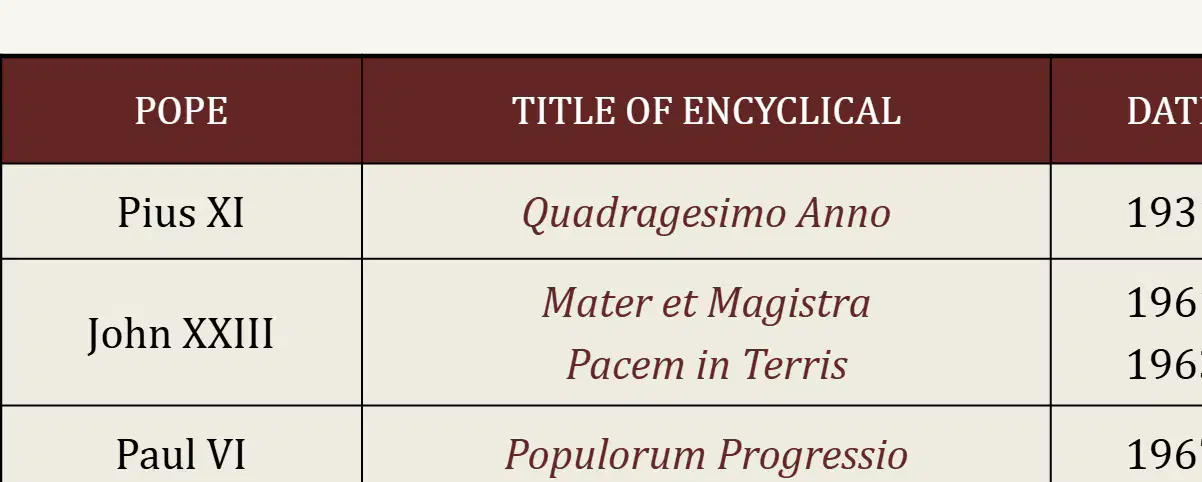
Which Pope issued the encyclical "Quadragesimo Anno"?
John XXIII
Paul VI
Pius XI
Benedict XVI
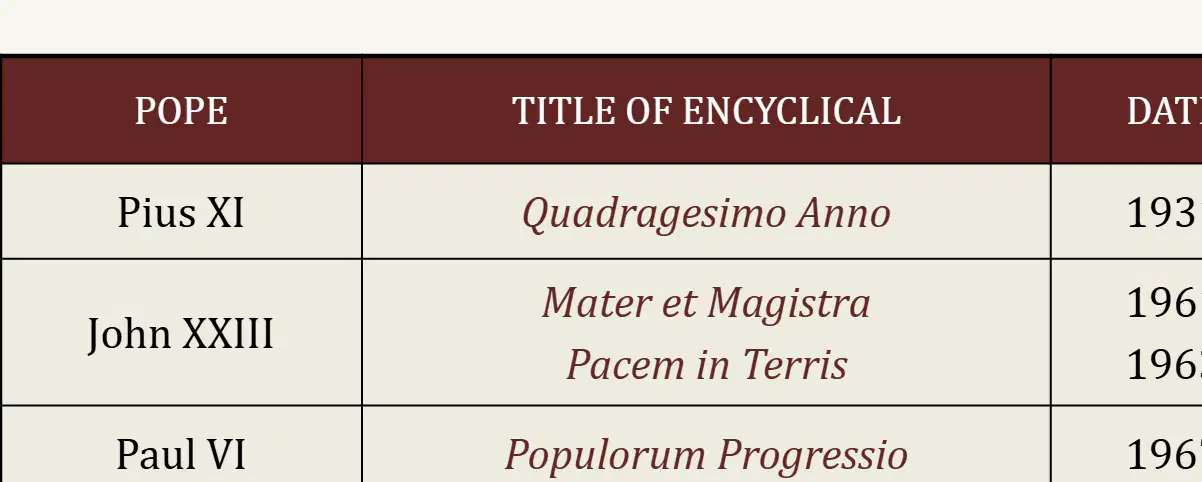
In what year was the encyclical "Populorum Progressio" published?
1961
1967
1981
2005
Which encyclical was issued by John Paul II in 1991?
Laborem Exercens
Sollicitudo Rei Socialis
Centesimus Annus
Evangelium Vitae
Who was the Pope during the publication of "Caritas in Veritate"?
Pius XI
John XXIII
Paul VI
Benedict XVI
What is the title of the encyclical written by Pope Pius XI?
Rerum Novarum
Quadragesima Anno
Humanae Vitae
Laudato Si'
How many years after Rerum Novarum was Quadragesima Anno published?
20 years
30 years
40 years
50 years
During which major historical event was Quadragesima Anno written?
World War I
The Great Depression
The Cold War
The Industrial Revolution
What topics did Quadragesima Anno update from Rerum Novarum?
Progress of communism and socialism
Environmental issues
Technological advancements
Educational reforms
What critique did Pius XI echo regarding communism and unrestrained capitalism?
They promote individual freedom
They align with Catholic teachings
They fail to recognize humanity's social nature
They encourage spiritual growth
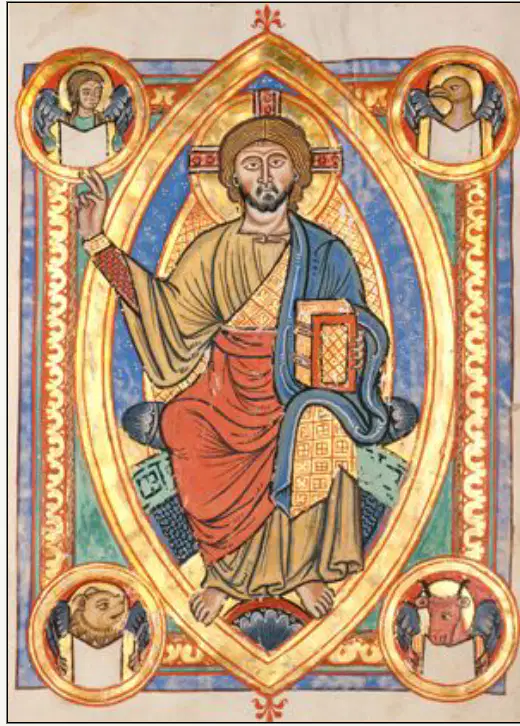
According to Pius XI, what is the conflict between being a sincere Catholic and a true socialist?
They both emphasize material wealth
They both support unrestrained capitalism
One cannot be both at the same time
They both promote social equality
What did Quadragesima Anno advise against in terms of government control of businesses?
Too much government control
Complete government ownership
No government involvement
Full privatization
According to Quadragesima Anno, what should social reformers seek justice based on?
Wealth
Charity
Power
Law
What type of government did Quadragesima Anno advise against for not addressing worker abuse?
Authoritarian
Democratic
Laissez-faire
Socialist
What is the English translation of "Mater et Magistra"?
Mother and teacher
Father and guide
Leader and mentor
Parent and instructor
In what year was "Mater et Magistra" published?
1951
1961
1971
1981
Which document's teachings were revisited in "Mater et Magistra"?
Rerum Novarum
Humanae Vitae
Evangelii Gaudium
Laudato Si'
Which of the following topics was NOT considered a "new thing" in "Mater et Magistra"?
Space exploration
New development of communism
The theory of relativity
Agricultural problems

What is the title of the document published by Saint John XXIII in 1963?
Pacem in Terris
Lumen Gentium
Gaudium et Spes
Humanae Vitae
During which historical period was "Pacem in Terris" published?
World War I
The Cold War
The Vietnam War
The Korean War
What fear did "Pacem in Terris" address?
Economic collapse
Nuclear warfare
Environmental disaster
Technological unemployment
According to "Pacem in Terris," what is necessary for lasting peace?
Economic growth
Military strength
Obedience to natural law
Technological advancement
What cannot be separated from God according to "Pacem in Terris"?
Wealth and power
Truth, justice, and dignity
Science and technology
Art and culture
According to Saint John XXIII, what is the meaning of life?
The state
Wealth
God
Power
What is the purpose of the state according to the document?
To control individuals
To serve individuals and the common good
To accumulate wealth
To expand territory
Which authority is considered higher than the authority of the state?
Military authority
Economic authority
The authority of the conscience
Political authority
What is said about unjust and/or immoral laws in the document?
They must be followed
They are not binding
They should be ignored
They are necessary
What principle extends to relationships between nations according to the document?
Economic competition
Military dominance
Peace and justice
Cultural superiority
What is stated about nations in the document?
Nations are created unequal
Weaker nations should be exploited
Nations are created equal
Stronger nations should dominate
Who was the first encyclical addressed to according to the document?
Only Catholics
Only Christians
All people
Only religious leaders
What does "Populorum Progressio" mean?
On the Development of People
The Wealth of Nations
Universal Brotherhood
The Balance of Society
In what year was "Populorum Progressio" published?
1967
1975
1955
1980
What issue does "Populorum Progressio" address regarding the relations between nations?
Increasing disparity between rich and poor nations
The rise of global technology
The spread of democracy
The decline of cultural traditions
What does "Populorum Progressio" suggest the wealthy should do to assist the poor?
Embrace universal brotherhood
Increase their investments
Focus on personal profit
Maintain the status quo
What does "Laborem Exercens" mean?
On Human Work
On Divine Work
On Social Justice
On Economic Theory
In what year was "Laborem Exercens" published?
1981
1971
1991
1961

How many years after "Rerum Novarum" was "Laborem Exercens" published?
90 years
80 years
100 years
70 years
What does "Laborem Exercens" discuss regarding the nature and dignity of human work?
The importance of technological advancement
The exclusive materialistic and economic valuation of labor
The role of government in regulating work
The necessity of global trade agreements
According to "Laborem Exercens," how are workers encouraged to view their labor?
As a means to achieve personal wealth
As a way to imitate Christ and participate in His work of redemption
As a method to gain social status
As a way to escape poverty
What does "Laborem Exercens" say about communism and economic liberalism in relation to work?
They fully understand the spiritual value of work
They fail to comprehend the true meaning of work
They promote the dignity of labor
They encourage fair wages for all workers
The Great Schism was
when the church split into Eastern Orthodox and Catholicism
When the church split between Jews and Christians
When Martin Luther voiced his complaints about the Catholic Church
Henry VIII order the formation of the Anglican Church
When the Eastern Orthodox church split from the Roman Cathlics
They excommunicated each other
The Pope insisted they pay a tax to leave
the Protestant Reformation began
They stopped letting the Pagans read the Bible
Middle Ages was

