
NEW
Font size
 Worksheets
Earth and Space
Total questions: 20
Worksheet time: 10mins
Earth rotates on its axis once every 24 hours. What is the result of the Earth's rotation?
the seasons
night and day
the moon's phases
the lenght of the year
Earth is titled on its axis. WHich of these would not exist if Earth had not tilt?
gravity
seasons
liunar phases
Earth's rotation
Earth revolves around the sun. How long does it take for Earth to complete one revolution?
one day
one week
one month
one year
In the late 1500's, an astronomer developed a new model of the universe. This model had the sun at the center of the universe, not Earth. Who was the astronomer?
Kopler
Galileo
Ptolemy
Copernicus
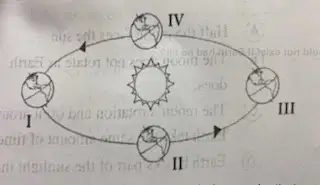
Look at the diagram. It shows Earth at four positions in its orbit around the Sun.
At which postion does the Northern Hemisphere receive the least amount of sunlight each day?
Position I
Position II
Position III
Position iV
The same side of the moon always faces Earth. Why is this?
Half the moon faces the sun.
The moon does not rotate as Earth does.
The moon's rotation and orbit around Earth take the same amount of time.
Earth blocks partof the sunlight that would shine on the moon's surface.
Kashvi likes to look out the window at the moon. She observes that it seems to change everey week. Which sentence best explains why this happens?
The moon moves between Earth and the sun.
The moon rotates only once in about a month
The same side of the moon always faces Earth.
The amount of the lighted part of the moon that faces Earth changes.

The picture shows one of the phases of the moon. Which phase does the picture show?
crescent
new moon
first quarter
third quarter

The picture shows one of the phases of the moon. What will the next phase be?
new moon
first quarter
third quarter
full moon
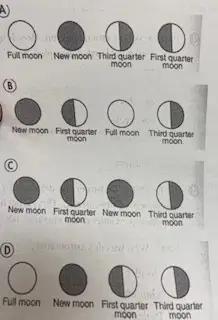
Which set of pictures shows the correct order of moon phases?
A
B
C
D
The sun is at the center of our solar system. What are the largest objects that revolve around the sun?
moons
comets
planets
asteroids
A thick atmosphere surrounds one of the planets. As a result, the temperature at its rocky surface is the hottest in the soalr system. Which planet is it?
Jupiter
Neptune
Saturn
Venus
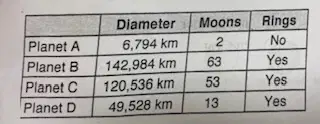
Look at the chart. It shows the characteristics of four planets. Based on teh data, which one is an inner planet?
Planet A
Planet B
Planet C
Planet D
The inner and outer planets can be grouped according to their characteristics. Which of these does not apply to the outer planets?
densest planets
very cold temps
gases surround a solid core
largest planets in the solar system
Inner planets and outer planets have different structures. Which characteristics do all inner planets share?
small solid core
large solid core
surface of frozen gases
surface of mostly liquid water
There are several types of galaxies. How do scientists classify galaxies?
by size
by shape
by temperature
by number of stars
There are many different colors of stars. Which characteristics determines the color of the star?
temperature
size and sharpe
actual brightness
distance from the Earth
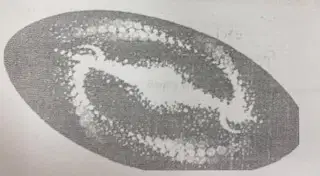
A galaxy is composed of bilions of stars held together by gravity. The illustration shows on common type of galaxy. What type of galaxy is shown in the illustration?
barred spiral
elliptical
spinning
spiral
In What ways are stars different from planets?
Stars are much larger than planets
Planets shine by refelcted light, while stars generate their own light.
Stars burn hydrogen in their cores, while planets do not.
all of the above
The sun is a medium-sized star, but it apears much larger than other stars. Why does the sun appear to be so large?
The sun is hotter than stars.
The sun produces more light than other stars
The sun is much closer to Earth than other stars are.
The sun is affected by Earth's gravity more than other stars are.

