
Font size
 Worksheets
Bundle 1 Pre-Assessment
Total questions: 39
Worksheet time: 57mins
Eagles and grizzly bears live together in the same habitat. There will be competition between the eagles and the grizzly bears only if which of the following is true?
Grizzly bears hibernate during the winter while eagles remain active.
Pesticides in the fish population affect eagles’ eggs and decrease their population.
Both grizzly bears and eagles feed on the same species of salmon.
Laws prevent humans from being able to hunt eagles or grizzly bears.
An increase in which of the following factors is likely to contribute to competition between two members of the same species living in a certain habitat?
Available food resources
Population of the species
Annual rainfall
Overall size of the habitat

The population of deer in a certain area is monitored over a period of six years. The data is represented in the graph provided.
Wolves, which prey on deer, were being hunted more than usual.
Rainfall in the previous spring was higher than the yearly average.
Humans introduced grazing animals that feed on the same plants as the deer.
More insects that pollinate flowering plants move into the habitat.
A student wants to investigate competition between two organisms. For the investigation, it is most important that the student should choose organisms that –
reproduce at the same rate.
are both active during the day.
have the same adaptations.
require the same resources.
Two species of fish live in the same pond. They eat the same kinds of plants. They are eaten by the same water birds. Which of the following would increase competition between these two species of fish?
Average habitat temperature increases.
Population of water birds increases.
Number of food plants increases.
Water level in the pond decreases.
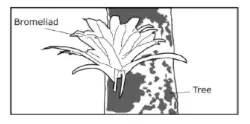
Bromeliads are small plants that grow attached to the sides of large trees high above the ground in warm, damp, and densely crowded tropical rain forests. Why do bromeliads do this?
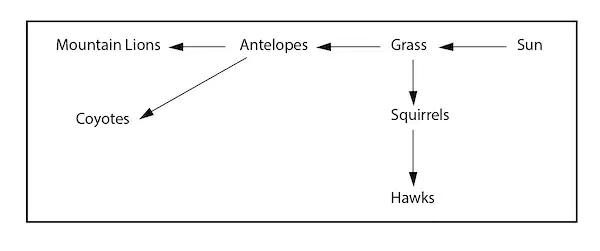
Examine the diagram provided. Based on the diagram, which organisms compete for food resources?

Refer to the tables provided. Which plants depend on and may compete for sandy soil in Zone 9?

The graph below shows the populations, over several years, for two animals that share a habitat. Foxes are mammals that hunt for food, and grouse are birds, a common prey animal of foxes. According to the data, in which year did the population of foxes show a decrease that is most likely the result of a decrease in the availability of a source of food?
2003
2005
2008
2012
An increase in the population of an organism would most likely be associated with which of the following?
A series of severe weather events in the habitat
A decrease in necessary resources available
An expansion of suitable living space
An increase in animals that prey on the organism
What data would be most helpful to support the claim that the population of a certain plant is dependent on the rainfall in its habitat?
The average amount of water absorbed by the roots and given off by the leaves of these plants
The amount of water retained in the soil in the area where the plants live
Rainfall amounts and number of these plants in a certain habitat over several years
The heights and number of leaves produced by these plants under different moisture conditions
The milkweed plant serves an important role in the life cycle of the monarch butterfly. Adult monarchs lay their eggs in milkweed, and then caterpillars eat that same plant during their development. Based on the relationship between monarchs and milkweed, which of the following trends would be predicted when looking at data on the populations of these two organisms?
Population decrease in monarch butterflies should follow population decrease in milkweed.
Population of monarch butterflies should remain constant when milkweed population decreases.
Population increase in monarch butterflies should follow population decrease in milkweed.
Population of milkweed should remain constant when monarch butterfly population increases.
Prairie dogs are small mammals that live in underground burrows in grassland prairie ecosystems. How do prairie dogs depend on these burrows?
Fish in a small pond depend on what biotic factors to meet their needs?
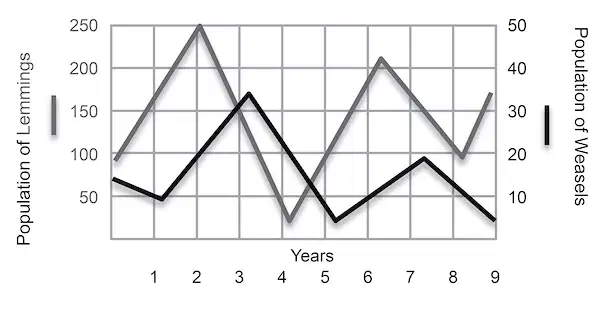
A graph showing the populations of lemmings and weasels in a given environment over a nine-year period is shown below. How many more lemmings are there than weasels during the peak of the lemmings population?
People try to conserve some resources, like fossil fuels, because they are not replaceable. Why can’t these resources be replaced?
They must be transported long distances.
Processes that make them take a long time.
No one can afford to buy more of them.
It is impossible to extract more from the earth.
People move into and begin living in an area that previously had no human activity. What will most likely be the effect on the amount of water?
Water will be more evenly distributed in the area.
Most of the fresh water in the area will be converted to salt water.
The amount of fresh water suitable for drinking will increase.
There will be less available for other living things.

The table provided shows areas where sedimentary rock layers are exposed, as well as the environmental factors that produced the rock layers.
Coal forms in locations where vegetation gets buried quickly and then altered by heat and pressure over millions of years. Which location is most likely to have coal?
Area A
Area B
Area C
Area D
Select all of the following examples that show demonstrate the quantity of the resource being used by humans is affected
petroleum taken from the ground and burned for fuel.
fresh water used for agriculture, recreation, and tourism.
wind power used to provide energy for homes and businesses.
metal ores mined and used to create building materials.
Metal ores are often formed in locations that had volcanic activity in the past. What information about an area would provide the best evidence that metal ores could be found there in the present?
Evidence that volcanoes in the area are currently active
Evidence that humans in the area use lots of metal ores
Evidence that metal ores had been brought to the area by ancient humans
Evidence that the area had active volcanoes long ago
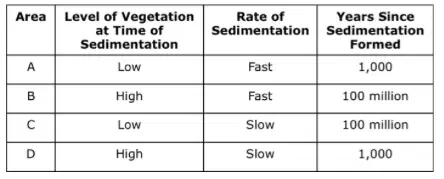
Humans depend on coal as a resource for energy needs. In the data table below, Area B is the most likely place where coal will be found. Explain the conditions needed for coal formation.
Why are Earth’s natural resources unevenly distributed around the planet?
Which of the following is true about how hydrogen and oxygen can combine to form molecules?
Hydrogen and oxygen can combine in many ways to form different molecules.
Two atoms of hydrogen are always required to bond with two atoms of oxygen.
When oxygen combines with hydrogen to make a molecule, water will always be produced.
Molecules composed of hydrogen and oxygen must have at least four atoms.
Molecules composed of hydrogen and oxygen must have at least four atoms.
Atoms are molecules that have a charge.
Atoms have smaller parts, called molecules
Molecules are made up of two or more atoms.
Molecules are atoms that have no mass.

The extended structure of sodium chloride (NaCl) is shown.
Which of the following describes the configuration of Layer 4 of the sodium chloride crystal?
It will be identical in all of its characteristics to Layer 1.
It will contain 4 atoms of chlorine and 5 atoms of sodium.
It will have chlorine atoms in all four of its corners.
It will have sodium that are bonded only to other sodium atoms.
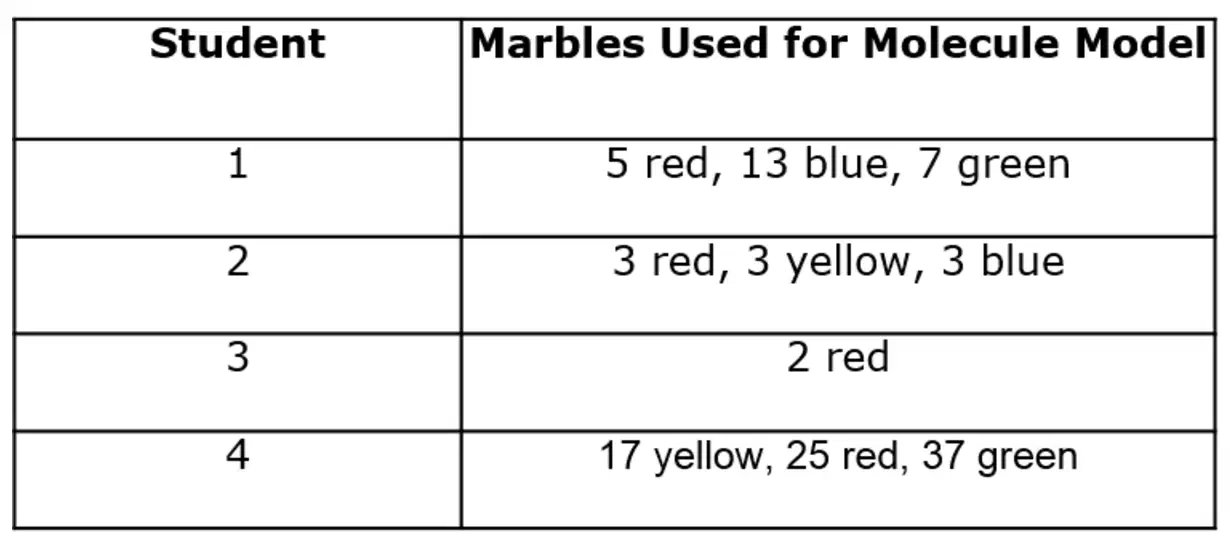
Students are asked to create models of molecules using marbles of different colors to represent atoms of different types. Below is a table describing the models made by four students.
Which of the following is the most accurate evaluation of these models?
Only Students 1,2, and 4 created acceptable models, since molecules must be made of different types of atoms.
All of the students created acceptable models because molecules can consist of many different configurations of atoms.
Only Student 2 created an acceptable model of a molecule, since every molecule must have a balance of atoms.
All student models are acceptable except that of Student 4, since molecules can't be made of so high a number of atoms.
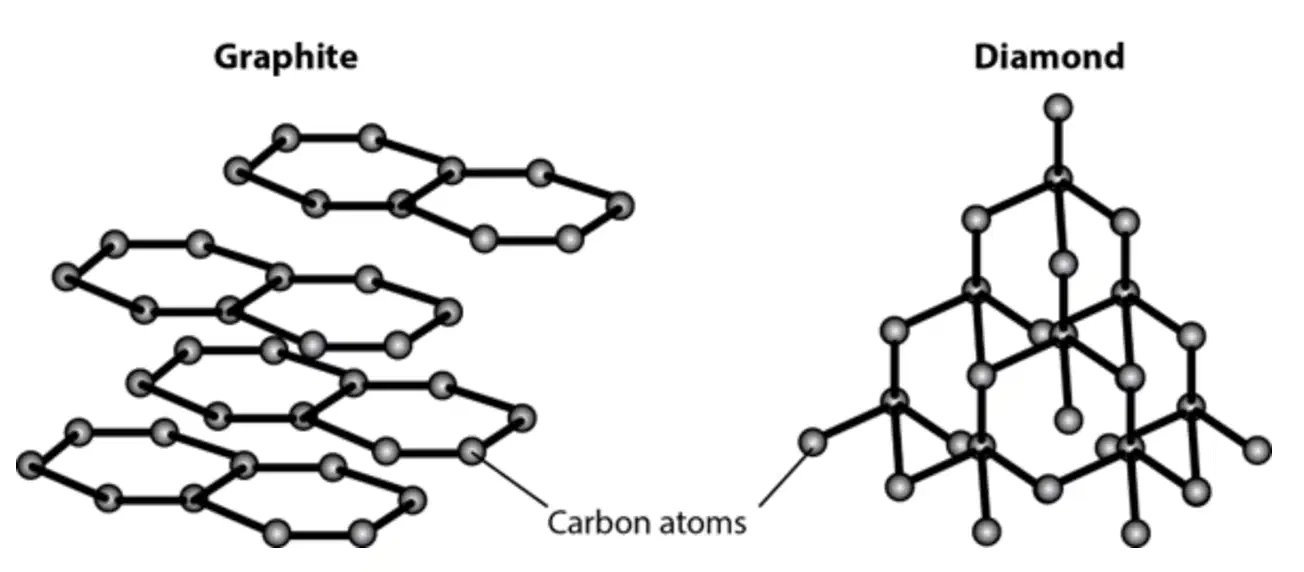
Atomic models of graphite and diamond are shown.
Graphite is a soft, dark material often used as a lubricant. Diamond is often a clear, hard crystal.
Which of the following best explains the difference in these materials?
The arrangement of the atoms of each one.
The elements of which each one is made.
The number of atoms each one is made of.
The size and shape of the individual atoms.
How many atoms are needed to form a molecule?
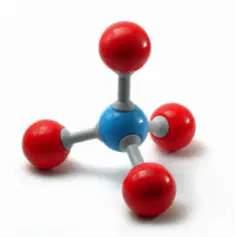
The following model was used to show a molecule of methane, or CH4. Describe the number and type of each component of the molecule.
Methane (CH4) combines with oxygen gas (O2) to form carbon dioxide (CO2) and water (H2O). Describe the number and type of atoms for a molecule of each substance.
Which of the following changes made to a sample of liquid would result in an increase in the distance between the individual molecules of the substance?
Transferring the substance to a smaller container
Adding heat energy to the substance
Changing the phase of matter from liquid to solid
Decreasing the overall kinetic energy of the liquid

A student drew a representation of the atoms of a solid. The illustration shows closely packed atoms vibrating, but remaining in the same relative positions.
Which of the following changes must the student make to the illustration to accurately represent the same substance in the liquid phase?
The illustration should show increased movement of the atoms
Each individual atom should be larger
There should be very wide spaces between the atoms
The shape of each atom must reflect the shape of the container
As thermal energy is added to a substance, which of the following changes can be predicted?
Spacing between particles will decrease
Vibration of individual particles will increase
Temperature of the substance will decrease
The pressure of the air around the substance will increase
Which of the following statements best describes the relationship between temperature and kinetic energy of particles in a substance?
As kinetic energy decreases, temperature is not affected
As kinetic energy increases, temperature decreases
As kinetic energy decreases, temperature increases
As kinetic energy increases, temperature increases

Students were asked to draw a concept map of changes in matter at the molecular level. An incomplete sample is provided here.
Which of the following labels would be most appropriate for completing the diagram?
Arrow A=particles become more tightly packed
Arrow B=the pressure of the substance increases
Arrow C= kinetic energy of particles increases
Arrow D= particles become more widely spaced
Describe the particle structure of liquids.
How are the molecules in a gas different from molecules in other states of matter?
How does adding thermal energy to solid ice affect the molecules in the ice?

