
 Worksheets
Unit 1: Solid, Liquid, Gases Quiz
Total questions: 12
Worksheet time: 6hrs 0mins
Which of these sentences defines the term particle as it refers to solids, liquids, or gases?
The pieces of rock produced by weathering.
Different types of natural substances, such as oxygen or carbon.
The tiny parts that make up matter.
A small portion of a metal.
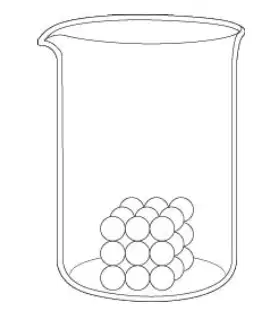
Look at the image.
What state of matter does the drawing represent and why?
It’s a solid because the particles are closely packed together.
It’s a liquid because the particles are held in a container.
It’s a gas because there are many loose particles.
It could be a solid, liquid, or gas because it is made of particles.
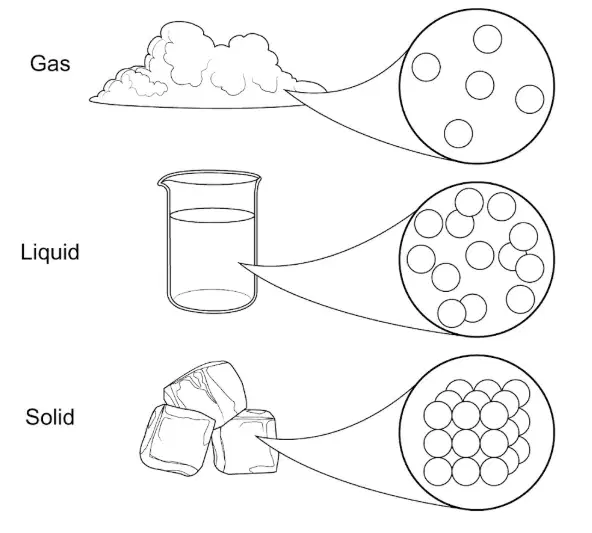
Look at the image of the states of matter.
Choose the words, in order, that finish the sentence.
Changing liquid water to gas requires ______ the water. Changing water vapor to liquid water requires ______ the water vapor.
heating; heating
heating; cooling
cooling; cooling
cooling; heating
Every day in a kitchen changes occur in which solids become liquid and liquids become solid. One example of this is water placed in a freezer; a liquid becomes a solid.
Explain three different changes of state that occur in your kitchen. At least one change should be solid to liquid, a second change should be liquid to solid, and a third change should be liquid to gas.
Which one of these answers below is a chemical change?
Which one of these below is NOT a physical change?
Digesting food
Which one of these is a physical change?
Solubility is when a substance can
Melt down and reform as a new substance
Dissolve in another substance
Broken into small tiny little particles
All of the above
What is an example below of a substance?
Water
Dr. Pepper
Ketchup
Lemonade
To group together based on similar traits is
classify
EXTRA CREDIT: Select all the ways you can classify matter
solubility
magnetic
density
all of the above
EXTRA CREDIT: If something is soluble, what happens to it?
It dissolves.

