
 Worksheets
Responsibility Assignment Matrix
Total questions: 37
Worksheet time: 56mins

According to the Responsibility Assignment Matrix, who is Responsible (R) for Work package 1?
Person 1
Person 3
Person 5
Person 6

According to the Responsibility Assignment Matrix, who is Consulted (C) for Work package 1?
Person 2
Person 3
Person 5
Person 7
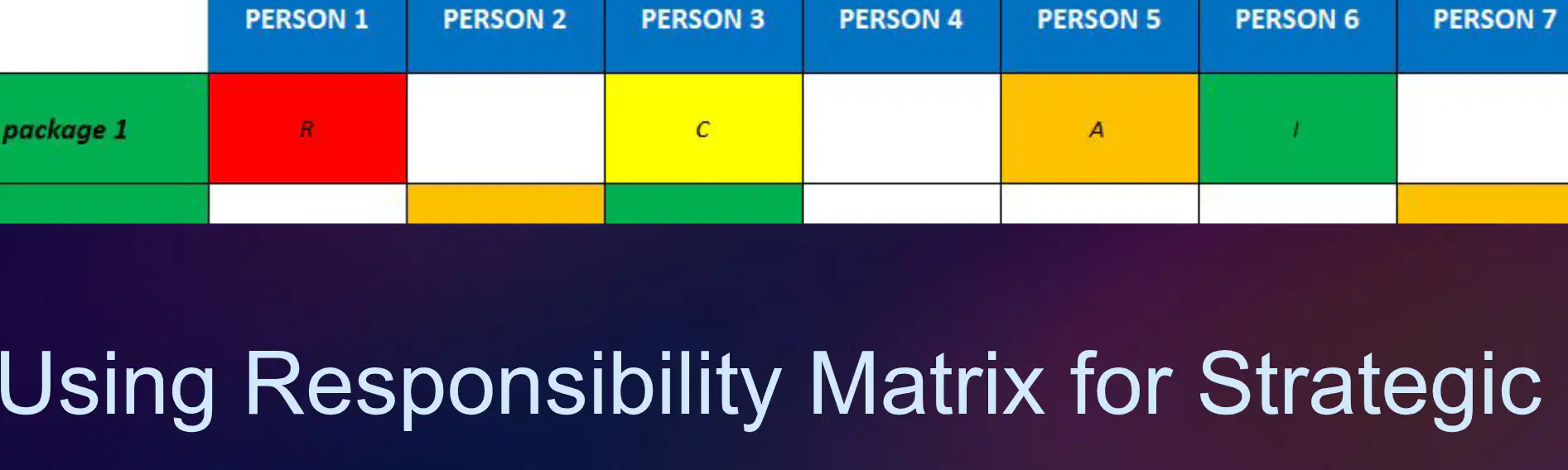
According to the Responsibility Assignment Matrix, who is Accountable (A) for Work package 1?
Person 4
Person 5
Person 6
Person 8

According to the Responsibility Assignment Matrix, who is Informed (I) for Work package 1?
Person 2
Person 4
Person 6
Person 8
What is the first topic listed in the contents?
The Strategic Need for Clarity
Effective Communication Strategies
Organizational Leadership Models
Implementing Change Initiatives
Which framework is explained in the second topic of the contents?
The RACI Framework
The Agile Framework
The Waterfall Model
The Scrum Methodology
What is the name of the process described in the third topic of the contents?
The Five-Step Implementation Process
The Evaluation Cycle
The Planning Sequence
The Feedback Loop
What is the focus of the fourth topic in the contents?
Role Negotiation as Strategic Dialogue
Team Building and Conflict Resolution
Organizational Change Management
Effective Communication Skills
Which company's turnaround is discussed in the fifth topic of the contents?
A Texas Company
A California Firm
A New York Corporation
A Florida Enterprise
What trap is mentioned in the sixth topic of the contents?
The 'Everyone is Accountable' Trap
The 'No One is Responsible' Trap
The 'Blame Game' Trap
The 'Micromanagement' Trap
What is described as a discipline in the seventh topic of the contents?
Strategic Execution
Financial Analysis
Market Research
Product Development
What is the focus of the eighth topic in the contents?
Leadership’s Role in Matrix Facilitation
Financial Planning in Organizations
Technological Innovations in Management
Human Resource Allocation Strategies
What is being embedded into organizational culture in the ninth topic of the contents?
The Matrix
Agile Methodology
Six Sigma
Total Quality Management
What is described as a catalyst for change in the tenth topic of the contents?
The Matrix
The Catalyst
The Revolution
The Awakening

In this lesson you will need: ________ or notebook/paper.
Exercise book
Calculator
Ruler
Textbook

In this lesson you will need: A ________ or pen.
pencil
eraser
ruler
notebook

In this lesson you will need: Your brain and your ________ attention, please.
undivided
divided
casual
partial
Ambiguity in roles undermines strategic execution by:
Creating confusion and lack of accountability
Increasing motivation and clarity
Ensuring clear communication and direction
Promoting efficient teamwork
A lack of accountability can be culturally ingrained in organizations.
Yes, it can be culturally ingrained.
No, it cannot be culturally ingrained.
Only in small organizations.
Only in non-profit organizations.
What risks arise when multiple people are labeled “Accountable”?
It can lead to confusion, lack of ownership, and tasks being neglected.
It ensures everyone is more productive.
It guarantees faster completion of tasks.
It reduces the need for communication among team members.
The RACI model can be adapted for agile or flat organizations by:
Emphasizing collaboration and flexible roles
Strictly enforcing hierarchical decision-making
Eliminating all role definitions
Focusing only on individual accountability
Independent input is crucial before group discussion because:
it prevents groupthink and encourages diverse perspectives.
it ensures everyone agrees from the start.
it speeds up the decision-making process.
it eliminates the need for further discussion.
Matrix discrepancies can reveal deeper organizational issues by:
Highlighting misalignments in roles and responsibilities
Increasing employee satisfaction
Reducing the need for communication
Ensuring perfect workflow
Role negotiation can improve team cohesion by:
clarifying responsibilities and reducing conflicts
increasing competition among team members
encouraging individualism over teamwork
ignoring team members' preferences
Essential leadership skills to guide these discussions include:
Active listening and effective communication
Technical expertise only
Authoritarian decision-making
Avoiding feedback from others
This case reveals the following about leadership transparency:
It highlights the importance of open and honest communication.
It shows that secrecy is always the best policy.
It suggests that leaders should avoid sharing information.
It proves that transparency leads to confusion.
Documentation of roles can sustain long-term execution by:
Providing clarity and consistency over time.
Increasing short-term confusion.
Eliminating the need for communication.
Reducing accountability among team members.
Leaders can shift from shared to individual accountability by:
Clearly defining individual roles and responsibilities.
Encouraging group decision-making for all tasks.
Relying solely on team-based performance metrics.
Avoiding direct feedback to individuals.
The psychological effects of unclear responsibility include:
Increased stress and confusion
Improved communication
Enhanced motivation
Clearer decision-making
Organizational structure influences execution success by:
Defining roles and responsibilities for effective coordination.
Increasing employee turnover rates.
Reducing the need for communication.
Eliminating the need for leadership.
Execution discipline can be taught across all levels.
Yes, it can be taught across all levels.
No, it can only be taught at the top level.
It depends on the organization size.
Only experienced employees can learn it.
Facilitation techniques that enhance matrix outcomes include:
Active listening and clear communication
Ignoring team input
Discouraging collaboration
Focusing only on individual goals
Leaders can balance authority with collaboration by:
Encouraging team input while maintaining decision-making power
Making all decisions alone without consulting others
Delegating all authority to team members
Ignoring team feedback and focusing solely on rules
Organizations can institutionalize the matrix process by:
Establishing clear roles, responsibilities, and communication channels.
Eliminating cross-functional teams entirely.
Focusing only on hierarchical decision-making.
Discouraging collaboration between departments.
HR plays which role in sustaining responsibility culture?
Developing and enforcing policies that promote responsibility
Focusing solely on recruitment
Ignoring employee behavior
Delegating all responsibility to management
The matrix can support change management initiatives by:
Facilitating communication and collaboration across departments
Limiting employee involvement in decision-making
Discouraging cross-functional teamwork
Reducing transparency in project roles
Clarity of roles enhances innovation by:
Reducing confusion and enabling focused collaboration
Increasing competition among team members
Limiting communication between departments
Discouraging new ideas

