
NEW
Font size
 Worksheets
US History Quiz
Total questions: 26
Worksheet time: 13mins
What was the Era of Good Feelings characterized by?
Political harmony due to one political party
Economic prosperity due to industrialization
Cultural renaissance in the arts
Military expansion and conquest
What was the main idea behind Manifest Destiny?
The belief in the divine right to expand westward
The need to establish a strong military presence
The desire to create a new political system
The focus on industrial development
Why was the Louisiana Purchase controversial?
It was seen as a violation of the US Constitution
It was too expensive for the US government
It led to immediate conflict with Native Americans
It was opposed by European nations
What was a cause of the Mexican War?
Dispute over the southern boundary of Texas
Conflict over the Oregon Territory
Disagreement over the Louisiana Purchase
Tensions regarding the Monroe Doctrine
What was the goal of the Monroe Doctrine?
To prevent European nations from interfering in the Western Hemisphere
To establish trade agreements with European countries
To promote cultural exchange with Latin America
To expand the US military presence in Europe
What did the Treaty of Guadalupe Hidalgo accomplish?
Ended the Mexican American War
Started the Civil War
Established the Monroe Doctrine
Annexed the Oregon Territory
What was a result of acquiring new territories to the west?
Increased division between the North and the South
Immediate economic prosperity
Unification of political parties
Decrease in sectionalism
What was one of the characteristics of Andrew Jackson's administration?
Reduced voting rights for the common man
Expanded suffrage for the common man
Increased property requirements for voting
Supported the National Bank
Which Supreme Court case decided whether states could enforce laws against Native American nations?
Marbury v. Madison
McCulloch v. Maryland
Worcester v. Georgia
Dred Scott v. Sandford
What was the main purpose of the internal improvements in Henry Clay's American System?
To increase tariffs on foreign goods
To provide faster and cheaper ways to transport goods
To reduce the power of the federal government
To eliminate the need for a national bank
What was the impact of the Cotton Gin invented by Eli Whitney?
It decreased the profitability of cotton
It reduced the need for slaves
It made cotton profitable and increased slavery
It eliminated the need for interchangeable parts
What was the main economic base of the Northern economy in the early 19th century?
Agriculture and farming
Industry and manufactured products
Mining and resource extraction
Fishing and maritime trade
What was the main focus of the Second Great Awakening led by Charles G. Finney?
Emphasizing religious rituals
Reforming bad things in America
Promoting industrial growth
Expanding territorial boundaries
Who was known for their involvement in the Underground Railroad?
William Garrison
Frederick Douglass
Harriet Tubman
John Brown
What was the ultimate goal of the Underground Railroad?
To promote industrialization
To help slaves flee to free states
To expand voting rights
To support the temperance movement
What did the Seneca Falls Convention advocate for?
Abolition of slavery
Expanded women’s rights
Temperance movement
Industrial growth
What was the Missouri Compromise primarily about?
Expanding the railroad system
Balancing free and slave states
Promoting religious freedom
Establishing new trade routes
What was the most controversial part of the Compromise of 1850?
California would be a free state
Fugitive Slave Law passed
Slavery outlawed in Washington DC
Popular Sovereignty
What did the Kansas-Nebraska Act accomplish?
It reinforced the Missouri Compromise
It allowed Popular Sovereignty north of the line
It banned slavery in all new territories
It made Kansas a free state
What was the result of the Dred Scott Case?
Slaves were granted citizenship
Congress could restrict slavery in the western territories
Slaves were ruled as property
Dred Scott was freed
Why did the Southern states secede after the Election of 1860?
They supported the Republican Party
They were upset with the election of Lincoln
They wanted to expand slavery
They wanted to join the Union
What was the viewpoint of the Republican Party regarding slavery?
They wanted to expand slavery
They opposed slavery where it already existed
They did not oppose slavery where it already existed
They supported the Fugitive Slave Law
What event marked the first shots of the Civil War?
Battle of Gettysburg
Battle of Fort Sumter
Battle of Antietam
Battle of Bull Run
Which of the following was a cause of sectional conflict leading to the Civil War?
Missouri Compromise
Nullification Crisis
Louisiana Purchase
Monroe Doctrine
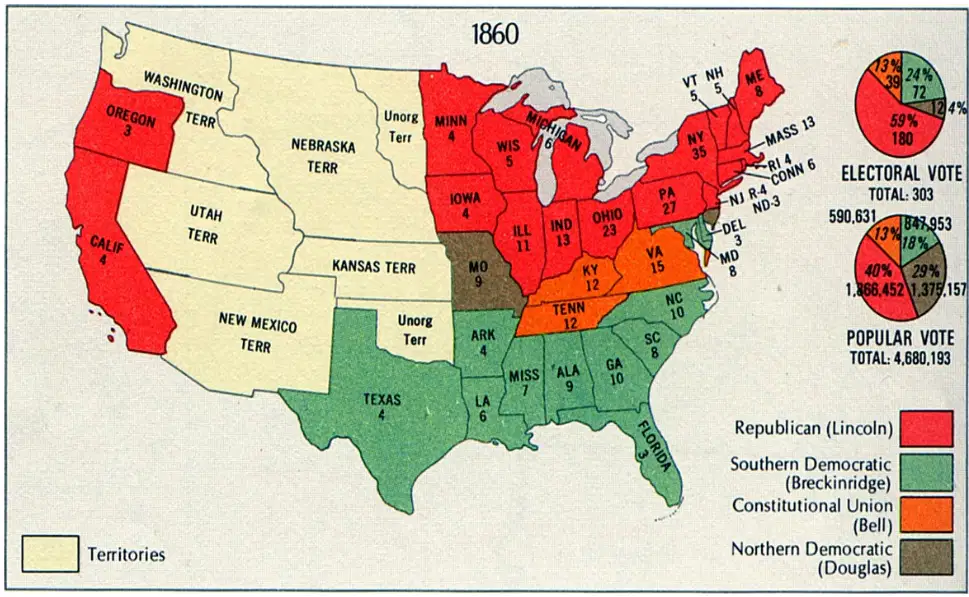
What does the map from 1860 illustrate about the United States?
The economic growth of the US
The territorial expansion of the US
The sectional differences and division in the election
The industrial development in the US
Which act is associated with the expansion of slavery into new territories?
Kansas Nebraska Act
Homestead Act
Dawes Act
Morrill Act

