
 Worksheets
Integumentary System Test B
Total questions: 72
Worksheet time: 36mins
The top layer of the epidermis
Is the stratum basale – the base layer of the skin.
Is the stratum granulosum – because it has a grainy feel.
Is the stratum spinosum – because the cells on top are spiny.
Is the stratum corneum – because the cells on top are dead.
Exposure to ultraviolet light darkens the skin by stimulating production of
Collagen
Elastin
Hemoglobin
Melanin
Hair is composed of
a. a root and a shaft
b. keratin and living cells
c. dead dermal cells
d. both a and b
Which of the following is a function of hair?
Oil production
keeping particles out of the body
production of Vitamin E
All of these
Eccrine glands
Are the most numerous sweat glands on the body and empty into pores.
Are found in the axillary and genital areas only.
Are not significant to heat regulation.
Are responsible for the permeability characteristics of the epidermis.
The human integumentary system includes
skin, nails, hair follicles, and exocrine glands.
just the skin, nerves, and blood vessels.
the epidermis, dermis, and subcutaneous layer.
muscles and bones.
As cells are pushed from the deeper part of the epidermis toward the surface,
they divide continually.
their supply of nutrients improves.
they keratinize and eventually die.
they become dermal cells.
The skin
prevents water loss from deeper tissues
excretes wastes
regulates body temperature
synthesizes vitamin D
all of these
The epidermis
Is made up of epithelial tissue
Is vascular
A patient comes in with blisters and red skin – he will likely be diagnosed with what degree burn?
first
second
third
Between the epidermis and dermis dermal papillae press into the epidermis creating friction ridges forming?
blisters
keratin
melanocytes
fingerprints
The cells of the epidermis fill with what substance as they move up
collagen
melanin
elastin
keratin
A patient is brought in to the emergency room and clearly has blood that has escaped from circulation and has gathered in the tissue – the doctor uses this term to refer to the colorful area.
erythema
jaundice
pallor
hematoma
Which part of the hair is where the living cells divide and grow?
Hair bulb at the base of the follicle
Hair shaft
Cuticle
Medulla
Sebaceous glands are important for
production of keratin
body thermoregulation
keeping skin and hair moisturized
production of earwax
Sweat
helps kill some bacteria
Is involved in heat regulation
may mix with bacteria to produce a musky odor
can be activated during stress, sexual foreplay, pain.
All of the above
The thin skin is different from thick skin because it does not have
stratum corneum
stratum granulosum
stratum lucidum
stratum basale
The subcutaneous layer is distinguishable from the dermis by its abundance of
vascular tissue
nervous tissue
epithelial tissue
adipose (fatty) tissue
Most of the dermis
Is the reticular layer
Is the papillary layer
Is dead skin
Is avascular
Which layer of skin is known for having lots of collagen and elastin fibers?
dermis
hypodermis
epidermis
Thick skin can be found on the
lower back.
Soles of the feet.
Buttocks and back of legs.
forearms.
Sebaceous glands are
found all over the body except for soles and palms
secrete sebum
known to produce more oil when sex hormones are produced
a, b, and c
In the axillary and genital areas, you will find
Sebaceous and apocrine sweat glands
Apocrine sweat glands
Eccrine sweat glands
Sebaceous and eccrine sweat glands
When the arrector pili muscles contract,
"goose bumps" are formed.
hairs are shed.
sweat is released from sweat glands.
shivering occurs.
The condition that results from clogged sebaceous glands is
a. a bruise.
b. hives.
c. acne (blackheads and whiteheads).
d. a blister.
What is the name of the oil the skin produces?
Sweat
Sebum
The layer that is below the dermis and contains fat and blood vessels is called the
Subcutaneous layer
Epidermis
Hypodermis
both a and c
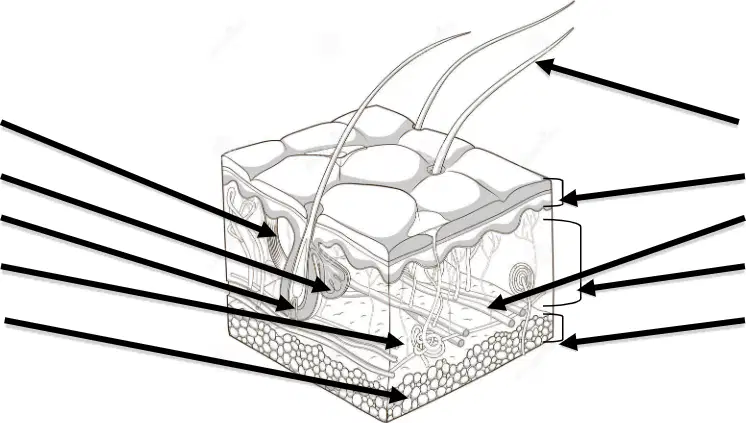
Refer to the diagram of the skin. Which letter(s) represent(s) a sebaceous gland?
B
A
C
D
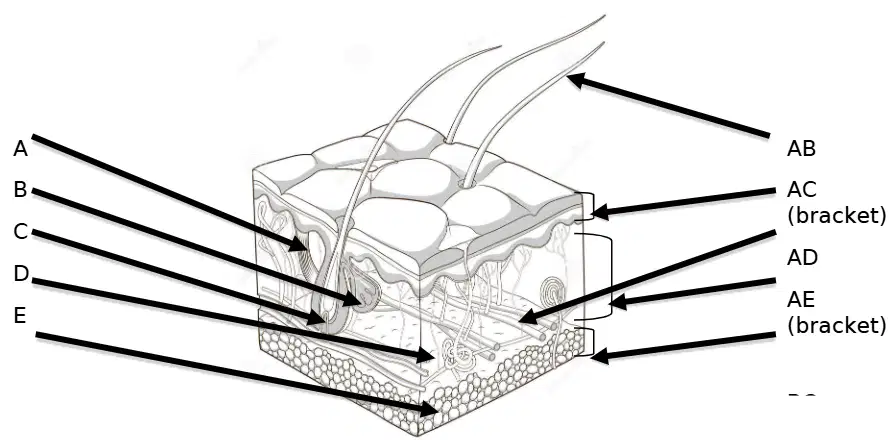
Refer to the diagram of the skin. Which letter(s) represent(s) the hair shaft?
AB
B
AE
D
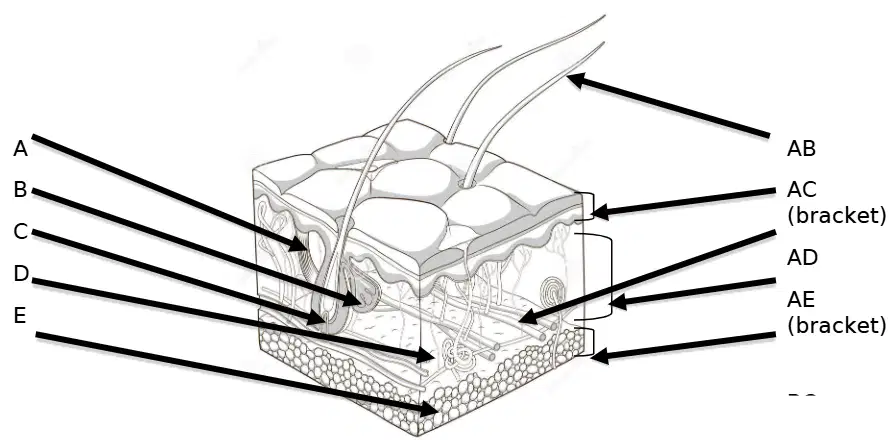
Refer to the diagram of the skin. Which letter(s) represent(s) the arrector pili muscle?
C
A
B
D
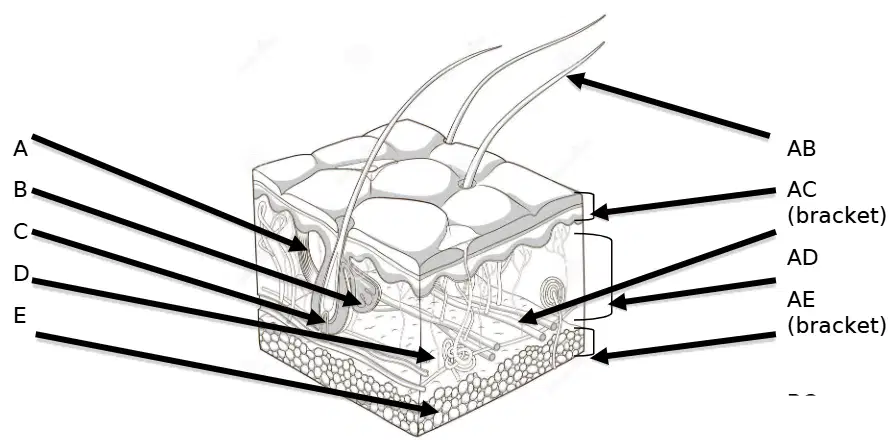
Refer to the diagram of the skin. Which letter(s) represent(s) the hypodermis?
AE
A
B
C
Toenails grow at the same rate as fingernails.
True
False
Blood vessels run up into the epidermis.
True
False
Only identical twins have the same fingerprints.
True
False
The correct order of the epidermal layers, from deepest to most superficial, is stratum basale, stratum spinosum, stratum granulosum, stratum lucidum, and stratum corneum.
True
False
Which of the following is not true about skin?
Produces melanin to protect skin from the ultraviolet rays of the sun
Makes vitamin E
Protects the underlying tissue by acting as a "shock absorber"
Partially composed of dead cells
The layer of the epidermis that is constantly undergoing cell division (mitosis) is called the
Dermal papillae
Stratum basale
Stratum corneum
Subcutaneous layer
The root of the nail lies in a groove and is hidden by a fold of skin called the
Cuticle
Nail bed
Lunula
Nail body
Which part of the skin senses pressure, pain, and heat?
blood vessels
hair
nerves
sebaceous glands
What are the opening where sweat leaves the skin called?
follicles
pores
channels
whiteheads
What is another word for sweat?
condensation
transpiration
perspiration
respiration
Which layer of the skin contains nerve endings?
hypodermis
epidermis
dermis
What do blood vessels bring to the skin?
sweat
oxygen and nutrients
collagen
As a person ages,
the skin dries and wrinkles form.
collagen and elastin fibers increase.
pigment cells in hair follicles increase.
sweat glands become more active.
The key factor when it comes to the quantity of melanin made is
the number of melanocytes
genetics
blood flow
all of the above
Freckles and moles result when
melanocytes reproduce
you have an allergy
anemia sets in
melanin accumulates in the skin
Milky white sweat with an odor likely developed in the
axillary region
genital region
manus region
a and b
all
Tattoos and stretch marks form in the
epidermis
hypodermis
dermis
Which layer of skin helps insulate the body?
epidermis
hypodermis
dermis
Redness, or erythema, of the skin may be due to
allergy
hypertension
fever
embarrassment
all
Fill in the blank: The pigment responsible for skin color is ________.
Melanin
Keratin
Hemoglobin
Chlorophyll
Fill in the blank: The hair is composed of ________.
Both a and b (root and shaft; keratin and living cells)
Only water and minerals
Cartilage and bone
Blood and nerves
Fill in the blank: Eyelashes and eyebrows help in ________.
Keeping particles out of the body
Hearing better
Digesting food
Growing hair faster
Fill in the blank: Eccrine glands are the most numerous sweat glands on the body and ________.
empty into pores
empty into hair follicles
produce sebum
are only found on the scalp
Fill in the blank: The integumentary system includes ________.
Skin, nails, hair follicles, and exocrine glands
Bones, muscles, and tendons
Heart, blood, and blood vessels
Lungs, trachea, and bronchi
Fill in the blank: As epidermal cells move up, ________.
They keratinize and eventually die
They become more flexible and divide rapidly
They absorb more nutrients and grow larger
They transform into nerve cells
Fill in the blank: The functions of the skin include ________.
All of these
Only protection from UV rays
Only temperature regulation
Only sensation
Fill in the blank: A burn that affects both the epidermis and dermis is called a ________.
Second-degree burn
First-degree burn
Third-degree burn
Thermal burn
Fill in the blank: The unique patterns on our fingers are called ________.
Fingerprints
Footprints
Handprints
Palm lines
Fill in the blank: The protein that gives skin its strength is ________.
Keratin
Collagen
Elastin
Myosin
Fill in the blank: A localized collection of blood outside the blood vessels is called a ________.
Hematoma
Edema
Embolism
Aneurysm
Fill in the blank: The base of the hair follicle is called the ________.
Hair bulb
Hair shaft
Sebaceous gland
Arrector pili muscle
Fill in the blank: ________ helps in keeping skin and hair moisturized.
Sebum
Keratin
Melanin
Collagen
Fill in the blank: The clear layer of the epidermis found only in thick skin is the ________.
Stratum lucidum
Stratum corneum
Stratum granulosum
Stratum spinosum
Fill in the blank: The tissue that stores fat is called ________.
Adipose (fatty) tissue
Cartilage tissue
Muscle tissue
Nervous tissue
Fill in the blank: The deeper layer of the dermis is called the ________.
Reticular layer
Papillary layer
Epidermal layer
Subcutaneous layer
Fill in the blank: The thick layer of skin beneath the epidermis is the ________.
Dermis
Epidermis
Hypodermis
Stratum corneum
Fill in the blank: The thickest skin is found on the ________.
Soles of the feet
Eyelids
Back of the hand
Scalp
Fill in the blank: The glands responsible for sweat production are ________.
Sebaceous and apocrine sweat glands
Sebaceous glands only
Endocrine glands
Lymph glands
Fill in the blank: The oily substance that lubricates the skin and hair is called ________.
Sebum
Keratin
Collagen
Melanin
Toenails grow more slowly.
True
False
A yellowing of the skin can be a sign of a liver disorder or vitamin D deficiency. This is known as
erythema
pallor
hematoma
jaundice