wayground logo

Free Printable Worksheets

Font size

S
M
L
XL
Worksheets

PRE AP QUIZ 2-STATES, PROPERTIES, CHANGES

Total questions: 20

Worksheet time: 11mins

Name
Class
Date
1.
Which of the following is a Physical Property?
a)
Flammability
b)
Color
2.
Which of the following describes an intensive physical properties of the substance shown?
a)
Mass of 25 grams
b)
Volume of 15 mL
c)
Melting point of 115 degrees celcius
3.
Which of the following is an example of an intensive property? (does NOT depend on the amount)
a)
Mass
b)
Density
c)
Volume
d)
Length
4.
Which of the following is a Chemical Property?
a)
Ability to oxidize
b)
Freezing point
5.
What of the following represents a Chemical Change?
a)
Shredding Cheese
b)
Dissolving Sugar
c)
Boiling Water
d)
Iron Rusting
6.
Is Burning of Wood a physical or chemical change?
a)
Physical Change
b)
Chemical Change
7.
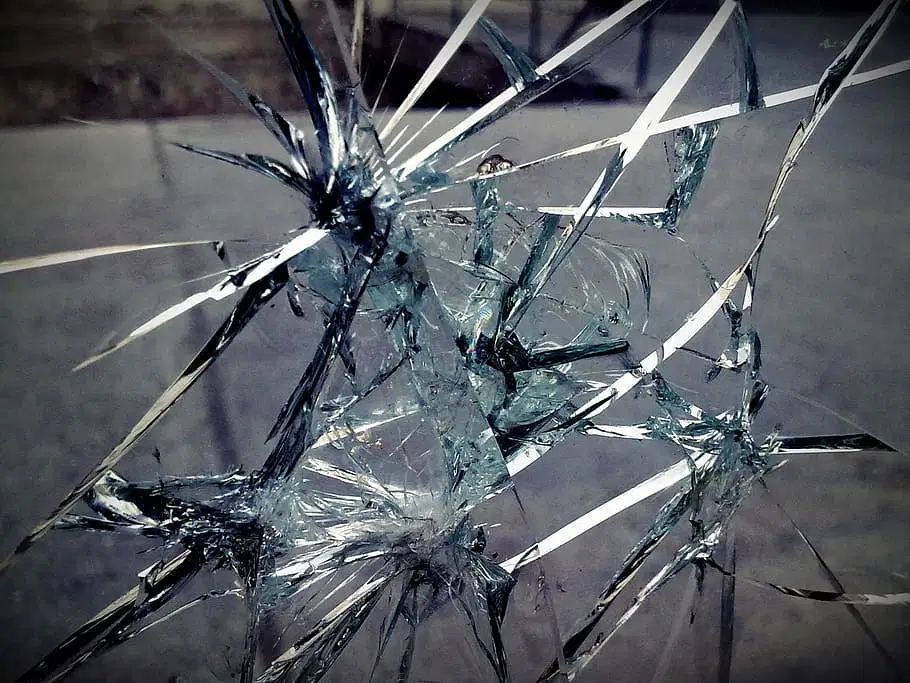
Is the Breaking of Glass a physical or chemical change?
a)
Chemical Change
b)
Physical Change
8.
During an investigation, a student combined the two clear, colorless solutions shown below. The student observed that the temperature changed from 25° C to 23° C when the solutions were combined and that a yellow solid substance rapidly formed and settled to the bottom of the container. What most likely happened to produce these results?
a)
One of the original compounds came out of solution.
b)
The solutions reacted chemically.
c)
Some of the water froze into ice crystals.
d)
Rapid evaporation of water occurred, leaving a solid.
9.
Which of the following is an example of an extensive property? (does depend on the amount)
a)
Mass
b)
Density
c)
Color
d)
Odor
10.
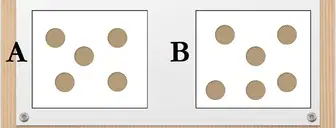
Which particle diagram shows a more dense substance?
a)
A
b)
B
11.
Density is an intensive physical property because.....
a)
It depends on the amount
b)
It does not depend on the amount
12.
Why did the dish soap sink under the water?
a)
Dish soap is the same density as water
b)
Dish soap is less dense than water
c)
Dish soap is more dense than water
d)
Dish soap is yellower than water
13.
A sample of iron has a mass of 200 grams and a volume of 25.4 cm3. What is its density? (formula: D=m/v)
a)
0.04 rounded to 1 sig fig
b)
0.039 rounded to 2 sig figs
c)
7.9 rounded to 2 sig figs
d)
8 rounded to 1 sig fig
14.
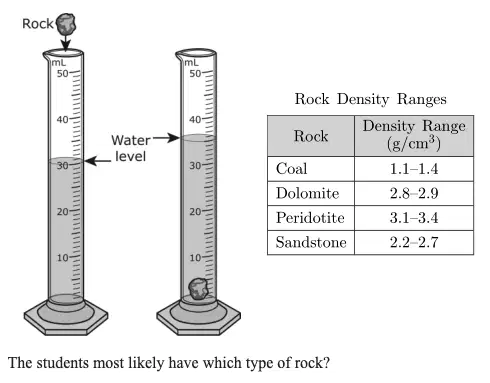
The mass of an unidentified rock is 15.5 grams. Students determine the volume of the rock by placing the rock in a cylinder with water. The students calculate the density of the rock. They determine the identity of the rock based on the density ranges in the table.The students most likely have which type of rock?
a)
Coal
b)
Dolomite
c)
Peridotite
d)
Sandstone
15.
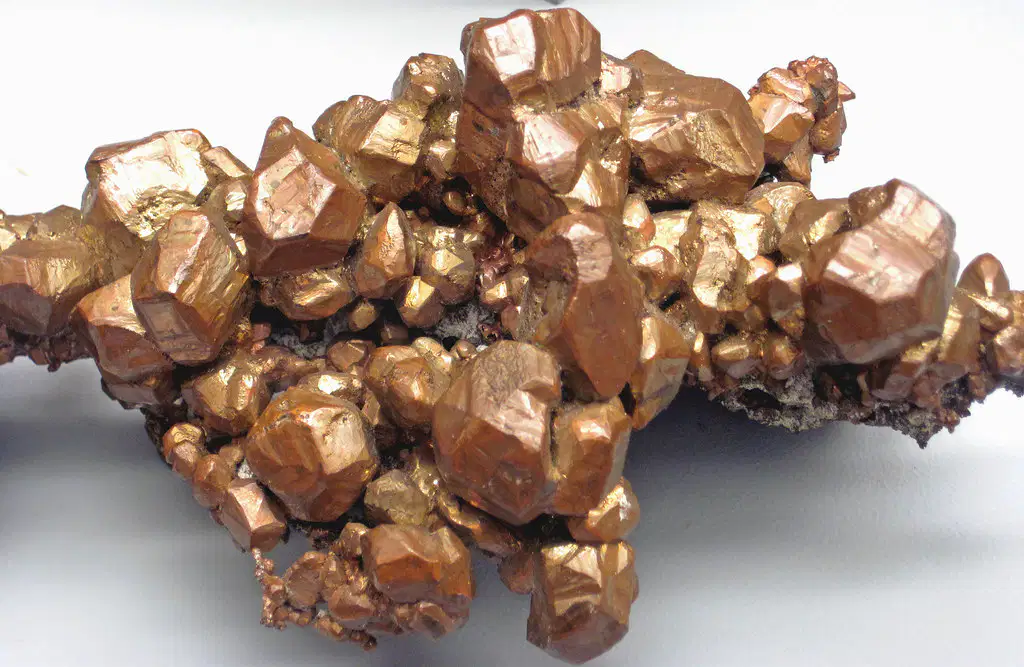
A sample of copper has a mass of 250 grams and is said to have a density of 8.96 g/mL. What is the volume of this sample of copper? (formula: D=m/v)
a)
30 mL rounded to 1 sig fig
b)
28 mL rounded to 2 sig figs
c)
0.04 mL rounded to 1 sig fig
d)
0.036 mL rounded to 2 sig figs
16.

A substance with particles that vibrate but stay in the same position is a ___.

a)

solid

b)

liquid

c)

gas

d)

plasma

17.

Of the 3 states listed below, which has the fasted moving particles?

a)

solid

b)

liquid

c)

gas

18.

The diagram to the left represents particles in a gas. (The length of the arrow represent the amount of particle energy.) Which of the diagrams below best represents the particles after the gas is heated?

a)
b)
c)
d)
19.

Before mixing sugar into hot tea, a student recorded the observations

shown in the table. Which physical property of the sugar will stay the same after the

sugar is mixed with the hot tea?

a)

Color

b)

Texture

c)

Mass

d)

Shape

20.

The diagram represents four liquids that each has a different density. Which statement best describes the density of Layer C?

a)

Layer C is more dense than Layer A and Less dense than Layer B.

b)

Layer C is more dense than Layer B and less dense than Layer D.

c)

Layer C is more dense than Layer B and less dense than Layer A.

d)

Layer C is more dense than Layer D and less dense than Layer B.