NEW
Font size
 Worksheets
Continental Drift and Seafloor Spreading
Total questions: 21
Worksheet time: 14mins
What is the name of the large supercontinent that once existed?
Gondwanaland
Laurasia
Eurasia
Pangea
Why did other scientists have a hard time believing Wegener's theory of continental drift?
He could not explain how the continents moved
He didn't have enough evidence
His evidence was wrong
He didn't use the right technology to gather data
The Appalachian Mountains in the U.S. match up with a similar mountain range in Northern Europe. How does this support Wegener's theory of Continental Drift?
The similarities provide evidence that North America and Europe were connected when the mountains formed.
The similarities show that the continents must have been closer to the equator at some point in time.
This does not provide any evidence to support his theory.
Which of the following has been used as evidence to support CDT?
constellations
mountain ranges on different continents with similar rocks
ocean currents
meteorites

What is the name of the process shown in this diagram?
Continental Drift
plate tectonics
seafloor spreading
Big Bang theory

According to the continental drift hypothesis, the presence of similar fossils in South America and Africa supports which scientific idea?
Animals easily and frequently travel from Africa to South America.
Species of animals probably traveled between continents on natural rafts (such as trees destroyed in tsunamis).
Land bridges once existed that connected the continents.
South America and Africa were once connected together.
Process by which new ocean crust forms.
Seafloor spreading
Continental drift
Mid-ocean ridge
Rift
What is it called when the ocean floor sinks beneath a deep-ocean trench?
Mid-Ocean Ridge
Deep-Ocean Trench
Sea-Floor Spreading
Subduction
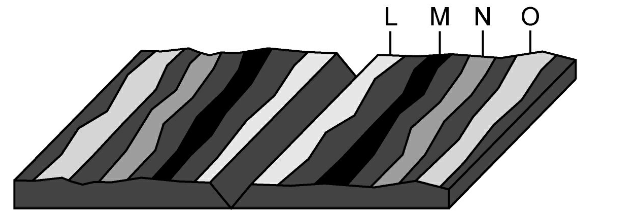
Magnetic Striping

What words describe M? choose all
Tectonic plates
Mid-ocean ridge
Subduction
Seafloor spreading

What feature is at C?
Subduction
Seafloor spreading
Deep ocean trench
Alfred Wegener
What is the process happening at R?
Subduction
Sea floor spreading
Mid ocean ridge
Sonar