
NEW
Font size
S
M
L
XL
 Worksheets
Balanced & Unbalanced Forces
Total questions: 10
Worksheet time: 15mins
Name
Class
Date
1.
(SC.6.P.13.3) During the car ride home from school, Peter explained to his father what he learned about motion in class that day. He predicted to his father that they would experience negative acceleration before they arrived home. When did Peter and his father experience negative acceleration?
a)
when they approached a stop sign
b)
when they passed another car
c)
when they filled the car up with gas
d)
when they drove out of the school parking lot onto the road
2.
(SC.6.P.13.3) At baseball practice, Takahiro and Alfredo both picked up the same bat and neither would let go until one of them had it for himself. Takahiro pulled the bat with a force of 15 newtons (N), while Alfredo pulled with a force of 20 newtons (N). Why did Alfredo end up with the bat?
a)
because the net force was 20 N in Alfredo’s direction.
b)
because the net force was 15 N in Takahiro’s direction.
c)
because the net force was 5 N in Alfredo’s direction.
d)
because the force was 5 N in Takahiro’s direction.
3.
(SC.6.P.13.3) Becky asked her classmate Manuel to help her move a table to the other side of the classroom. Becky pushed the table with a force of 20 newtons (N) and Manuel pulled the table with a force of 25 N. What was the net force acting on the table?
a)
45 N
b)
25 N
c)
5 N
d)
20 N
4.
(SC.6.P.13.3) Which of the following must happen in order to determine the force acting on an object that is being lifted by a pulley?
a)
All the forces acting on the object must be measured.
b)
Only the forces pulling upward must be measured.
c)
Gravitational force must be ignored.
d)
Only the distance over which the object is lifted by the pulley must be measured.
5.
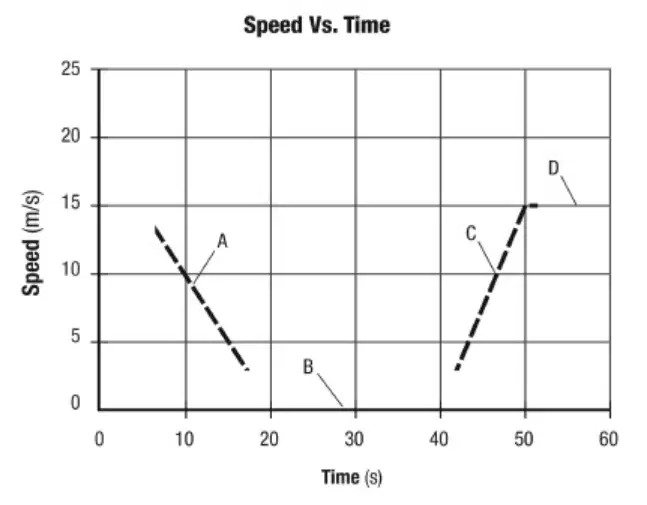
(SC.6.P.13.3) The graph below plots the speed of a moving object versus time.
Which letters on the graph indicate time periods when the object was changing speed?
a)
A and C
b)
A and B
c)
B and D
d)
B and C
6.
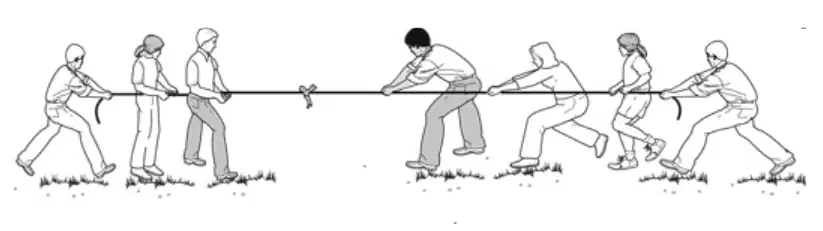
(SC.6.P.13.3) Force can change the speed or direction of motion of an object, or sometimes both. The illustration below shows a game of tug-of-war between two teams of students.
The team of students on the right won the contest. What force helped the winning team?
a)
gravitational force
b)
a balanced force
c)
and electrical force
d)
and unbalanced force
7.
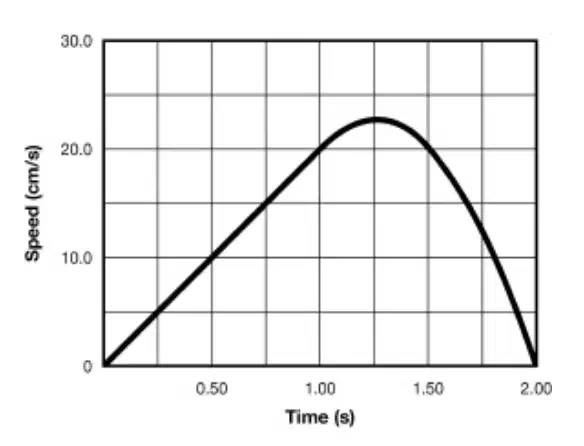
(SC.6.P.13.3) Manuel determined the speed of a moving object over time while applying an unbalanced force to the object. Manuel plotted the results of his measurements on the graph shown below.
When did the moving object begin to display negative acceleration?
a)
at 1.00 s
b)
at 2.00 s
c)
at 0.50 s
d)
at 1.25 s
8.
(SC.6.P.13.3) An unbalanced force will affect the motion of an object. Which of the following is the result of an unbalanced force?
a)
An object moves at a constant speed.
b)
An object has no acceleration.
c)
An object increases in mass.
d)
An object changes direction of motion.
9.
(SC.6.P.13.3) An unbalanced force on an object can change its direction. Which of the following set of conditions would cause an object to move upward?
N is the unit for force in newtons, and "up" or "down" indicates the direction of the force.
a)
25 N down and 20 N up
b)
30 N up and 35 N down
c)
35 N up and 30 N down
d)
20 N down and 20 N up
10.
(SC.6.P.13.3) The forces acting on an object can either be balanced or unbalanced. If an unbalanced force is applied to an object, what might happen to the object?
a)
neither the speed or direction of the object might change
b)
only the speed of the object might change
c)
only the direction of the object might change
d)
both the speed and direction of the object might change
Reset

