wayground logo

Free Printable Worksheets

Font size

S
M
L
XL
Worksheets

Year 8 Volcanoes

Total questions: 92

Worksheet time: 1hrs 16mins

Name
Class
Date
1.

Magma is...

a)

molten rock above the earth's surface

b)

molten rock in the ocean

c)

molten rock beneath the earth's surface

2.

lava is...

a)

molten rock above the earth's surface

b)

molten rock below the earth's surface

c)

molten rock in the center of the earth

3.

Most volcanoes are located...

a)

in the middle of the United States

b)

at the edges of the tectonic plates

c)

on Mars

4.

The biggest volcano is located...

a)

on Mars

b)

on Earth

c)

on Jupiter

5.

Some benefits of volcanic eruptions include (pick all that apply)

a)

new land formations

b)

new ocean marine life

c)

fertilized soil

6.

What are some problems that volcanic eruptions cause? (select all that apply)

a)

earthquakes

b)

mudslides

c)

floods

d)

avalanches

7.

Which volcano type has a gentle slope and gentle eruptions that last a long time?

a)

Cinder cone volcanoes

b)

Shield volcanoes

c)

Composite4 volcanoes

8.

Which volcano has steep slopes and the lava flows through a single vent?

a)

Composite volcanoe

b)

Shield volcano

c)

Cinder Cone volcano

9.

This type of volcano has steep slopes, has explosive eruptions of gas and ash. Most volcanoes are this type.

a)

Composite volcano

b)

Shield volcano

c)

Cinder Cone volcano

d)

Ash volcanoe

10.

All volcanoes that were made for the lab were...

a)

Active volcanoes

b)

Dormant volcanoes

c)

Extinct volcanoes

11.
What is the opening in Earth's crust through which molten rock, gases, and ash erupt?
a)
Divergent Boundary
b)
Magma
c)
Subduction Boundary
d)
Volcano
12.
What is molten rock that has formed deep within the Earth?
a)
Hot Spot
b)
Magma
c)
Lava
d)
Volcano
13.
Why does magma tend to rise to the surface?
a)
It has large amounts of silica.
b)
It contains very little silica.
c)
It is denser than the surrounding material.
d)
It is less dense than the surrounding material.
14.

The formation of magma depends on which set of conditions?

a)

Pressure, Density, and Water Content

b)

Temperature, Density, and Pressure

c)

Temperature, Density, and Water Content

d)

Temperature, Dissolved Gases, and Water Content

15.
The volcanoes on the Hawaiian Islands form due to which of the following?
a)
Divergent Boundary
b)
Hot Spot
c)
Subduction Boundary
d)
Transform Boundary
16.
What is the principal ingredient to all types of magma?
a)
Iron
b)
Magnesium
c)
Silica
d)
Water
17.
Which type of magma has the lowest amount of silica content?
a)
Andesitic Magma
b)
Basaltic Magma
c)
Rhyolitic Magma
d)
Viscous Lava
18.
What is the resistance of a liquid, such as lava, to flow?
a)
Elasticity
b)
Pyroclasticity
c)
Silica
d)
Viscosity
19.
What are solid rock fragments that are ejected during a volcanic eruption?
a)

Lahar

b)
Magma
c)
Pyroclastic Material
d)
Silica
20.

What type of volcano is Moana Loa, which is located in Hawaii?

a)

Caldera

b)

Cinder Cone

c)

Composite Volcano

d)

Shield Volcano

21.
Where are most volcanoes found?
a)
Southern Hemisphere
b)
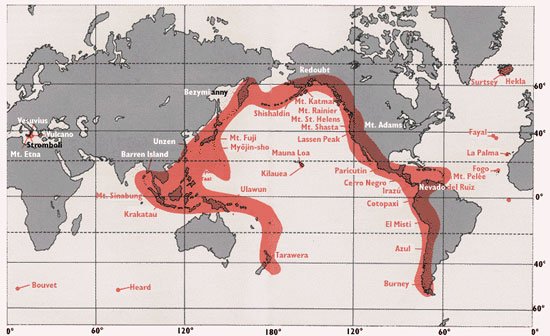
Ring of Fire
c)
Mid-Atlantic Ridge
d)
Hot Spots
22.
What kind of magma produces violent volcanic eruptions?
a)
Magma low in silica
b)
Magma that is fluid, and runny
c)
Magma that is high in gas content
d)
Magma rich in iron
23.
What type of volcano is Mount St. Helens?
a)
Caldera
b)
Cinder Cone
c)
Composite Volcano
d)
Shield Volcano
24.
What do you call a large crater formed by the collapse of a volcano?
a)
Caldera
b)
Cinder Cone
c)
Composite Volcano
d)
Shield Volcano
25.
Where do volcanoes come from?
a)
Places where plates move apart
b)
Places where plates are moving together
c)
Hot Spots
d)
All of these options
26.
What factor(s) determine(s) whether an eruption will be explosive?
a)
The amount of gases in the magma
b)
The amount of silica in the magma
c)
The amount of gas and silica in the magma
d)
None of these affect the explosiveness of the volcano
27.
Which volcanic eruption was an example of pyroclastic flow?
a)
Mount Vesuvius buried the Roman city of Pompeii.
b)
Kilauea is currently forming the Hawaiian Islands.
c)
The Columbia Plateau was formed in parts of Washington, Oregon, and Hawaii.
d)
Mauna Loa is a shield volcano that was formed on Hawaii.
28.

Which type of volcano is Yellowstone in Wyoming?

a)

Caldera

b)

Cinder Cone

c)

Composite Volcano

d)

Shield Volcano

29.

Which type of volcano is Mount Tabor in Oregon?

a)

Caldera

b)

Cinder Cone

c)

Composite Volcano

d)

Shield Volcano

30.

What type of volcano is Mount St. Helens in Washington?

a)

Caldera

b)

Cinder Cone

c)

Composite Volcano

d)

Shield Volcano

31.

molten rock that comes from a volcano

a)

lava

b)

layers

c)

magma

d)

explosion

32.

molten rock beneath the earth's crust

a)

volcano

b)

lava

c)

magma

d)

explosion

33.

a cone-shaped hill made of ash and rock particles around the vent of a volcano

a)

cinder cone volcano

b)

shield volcano

c)

stratovolcano

34.

a gently-sloping volcano formed when runny lava spreads out over a large area

a)

cinder cone volcano

b)

shield volcano

c)

stratovolcano

35.

a steep-sided, cone-shaped volcano made of alternating layers of ash and lava

a)

shield volcano

b)

stratovolcano

c)

cinder cone volcano

36.

the place on Earth's surface where there are clusters of volcanic activity

a)

volcanic field

b)

volcanic region

c)

magma chamber

d)

vent

37.

a volcano that is currently erupting or is expected to erupt

a)

extinct volcano

b)

active volcano

c)

dormant volcano

38.

a volcano that is currently not erupting, but has erupted in the past and is likely to erupt in the future

a)

active volcano

b)

extinct volcano

c)

dormant volcano

39.

a volcano that is not currently active and is not likely to erupt again

a)

active volcano

b)

dormant volcano

c)

extinct volcano

40.

a pocket where magma collects beneath Earth's surface

a)

magma chamber

b)

vent

c)

magma pocket

d)

crater

41.

a pipe-like channel through which magma travels from a magma chamber to Earth's surface

a)

vent

b)

magma chamber

c)

magma pipe

d)

magma channel

42.

a bowl-like depression at the top of a volcanic structure where the vent ends

a)

summit crater

b)

crater

c)

magma chamber

d)

vent bowl

43.

a large-bowl shaped depression formed by the collapse of part of a volcano

a)

caldera

b)

summit crater

c)

vent

d)

magma chamber

44.

the release of material from under Earth's crust to its surface

a)

volcanic eruption

b)

Earth eruption

c)

Earth explosion

d)

volcanic motion

45.

a thick, rapidly moving, deadly, gaseous cloud produced by a volcano

a)

nuee ardente

b)

death cloud

c)

volcanic cloud

d)

gas cloud

46.

any particle ejected by a volcano that is less than 2 mm across

a)

volcanic ash

b)

volcanic particles

c)

dust particles

47.

places in the middle of plates where very hot plumes of magma rise for a short time, forming volcanoes

a)

hot spots

b)

volcanic spots

c)

plume locations

48.

magma that rises toward the surface but cools and hardens below Earth's surface before it breaks through

a)

igneous intrusion

b)

hot spots

c)

igneous rock

49.

a rock that has solidified from molten or partly molten materials

a)

igneous rock

b)

sedimentary rock

c)

metamorphic rock

50.

particles of solid material that have been moved from their place of origin by wind, moving water, or glacier ice and deposited on a surface

a)

sediment

b)

magma

c)

lava

d)

dust

51.

rock formed from small particles of rock or pieces of once-living things

a)

sedimentary rock

b)

igneous rock

c)

metamorphic rock

52.

rock formed by heat and pressure from another kind of rock

a)

metamorphic rock

b)

sedimentary rock

c)

igneous rock

53.

What type of volcano is this?

a)

cinder cone volcano

b)

stratovolcano

c)

shield volcano

54.

What type of volcano is this?

a)

cinder cone

b)

shield

c)

stratovolcano

55.

What type of volcano is this?

a)

cinder cone

b)

stratovolcano

c)

shield volcano

56.
What is molten rock that has formed deep within the Earth?
a)
Hot Spot
b)
Magma
c)
Lava
d)
Volcano
57.
What is molten rock that has reached the Earth's surface?
a)
Aa
b)
Lava
c)
Magma
d)
Pahoehoe
58.
What factor(s) determine(s) whether an eruption will be explosive?
a)
The amount of gases in the magma
b)
The amount of silica in the magma
c)
The amount of gas and silica in the magma
d)
None of these affect the explosiveness of the volcano
59.
Where are most volcanoes found?
a)
Southern Hemisphere
b)
Ring of Fire
c)
Mid-Atlantic Ridge
d)
Hot Spots
60.
What is / are sign(s) that a volcano may erupt soon?
a)
Earthquake activity in the area
b)
Changes in the shape of the volcano
c)
Different amounts of gas being produced
d)
All of these are signs
61.

What type of volcano has steep slopes made of alternating layers of ash and silica rich lava?

a)

Caldera

b)

Cinder Cone

c)

Stratovolcano

d)

Shield Volcano

62.
What type of volcano is Kilauea, which is located in Hawaii?
a)
Caldera
b)
Cinder Cone
c)
Composite Volcano
d)
Shield Volcano
63.
What is the definition of dormant?
a)
sleeping
b)
extinct
c)
active
d)
invisible
64.

What type of volcano is Mt. St. Helens?

a)

shield

b)

stratovolcano

c)

cinder cone

d)

active

65.
A live volcano
a)
Dormant volcano
b)
Active volcano
c)
Extinct volcano
d)
Shield volcano
66.
Wide gentle sloping mountain from lava pouring out of the vent and hardens on top of previous layers
a)
Earthquake
b)
Cinder cone volcano
c)
Composite volcano
d)
Shield volcano
67.
A dead volcano, one that is unlikely to erupt again
a)
Dormant volcano
b)
Extinct volcano
c)
Shield volcano
d)
Caldera
68.
Volcanoes that have not erupted for at least 10,000 years are described as...
a)
Sleeping
b)
Dormant
c)
Active
d)
Extinct
69.
This is the name for the chain of volcanos around the edge of the Pacific Plate.
a)
Circle of Fire
b)
Ring of Lava
c)
Ring of Fire
d)
Circle of Magma
70.
When an explosive eruption  forms a mixture of hot rock, ash, and gas, this material is called a...?
a)
Land slide
b)
Lava
c)
Eruption trail
d)
Pyroclastic flow
71.
The volcanoes on the Hawaiian Islands form due to which of the following?
a)
Divergent Boundary
b)
Hot Spot
c)
Subduction Boundary
d)
Transform Boundary
72.
What is the principal ingredient to all types of magma?
a)
Iron
b)
Magnesium
c)
Silica
d)
Water
73.

A volcano that has lava that is low in silica will...

a)

is thick and will plug the vent

b)

be runny and run far from the vent

c)

never erupt

74.
If a volcano's magma is high in silicia, the volcano will probably
a)
erupt quietly
b)
remain dormant
c)
erupt explosively
d)
produce dark color lava
75.
The main hazard from a quiet volcanic eruption is 
a)
volcanic bombs
b)
lava flows
c)
volcanic cinders
d)
volcanic ash
76.
When many layers of thin, runny lava build up a high, level area, the result is a 
a)
lava plateau
b)
shield volcano
c)
cinder cone volcano
d)
composite volcano
77.
Which planet has shield volcanoes and lava flows similiar to those on Earth?
a)
Jupiter
b)
Venus
c)
Mercury
d)
Neptune
78.
The huge hole left by the collapse of a volcanic mountain is called a 
a)
lava plateau
b)
caldera
c)
cinder cone
d)
shield volcano
79.
If geologists detect many small earthquakes in the area near a volcano, what can they infer about the volcano?
a)
It is dormant
b)
It is probably about to erupt
c)
It is extinct
d)
It is a good source of geothermal energy
80.
When ash, cinders, and bombs build up in a steep pile around a volcano's vent, the result is a 
a)
cinder cone volcano
b)
shield volcano
c)
composite volcano
d)
dormant volcano
81.
Which of the following helps to determine how easily magma flows?
a)
the amount of silica in the magma
b)
the diameter of the pipe
c)
the size of the crater
d)
the number of vents on the volcano
82.

The main hazard from an explosive volcanic eruption is

a)

Volcanic bombs

b)

Lava flows

c)

Pyroclastic Flow

d)

Volcanic ash

83.

What can be more dangerous than lava?

a)

magma

b)

ash cloud

c)

vent

d)

spiders

84.

What is the difference between lava and magma?

a)

Lava is inside the volcano and magma is out of the volcano.

b)

Lava and magma are liquid rock.

c)

Lava is outside of the volcano and magma is inside of the volcano.

d)

Lava and magma are really hot.

85.

How is a volcano formed?

a)

It is a landform.

b)

Tectonic plates

c)

The lava gets really hot and makes a volcano.

d)

Green plates

86.

What is found inside of an ash cloud?

a)

rock, hot gas and lava

b)

ash, rock and magma

c)

rock, hot gas and water

d)

rock, hot gas and ash

87.

What kind of volcano forms an island?

a)

Submarine volcano

b)

Shield volcano

c)

Stratovolcano

d)

Regular volcano

88.

Shield volcanoes are not dangerous because___________.

a)

They are old.

b)

They are too small.

c)

They are extinct.

d)

It's lava travels very slowly.

89.

What is an active volcano?

a)

A volcano that has recently erupted and will probably erupt again.

b)

A volcano that hasn't erupted in a long time but might erupt again.

c)

A volcano that will never erupt again.

d)

It loves to run and exercise.

90.

What is an extinct volcano?

a)

A volcano that erupted recently and may erupt again soon.

b)

A volcano that will not erupt again.

c)

A volcano that hasn't erupted in a long time but may erupt again.

d)

A volcano that erupts everyday.

91.

The city of Pompeii, Italy was ______________.

a)

really far away.

b)

covered by lava.

c)

covered by an ash cloud.

d)

inside a tomb.

92.

Besides a volcano, what is another type of landform?

a)

apartment building

b)

isthmus

c)

ocean

d)

cloud

Similar Resources on Wayground