wayground logo

Free Printable Worksheets

Font size

S
M
L
XL
Worksheets

Ch 4 Life in the Colonies Quiz

Total questions: 89

Worksheet time: 47mins

Name
Class
Date
1.
What does Benjamin Franklin's story tell us about the possibilities Europeans hoped to find by moving to the American colonies?
a)
The possibility that someone could have access to a printing shop.
b)
The possibility of employment in the newsprint business.
c)
The possibility of becoming a famous poet by writing for almanacs.
d)
The possibility that someone could go from penniless to wealthy.
2.
During the early 1700s, _________ out of 10 people lived on small family farms and were self-sufficient.
a)
9
b)
2
c)
1
d)
3
e)
5
3.
Which statement about education in the colonies is FALSE?
a)
Few places in the Middle and the Southern colonies had public schools.
b)
Religious differences slowed the growth of education in the Middle Colonies.
c)
Puritans supported public education because they wanted their children to be capable of reading the Bible.
d)
Every town in Massachusetts with 50 or more families was required to build a school.
4.
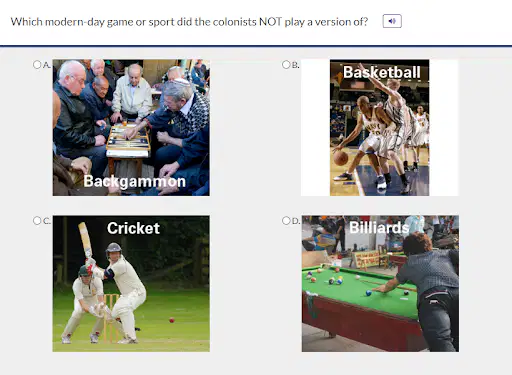
Which modern-day game or sport did the colonists NOT play a version of?
a)
A
b)
B
c)
C
d)
D
5.
Treason
a)
Acts of disloyalty toward the government.
b)
An agreement in 1215 listing the rights granted by King John to all free men of the kingdom.
c)
Robbery at sea.
d)
A revival of religious feeling and belief among Protestant Christians in the American colonies that began in the 1730s.
e)
Powers or privileges that belong to people as citizens and that cannot or should not be taken away by the government.
6.
English Bill of Rights
a)
An act passed by Parliament in 1689 that limited the monarch’s power by giving certain powers to Parliament and listing specific rights of the citizens.
b)
Acts of disloyalty toward the government.
c)
An agreement in 1215 listing the rights granted by King John to all free men of the kingdom.
d)
Robbery at sea.
e)
A revival of religious feeling and belief among Protestant Christians in the American colonies that began in the 1730s.
7.
petition
a)
To make a formal demand or request.
b)
Acts of disloyalty toward the government.
c)
An agreement in 1215 listing the rights granted by King John to all free men of the kingdom.
d)
Robbery at sea.
e)
A revival of religious feeling and belief among Protestant Christians in the American colonies that began in the 1730s.
8.
right
a)
Powers or privileges that belong to people as citizens and that cannot or should not be taken away by the government.
b)
Acts of disloyalty toward the government.
c)
An agreement in 1215 listing the rights granted by King John to all free men of the kingdom.
d)
Robbery at sea.
e)
A revival of religious feeling and belief among Protestant Christians in the American colonies that began in the 1730s.
9.
piracy
a)
Robbery at sea.
b)
Acts of disloyalty toward the government.
c)
An agreement in 1215 listing the rights granted by King John to all free men of the kingdom.
d)
A revival of religious feeling and belief among Protestant Christians in the American colonies that began in the 1730s.
e)
Powers or privileges that belong to people as citizens and that cannot or should not be taken away by the government.
10.
parliament
a)
The lawmaking body of England, consisting of representatives from throughout the kingdom.
b)
Acts of disloyalty toward the government.
c)
An agreement in 1215 listing the rights granted by King John to all free men of the kingdom.
d)
Robbery at sea.
e)
A revival of religious feeling and belief among Protestant Christians in the American colonies that began in the 1730s.
11.
Magna Carta
a)
An agreement in 1215 listing the rights granted by King John to all free men of the kingdom.
b)
Acts of disloyalty toward the government.
c)
Robbery at sea.
d)
A revival of religious feeling and belief among Protestant Christians in the American colonies that began in the 1730s.
e)
Powers or privileges that belong to people as citizens and that cannot or should not be taken away by the government.
12.
Great Awakening
a)
A revival of religious feeling and belief among Protestant Christians in the American colonies that began in the 1730s.
b)
Acts of disloyalty toward the government.
c)
An agreement in 1215 listing the rights granted by King John to all free men of the kingdom.
d)
Robbery at sea.
e)
Powers or privileges that belong to people as citizens and that cannot or should not be taken away by the government.
13.
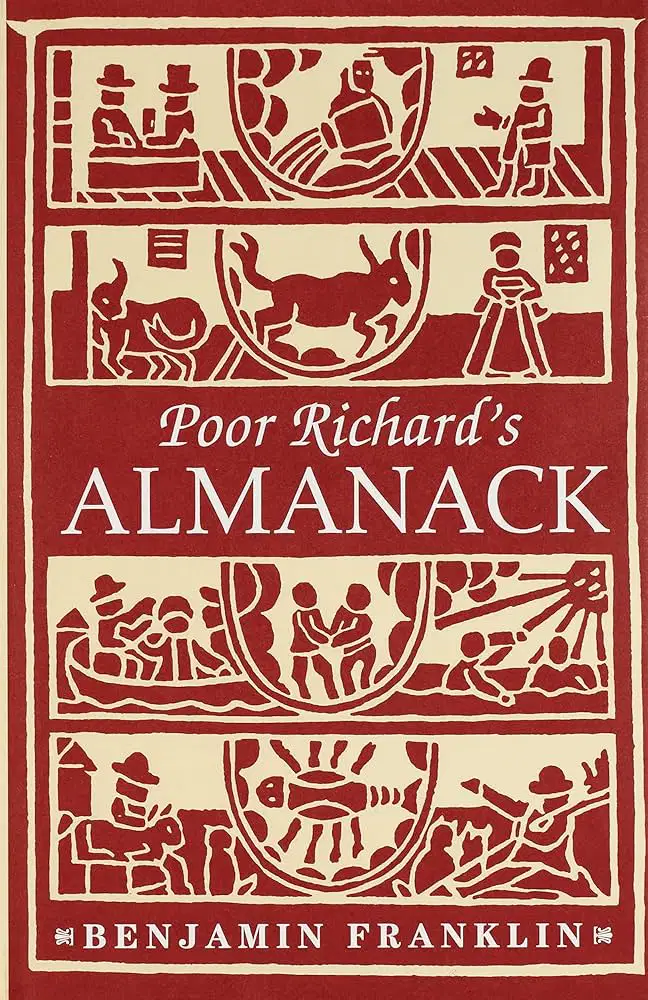
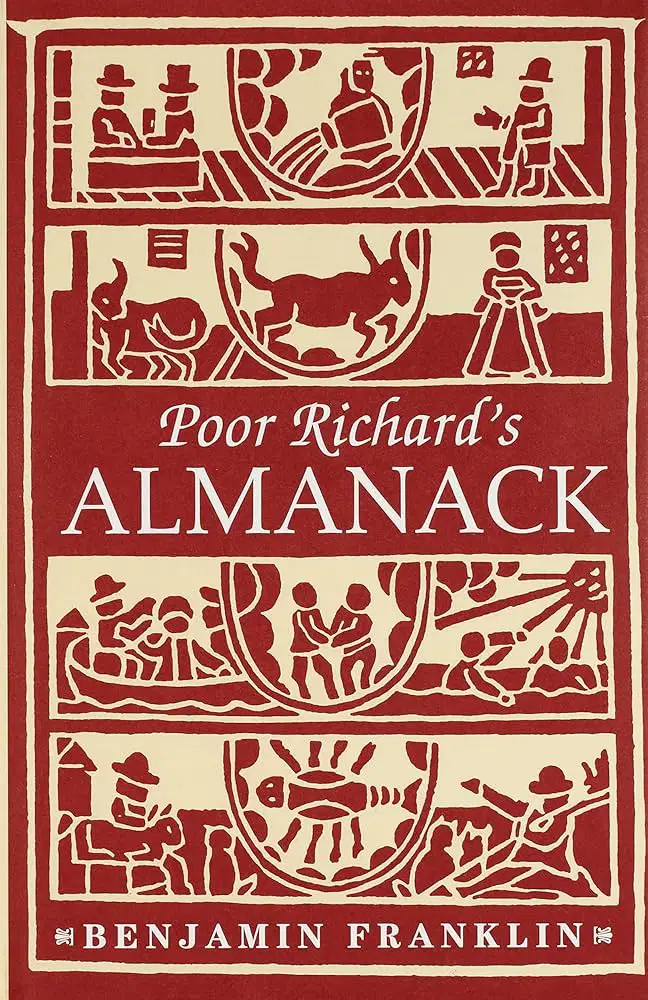
1. Who wrote the book Poor Richard’s Almanac?
a)
A. George Washington
b)
B. Thomas Jefferson
c)
C. Benjamin Franklin
d)
D. John Adams
14.
Where did most people in the colonies live?
a)
A. In cities
b)
B. On farms
c)
C. Near rivers
d)
D. In forts
15.
3. In the year 1750, one colonist out of 20 lived where?
a)
A. On a plantation
b)
B. In the frontier
c)
C. In a city
d)
D. On a ship
16.
4. What were the two largest colonial cities in 1700?
a)
A. Boston and New York
b)
B. Philadelphia and Charleston
c)
C. Williamsburg and Savannah
d)
D. Baltimore and Plymouth
17.
5. In 1215, when King John agreed to sign the _______ _______, or "Great Charter." This agreement established the idea that the ______ of the monarch (ruler) was ______. Not even the ______ was above the law.
a)
A. Magna Carta, power, limited, king
b)
B. English Bill, authority, unlimited, Parliament
c)
C. Royal Decree, rule, final, church
d)
D. Charter of Rights, strength, absolute, ruler
18.
6. Colonists in America considered themselves to be ________ citizens.
a)
A. American
b)
B. French
c)
C. Spanish
d)
D. English
19.
7. What are some examples of serious crimes that were punishable by death?
a)
A. Stealing food and disobeying parents
b)
B. Piracy and murder
c)
C. Lying and gossiping
d)
D. Protesting and voting
20.
8. What is “breaking the Sabbath?” Was it a crime and what would be the punishment?
a)
A. Refusing to pay taxes; punished by exile
b)
B. Working or playing on Sunday; punished by fines or public shaming
c)
C. Attacking a church; punished by death
d)
D. Missing school; punished by whipping
21.
9. Slavery in the colonies began in _____. By the early 1700s, enslaved Africans were ______ in every ______.
a)
A. 1492; freed; town
b)
B. 1607; working; church
c)
C. 1619; living; colony
d)
D. 1700; hiding; plantation
22.
10. Where did most of the enslaved people who were brought to the colonies come from?
a)
A. South America
b)
B. Africa
c)
C. Asia
d)
D. Europe
23.
11. What was an important part of colonial life? What were children brought up to read from cover to cover several times over?
a)
A. History books
b)
B. Maps and charts
c)
C. The Bible
d)
D. Newspapers
24.
12. The Great Awakening had a powerful effect on the colonies because it helped spread the idea of what?
a)
A. Independence from Britain
b)
B. That all people are equal in the eyes of God.
c)
C. Power of Parliament
d)
D. Royal authority in the church
25.
13. Except in New ________, most children in the colonies received little or no formal _________.
a)
A. Jersey; food
b)
B. France; clothing
c)
C. England; education
d)
D. Amsterdam; discipline
26.
14. What was the one book used to teach the alphabet, syllables, and prayers?
a)
A. The Colonial Primer
b)
B. The Bible
c)
C. The Hornbook
d)
D. The New England Primer
27.
15. Colonial families were generally ___ and often had between ____ and ____ children.
a)
A. Large; 7 and 10
b)
B. Small; 2 and 4
c)
C. Wealthy; 10 and 15
d)
D. Poor; 3 and 6
28.
Benjamin Franklin had ___ siblings.
a)
16
b)
6
c)
20
d)
8
29.
16. Although married women in the colonies gave _____ many times, nearly ____ of all children _____ before they reached adulthood.
a)
A. birth; half; married
b)
B. birth; one-fourth; died
c)
C. land; most; left
d)
D. money; none; worked
30.
19. Why did colonists eat a lot of corn, and who taught them?
a)
A. It grew fast and was learned from the French
b)
B. It was cheap and came from Africa
c)
C. It was a cash crop grown by Europeans
d)
D. It was easy to grow and Native Americans taught them
31.
20. How did colonists keep meat from going bad, and what did they do to make old meat taste better?
a)
A. They froze it and added sugar
b)
B. They dried it and soaked it in vinegar
c)
C. They salted and smoked it, and added lots of spices
d)
D. They buried it in cold ground and used honey
32.

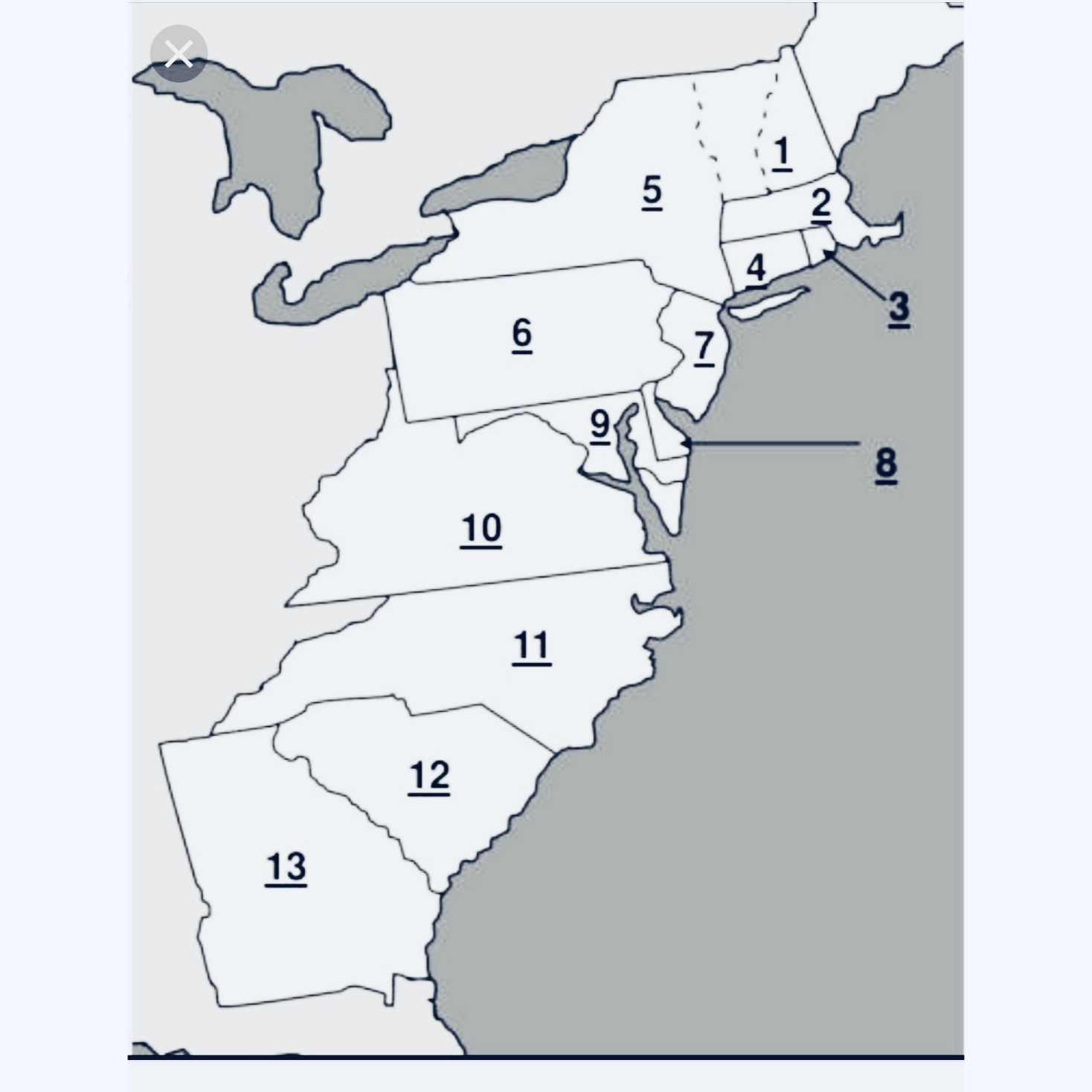
Which colony is number 1?

a)

New Hampshire

b)

Rhode Island

c)

New Jersey

d)

Connecticut

33.

Which colony is number 2?

a)

New Hampshire

b)

Rhode Island

c)

Massachusetts

d)

Connecticut

34.

Which colony is number 3?

a)

New Hampshire

b)

Rhode Island

c)

Massachusetts

d)

Connecticut

35.

Which colony is number 4?

a)

New Hampshire

b)

Rhode Island

c)

Massachusetts

d)

Connecticut

36.

Which colony is number 5?

a)

New York

b)

New Jersey

c)

Massachusetts

d)

Delaware

37.

Which colony is number 6?

a)

New York

b)

Pennsylvania

c)

Massachusetts

d)

Delaware

38.

Which colony is number 7?

a)

New York

b)

New Jersey

c)

Pennsylvania

d)

Delaware

39.

Which colony is number 8?

a)

New York

b)

New Jersey

c)

Pennsylvania

d)

Delaware

40.

Which colony is number 9?

a)

Maryland

b)

South Carolina

c)

Pennsylvania

d)

Virginia

41.

Which colony is number 10?

a)

North Carolina

b)

South Carolina

c)

Georgia

d)

Virginia

42.

Which colony is number 11?

a)

North Carolina

b)

South Carolina

c)

Georgia

d)

Virginia

43.

Which colony is number 12?

a)

North Carolina

b)

South Carolina

c)

Georgia

d)

Virginia

44.

Which colony is number 13?

a)

North Carolina

b)

South Carolina

c)

Georgia

d)

Virginia

45.

Which colonies make up the Mid Atlantic Colonies?

a)

New York

b)

Georgia

c)

Virginia

d)

Pennsylvania

e)

New Jersey

46.

Which colonies make up the New England Colonies?

a)

Massachusetts

b)

New Jersey

c)

New Hampshire

d)

New York

e)

Rhode Island

47.

Which colonies make up the Southern Colonies?

a)

Georgia

b)

South Carolina

c)

Maryland

d)

Virginia

e)

Pennsylvania

48.

While working on a history project, Olivia discovers that a major change occurred for the Native Americans of the Great Plains when a new animal was introduced to their way of life. Who brought horses to the Native Americans of the Great Plains? A. French traders B. Spanish explorers C. British settlers D. Native tribes from the Southwest

a)

A. French traders

b)

B. Spanish explorers

c)

C. British settlers

d)

D. Native tribes from the Southwest

49.

Pick the picture from Spongebob

a)
b)
c)
d)
50.

What show does this pic come from?

a)

Ben 10

b)

Sponge bob

c)

Power Puff Girls

d)

The Amazing World of Gumball

51.

Which is a character from The Amazing World of Gumball?

a)

Darwin

b)

Bubbles

c)

Sandy

d)

Ms. Puff

52.

What character is from Teen Titans Go? (multiple right answers)

a)

Patrick

b)

Robin

c)

Buttercup

d)

Cyborg

53.
Who is this?
a)
Bluto
b)
Olive Oyl
c)
Barnacle Bill
d)
Popeye
54.
Who is this?
a)
Steven Universe
b)
Steven Galaxy
c)
Steven Planet
d)
Steven Earth
55.
What movie is this photo from?
a)
Sleeping & Beauty 
b)
Cinderella
c)
Tangled
d)
Aladdin
56.
What logo is this?
a)
Shell
b)
Google
c)
bp
d)
Marothon
57.
What logo is this?
a)
Olympics
b)
Audi
c)
Microsoft Excel
d)
Apple Works
58.
What logo is this?
a)
NBC
b)
Good Morning America
c)
Google Docs
d)
Google earth
59.
The most sophisticated animal in the world 
a)
elephant
b)
dog 
c)
human
d)
chicken
60.

Let’s guess how many blocks in this tower?

a)

5

b)

7

c)

9

61.

What has to be broken before you can use it?

(a)  

62.

I am not alive but have five fingers. What am I?

a)

clock

b)

shadow

c)

green lights

d)

cane's

e)

glove

63.

Who is this?

a)

George Lopez

b)

Joe Man

c)

Johnny Bravo

64.

What movie is this from ?

a)

Beauty and the Beast

b)

Moana

c)

Princess and the Frog

d)

Frozen

65.
Which country is 1?
a)
England (United Kingdom)
b)
France
c)
Germany
d)
Spain
66.
Which country is 2?
a)
Russia
b)
Poland
c)
Italy
d)
Spain
67.
Which country is 3?
a)
England (United Kingdom)
b)
Italy
c)
France
d)
Spain
68.
Which landform is E?
a)
Alps (Mountains)
b)
Scandinavia (Peninsula)
c)
Mediterannean Sea
d)
Apennines (Mountains)
69.

Which body of water is circled?

a)

Mediterranean Sea

b)

North Sea

c)

Atlantic Ocean

d)

Black Sea

70.

Which body of water is circled?

a)

North Sea

b)

Atlantic Ocean

c)

Mediterranean Sea

d)

Black Sea

71.

Which city is closest to letter A?

a)

Rome

b)

Carthage

c)

Athens

d)

Alexandria

72.

Which continent is identified on this map?

a)

North America

b)

South America

c)

Africa

d)

Asia

73.

Which continent is identified on this map?

a)

North America

b)

Europe

c)

Africa

d)

Asia

74.

Name that country!

a)

Japan

b)

South Korea

c)

Philippines

d)

Russia

75.

Name that country!

a)

Malaysia

b)

Thailand

c)

Philippines

d)

Indonesia

76.

Colonial cities were very small by today's standards. Boston and Philadelphia, the two largest, had fewer than 20,000 people in 1700.


Today, Riverside has over a million people living here.

True or false.

(a)  

77.

__________ craft, shape, and repair metal objects by heating iron or steel in a forge and hammering it into desired forms

a)

cobblers

b)

blacksmiths

c)

alchemists

d)

conductors

e)

miners

78.

Magna Carta means the (a)   Charter.

79.

What was an important part of colonial life?

a)

food

b)

leisure

c)

religion

d)

education

80.

  • Most colonists believed that (a)   needed more education than girls

81.

Many colonists thought (a)   were unhealthy, particularly if eaten raw.

82.

(a)   was a favorite food for many colonists.
83.

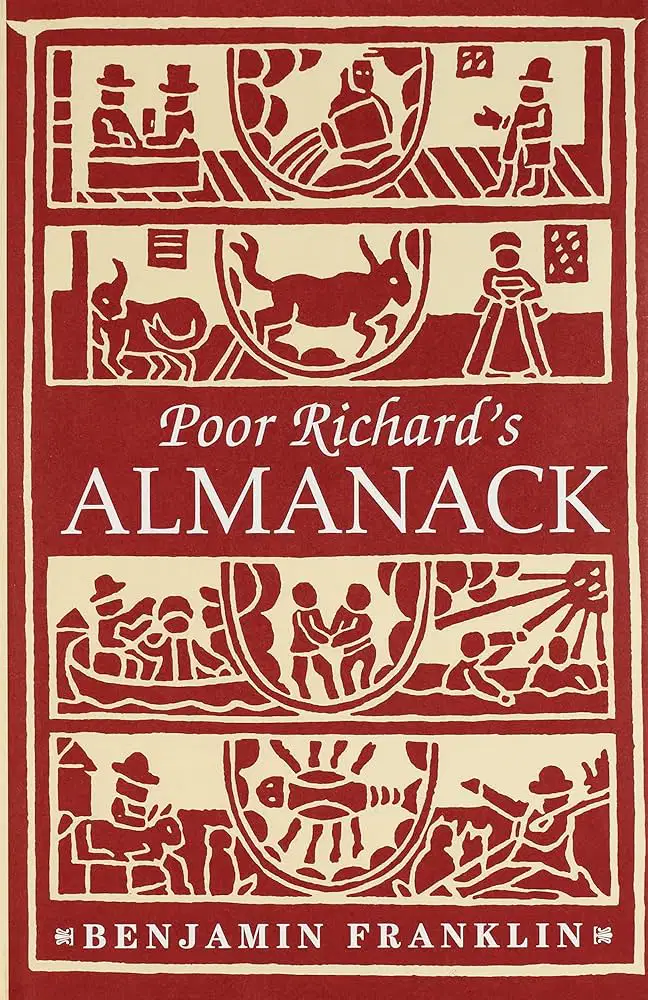
Nobody knew that the author and printer were the same person.

Benjamin Franklin and (a)   Saunders

84.

“Early to bed, early to rise, makes a man healthy, wealthy, and (a)   .

85.

“A Penny saved is a penny (a)   .”


86.

“Poor Richard’s Almanac” sold so well that Franklin was able to retire at (a)   .

87.
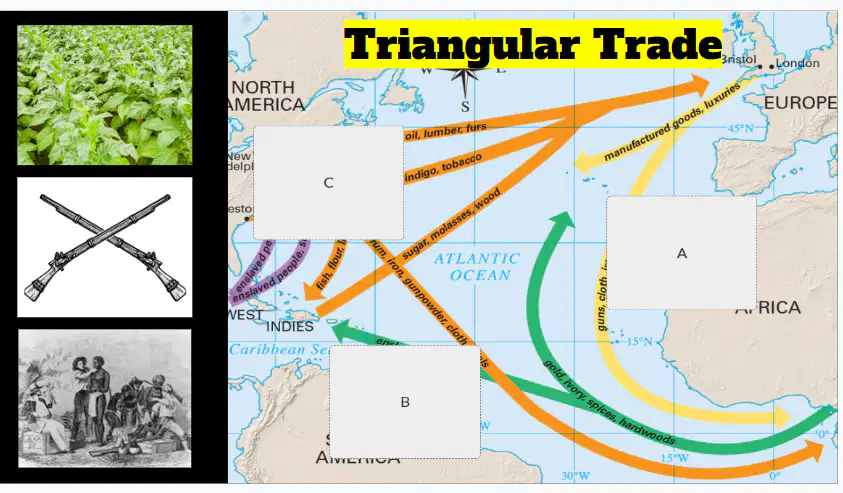
Question Image
a)

1.

A

b)

2.

C

c)

3.

B

88.

Most colonists believed that (a)   needed more education than girls.

89.

Although married women in the colonies gave birth many times, nearly half of all children (a)   before they reached adulthood.