
NEW
Font size
 Worksheets
Formation of Solar System ( Radioactive Decay and half-life)
Total questions: 33
Worksheet time: 1hrs 8mins
The main force at play during making of our solar system
strong force
weak force
gravity
electrostatic force


The planets formed by accretion. This means ________.
that little bits of rock and gas kept combining and growing, eventually becoming a planet
one large planet broke apart bit by bit, forming the planets we have now
the planets were formed when the sun was born and blew several large chunks off that became the planets
the planets got caught in the sun's gravity as they were drifting through the galaxy

The age of the Earth was found using ______________.
radiometric dating
carbon dating
blind dating
Tinder dating
Why did the lighter elements stay in the Gas Giants?
Just because the solar wind does not affect these planets
Because they less dense
Because the solar wind does not affect these planets AND their own gravity is strong enough
Just because their own gravity is strong enough

Put these steps in order for the Formation of our Solar System.
1. Dust and gas created planets.
2. A cloud of dust and gas interacted with the supernova and collapsed into a center disk.
3. A supernova exploded
4. Nuclear reactions created our sun.
a. 1,4,2,3
b. 3,1,2,4
c. 3,2,4,1
d. 4,2,1,3
The ____________ of the solar nebula, a large cloud of dust and gas, led to a disk-shaped protoplanetary disk, from which the sun and planets formed.
dispersiondisappearancecontractionsublimation
dispersion
disappearance
contraction
sublimation
The terrestrial planets are relatively small and rocky. In part, that is because the inner solar system was ____________ during their formation for ice-forming compounds to condense.
too hot
too cool
too big
too small
Which of the following does NOT happen during radiometric decay?
The mass of the atom decreases.
One type of element changes into another type of element.
The nuclei of radioactive isotopes stay the same.
Radiation is released.
If radioactive isotopes in a rock have undergone one half-life, what percentage of the original sample of radioactive isotope remains?
1/2%
1%
50%
100%
If radioactive isotopes in a rock have undergone two half-lives, what percentage of the original sample of radioactive isotope remains?
2%
20%
25%
50%
A rock is found that contains 2 grams of the radioactive isotope Uranium-235. The half-life of Uranium-235 is 700 million years. How old is the rock?
1,400 million years old
700 million years old
350 million years old
There is not enough information to determine the age of the rock
Supernova of a nearby star occurs. Then what?
Shock waves hit the nebula causing it to collapse.
The energy enriched nebula begins to contract further due to gravity.
The nebula begins to spin and flatten.
Shock waves hit the nebula causing it to collapse. Then what?
Supernova of a nearby star occurs.
The energy enriched nebula begins to contract further due to gravity.
The nebula begins to spin and flatten.
The energy enriched nebula begins to contract further due to gravity. Then what?
The center of the nebula begins to get hot and dense.
Shock waves hit the nebula causing it to collapse.
The nebula begins to spin and flatten.
The nebula begins to spin and flatten. Then what?
The center of the nebula begins to get hot and dense.
Gravity causes light gases to move to the center while heavier materials and ice stay in outer areas.
A protostar forms in the center of the nebula.
What is the FIRST event in the formation of the solar system?
About 4.5 billion years ago pieces of rock and ice accumulate more material until they grow into planets and moons.
About 4.6 billion years ago, a cloud of stellar dust or nebula exists within the Milky Way.
None of the above.
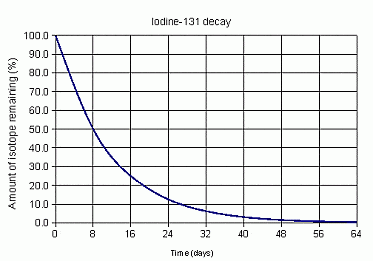
The % of the parent isotope remaining after 1 Half Life.
50%
25%
12.5%
6.25%
The % of the parent isotope remaining after 2 Half Lives.
50%
25%
12.5%
6.25%
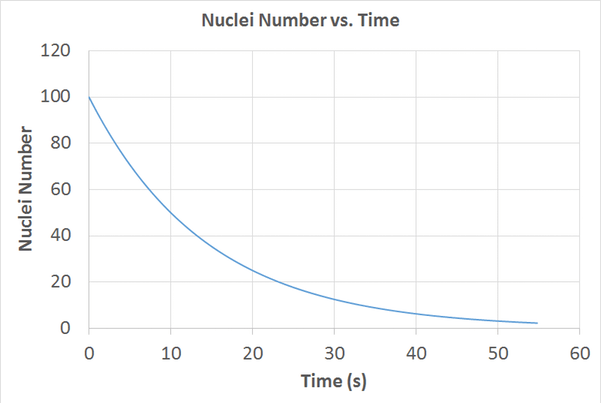
What is the Half life of this isotope?
5 seconds
10 seconds
15 seconds
20 seconds
Why do some elements have half-lives?
they radioactively decay
half of their atom gets stolen
They are Twizzlers that break in half
Half life (in radioactivity) is the amount of time it takes for half of a radioactive sample to
split.
combine.
decay.
become parent material.
Barium-122 has a half-life of 2 minutes. A fresh sample weighing 80 g was obtained. If it takes 10 minutes to set up an experiment using barium-122, how much barium-122 will be left when the experiment begins?
0.25g
2.5g
25g
80g

