
 Worksheets
Unit 2 Test Review
Total questions: 94
Worksheet time: 1hrs 12mins
Who was the president during the acquisition of the Louisiana Territory?
George Washington
Thomas Jefferson
John Adams
James Madison
What was one of the reasons the U.S. was unhappy leading up to the War of 1812?
British Navy kidnapped American sailors
French Navy kidnapped American sailors
Spanish Navy kidnapped American sailors
Dutch Navy kidnapped American sailors
Who was the U.S. President during the War of 1812?
Thomas Jefferson
James Madison
John Adams
Andrew Jackson
Which group wanted a war during the War of 1812?
Federalists
Warhawks
Loyalists
Pacifists
Which political group did not want a war during the War of 1812?
Warhawks
Federalists
Republicans
Democrats
What significant event happened in 1814 during the War of 1812?
The Battle of New Orleans
The signing of the Treaty of Ghent
British burned the White House
The Battle of Tippecanoe
Who wrote the "Star Spangled Banner" during the Battle of Baltimore?
Andrew Jackson
Thomas Jefferson
Francis Scott Key
James Madison
Which battle was Andrew Jackson a commander and hero in during the War of 1812?
Battle of Baltimore
Battle of New Orleans
Battle of Lake Erie
Battle of Tippecanoe
When was the Treaty of Ghent signed?
December 1812
December 1814
January 1815
December 1813
What war did the Treaty of Ghent end?
American Revolutionary War
War of 1812
Civil War
Spanish-American War
What event did America learn about by January after the Treaty of Ghent was signed?
Jackson's victory
The signing of the Declaration of Independence
The start of the Civil War
The Louisiana Purchase
What was one of the causes that encouraged American nationalism?
Revealed need for a strong standing army
Victory in the War of 1812
Brought end to the Federalist Party
Paved the way for American acquisition of FL
What happened to the Federalist Party after the War of 1812?
It gained popularity.
It became more powerful.
It died off.
It formed a coalition with the Democrats.
Why did the popularity of the Federalist Party fall?
They supported the war.
They opposed the war.
They had no political agenda.
They merged with another party.
Why were the times considered "good" during the Era of Good Feelings?
There was economic prosperity.
There was only one political party.
There was a strong military presence.
There was a cultural renaissance.
What event made Americans very proud of their country?
Signing of the Declaration of Independence
Defeating the British again
The Louisiana Purchase
The Gold Rush
What was the purpose of the Adams-Onis Treaty of 1819?
To establish trade routes with Canada
To end the War of 1812
Spain gave up Florida and Oregon
To purchase Alaska from Russia
What was the main warning given by President Monroe in the Monroe Doctrine of 1823?
European powers should establish new colonies in the Western Hemisphere.
European powers should interfere in the affairs of the Western Hemisphere.
European powers should not interfere in the affairs of the Western Hemisphere.
European powers should form alliances with newly independent countries.
What was the belief behind Manifest Destiny regarding the expansion of the U.S.?
It was God's will for the U.S. to expand west to the Pacific Ocean.
It was a plan to expand north to Canada.
It was a strategy to expand east to Europe.
It was a desire to expand south to South America.
What tension did the philosophy of Manifest Destiny create?
Tension between the U.S. and Canada.
Tension between the U.S. and Mexico.
Tension between the U.S. and Europe.
Tension between the U.S. and Asia.
What was the primary economic activity in the South and Southwest regions according to the concept of Sectionalism?
Industrial manufacturing
Agrarian – "King Cotton"
Mining
Fishing
What did the demand for cotton lead to in the South and Southwest?
A decrease in land prices
A westward land rush and the need for more slave labor
An increase in industrial jobs
A decline in agricultural activities
When did factories using machinery begin to appear?
Late 1700s
Early 1800s
Mid 1800s
Late 1800s
What material did factories use to make cloth?
Northern wool
Eastern silk
Southern cotton
Western flax
Where did textile factories spring up during the Industrial Revolution?
Southwest
Northeast
Northwest
Southeast
What is the term "King Cotton" commonly associated with?
A type of monarchy
A famous historical figure
The economic importance of cotton in the southern United States
A brand of clothing
What innovation did Eli Whitney create that involved rifles?
Mass production and interchangeable parts
Automatic loading mechanism
Laser sighting system
Silencer attachment
What was the primary function of the cotton gin invented by Eli Whitney?
To plant cotton seeds
To separate seeds from fibers
To dye cotton fabrics
To weave cotton into cloth
What was a significant consequence of the increased cotton production due to the cotton gin?
Decrease in cotton prices
More slaves were needed
Reduction in plantation sizes
Increase in cotton imports
What was an essential part of farming in the South?
Machinery
Slaves
Immigrants
Sharecropping
What was the stance of some people regarding the spread of slavery?
They wanted it to spread beyond the South
They did not want it to spread beyond the South
They were indifferent
They wanted it to spread to the North
Who were the key negotiators of the Missouri Compromise of 1820?
John Calhoun, Henry Clay, and Daniel Webster
Thomas Jefferson, James Madison, and John Adams
Andrew Jackson, Martin Van Buren, and John Quincy Adams
Abraham Lincoln, Ulysses S. Grant, and William Seward
What was the status of Missouri and Maine under the Missouri Compromise?
Missouri entered as a slave state and Maine as a free state
Both Missouri and Maine entered as slave states
Both Missouri and Maine entered as free states
Missouri entered as a free state and Maine as a slave state
What was the purpose of the Missouri Compromise regarding the balance of states?
To maintain a balance of slave and free states
To convert all states to free states
To convert all states to slave states
To create a balance of industrial and agricultural states
What was the significance of the 36°30' line in the Missouri Compromise?
All states below were slave states; all states above were free states
All states below were free states; all states above were slave states
All states below were industrial states; all states above were agricultural states
All states below were agricultural states; all states above were industrial states
Who was the first president to ride on a railroad train and the first to be nominated by a political party?
George Washington
Thomas Jefferson
Andrew Jackson
Abraham Lincoln
Who is known historically for creating a strong executive branch?
Andrew Jackson
James Monroe
John Quincy Adams
James K. Polk
Who was the first Democrat elected as President of the United States?
Thomas Jefferson
Andrew Jackson
James Madison
John Quincy Adams
What was notable about the election of 1828 in terms of campaign style?
It was the first election with televised debates.
It was the first election to involve types of entertainment like parades and rallies.
It was the first election to use social media.
It was the first election with online voting.
What characterized the campaign of the election of 1828?
It was a peaceful and respectful campaign.
It involved lots of mudslinging and was a messy campaign.
It was the first campaign to use radio broadcasts.
It was a campaign focused on environmental issues.
What was the main purpose of Jackson's Indian Removal Act of 1830?
To integrate Native American tribes into American society
To force tribes off their land promising them western land
To provide financial aid to Native American tribes
To establish new trade routes with Native American tribes
Which Native American tribe was primarily affected by the "Trail of Tears"?
Apache
Sioux
Cherokee
Navajo
What did the Nullification Theory state?
States could create their own federal laws.
States could reject a federal law if it was not in their best interest.
States must always follow federal laws.
States could secede from the Union at any time.
In which election was Calhoun dropped as Vice President under Jackson?
1828 Election
1832 Election
1836 Election
1840 Election
What action did South Carolina threaten to take, which means to withdraw from the Union?
Secede
Compromise
Negotiate
Ally
What was the name of the bill passed by Jackson that authorized the military to use force if South Carolina resisted?
Force Bill
Compromise Bill
Union Bill
Defense Bill
How did the Bank of the United States (BUS) help common people?
By increasing taxes.
By making loans affordable.
By reducing interest rates to zero.
By providing free financial advice.
What was underestimated by those who thought the charter of the Bank of the United States would be renewed?
The economic impact of the Bank.
The support from the public.
Jackson’s power.
The influence of foreign banks.
What was one of the goals of Henry Clay and his friends in the American System?
Develop a new currency
Establish a protective tariff
Abolish the National Bank
Reduce taxes on imports
Which transportation projects were part of Henry Clay's plan to ship goods?
Panama Canal and Trans-Siberian Railway
National Road, Erie Canal
Suez Canal and Silk Road
Interstate Highway and Transcontinental Railroad
What financial institution did Henry Clay want to re-establish?
Federal Reserve
National Bank
World Bank
International Monetary Fund
What did the Whig Party support in terms of economic policy?
Laissez-faire economics
The American System and federal control of the banking system
Free trade and minimal government intervention
Isolationism and protectionism
What does the term "Antebellum" refer to?
The period after the Civil War in the South
The period before the Civil War in the South
The period during the Civil War in the North
The period after the Civil War in the North
What was one of the effects of Nat Turner's rebellion on Southern whites?
It weakened their resolve
It strengthened their defense of slavery
It led to the abolition of slavery
It caused them to flee the South
What happened to many people during the Trail of Tears?
Many found new homes
Many died en route
Many gained wealth
Many returned home
What was stolen during the Trail of Tears?
Food and clothing
Money and livestock
Weapons and tools
Books and maps
What was the main purpose of the Indian Removal Act of 1830?
To grant Native Americans more land in the East
To force the Native Americans to move west
To integrate Native Americans into U.S. society
To establish trade agreements with Native Americans
Who ordered the forced removal of the Cherokees by U.S. troops?
The Vice President
The Secretary of State
The President
The Governor
What did the Kansas-Nebraska Act allow people in the territories of Kansas and Nebraska to decide?
Whether to allow slavery within their borders
Whether to join the Union
Whether to declare independence
Whether to form a new government
What did the Kansas-Nebraska Act repeal?
The Missouri Compromise of 1820
The Emancipation Proclamation
The Declaration of Independence
The Bill of Rights
Resulted in a national purpose and unified Americans leading into the "Era of Good Feelings"
Spanish-American War
American Revolution
War of 1812
Civil War
What did the Missouri Compromise deal with?
Admission of Maine and California into the nation
Expansion of slavery into the former Louisiana Territory
Ending the slave trade in Washington DC
Rights of states to negotiate treaties with other nations
The Articles of Confederation showed American distrust of ______________
Strong Central Government
States Rights
The Military
American citizens
What name was given to people who supported adopting the Constitution?
Federalists
Whigs
Tories
Republicans
What was the importance of the Whiskey Rebellion?
States nullified federal law to quell the rebellion
Federal Government used force to enforce laws
It was the first rebellion over taxes
It forced the nation to pass a prohibition law
Who ultimately won the Election of 1824?
Andrew Jackson
John Quincy Adams
Thomas Jefferson
James Monroe
What was the central controversy surrounding the Election of 1824?
The 'Corrupt Bargain'
The lack of voter participation in the election
The election being decided by the Supreme Court
The absence of political parties during the election
What role did Henry Clay play in the Election of 1824?
He became Vice President after the election
He used his influence to support John Quincy Adams
He ran as a candidate and won the presidency
He refused to participate in the election process
What nickname was used for Andrew Jackson in the campaign poster for the Election of 1828?
Old Hickory
The Great Compromiser
The Hero of the Revolution
The Father of the Constitution
What was the significance of the Election of 1828?
It marked the end of aristocratic rule in America.
It was a violent revolution comparable to the American Revolution.
It demonstrated the will of the common people.
It was a peaceful transition of power without any major changes.
What was the Indian Removal Act of 1830?
A law requiring southern Indian tribes to move to Indian Territory
A law granting Indian tribes full autonomy over their lands.
A law abolishing slavery in southern states.
A law establishing trade agreements with Indian tribes.
Which tribes were most affected by the Indian Removal Act?
The Five Civilized Tribes.
The Sioux and Apache tribes.
The Navajo and Hopi tribes.
The Iroquois Confederacy.
What was the Supreme Court's ruling in Worcester v. Georgia (1832)?
The Supreme Court ruled in favor of the Cherokee.
The Supreme Court ruled against the Cherokee.
The Supreme Court declared the Indian Removal Act unconstitutional.
The Supreme Court supported Andrew Jackson's policies.
What was Andrew Jackson's response to Congress's attempt to recharter the Second Bank of the United States in 1832?
He approved the recharter of the Bank.
He vetoed the recharter and made it his mission to destroy the Bank.
He ignored the recharter attempt.
He resigned from his position as President.
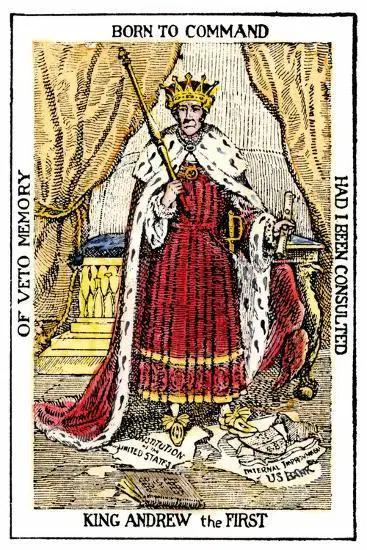
What does the figure in the illustration stand on, symbolizing power over it?
A crown
A throne
The Constitution
A sword
What was the main cause of the Nullification Crisis in 1832?
The Tariff of Abominations declared unconstitutional by South Carolina
The election of Andrew Jackson as president
The signing of the Force Bill
The Compromise Tariff of 1833
What action did President Jackson take in response to South Carolina's nullification of the tariff?
He resigned as president
He authorized the use of military forces with the Force Bill
He reduced the tariff to appease South Carolina
He declared South Carolina independent
What does Andrew Jackson consider incompatible with the existence of the Union in his proclamation to the people of South Carolina?
The power to annul a law of the United States by one state
The ability of states to form alliances with foreign nations
The enforcement of federal laws by state governments
The creation of new states within the Union
Select the correct place on the map where Native Americans were forced TO MOVE TO in the Indian Removal Act.
Who won the Election of 1816?
James Monroe
Rufus King
John Quincy Adams
Andrew Jackson
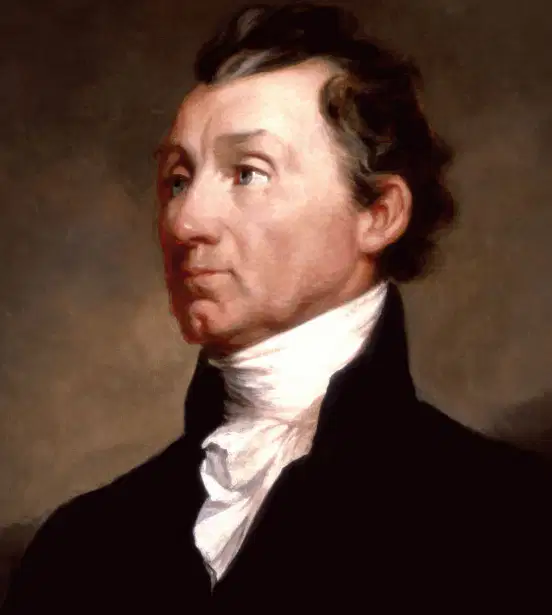
Why is the period after the War of 1812 known as the Era of Good Feelings?
It marked the end of political divisions and vibrant nationalism.
It was a time of economic hardship and political instability.
It was characterized by the rise of the Federalist Party.
It was a period of international conflict and war.
What was the name of the series of policies proposed by Henry Clay after the war?
The Federal System
The American System
The National System
The Economic System
What was one of the key components of Henry Clay's American System regarding banking?
The creation of a new bank called the Federal Reserve
The preservation of the Bank of the United States
The elimination of all banks in the United States
The establishment of state-controlled banks
What was the purpose of the Tariff of 1816 supported by Henry Clay?
To increase agricultural exports
To protect U.S. manufacturing from British competition
To reduce inflation in the United States
To fund military operations during the War of 1812

Which court case upheld the authority of the Bank of the United States?
Marbury v. Madison
McCulloch v. Maryland
Gibbons v. Ogden
Dred Scott v. Sandford
Henry Clay would have supported which leader's policies?
Hamilton, because he supported a strong federal government and economic policies Clay might align with.
Jefferson, because he advocated for states' rights and agrarian ideals Clay might support.
Neither, because Clay had entirely different political views.
Both, because Clay's views were a mix of federal and state interests.
Who won the Election of 1820?
John Quincy Adams
James Monroe
Andrew Jackson
Thomas Jefferson
What was the purpose of admitting Maine as a free state under the Missouri Compromise?
To increase the number of free states to 15.
To maintain the sectional balance at 12 to 12.
To prohibit slavery in the southern states.
To encourage westward expansion.
Who became a war hero at the Battle of New Orleans during the War of 1812?
George Washington
Alexander Hamilton
James Madison
What ended the War of 1812?
Britain and the US signed the Olive Branch Petition
the British purchased Louisiana
Britain and the US signed the Treaty of Ghent
the British burned down the White House

What was the main issue during John Adams' presidency?
Slavery
Women's rights
XYZ Affair
Louisiana Purchase
- made A. Jackson a national hero
- led to end of Federalist Party
- resulted in new sense of national identity
What is the list referring to?

