
 Worksheets
HOA 4 - Exam 1 PART 2
Total questions: 70
Worksheet time: 41mins
Earliest shelter form in the Philippines, requiring minimal modification of natural formations.
(a)
The largest cave network periodically dwelt in by prehistoric families for 30,000 years
Tabon Cave Complex
Tabang Cave Complex
Taoutbato Cave Complex
Torotot Cave Complex
Basic sleeping platform in caves
(a)
"People of the rock"
(a)
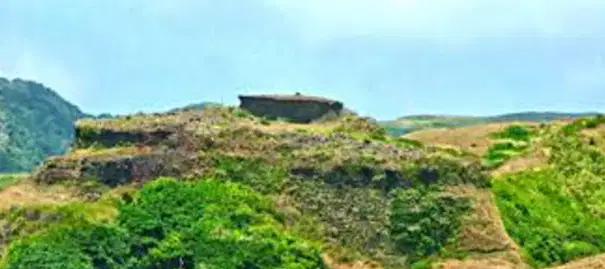
Also known as idjang, this is a testimony of defensive engineering of the early Ivatan settlers
Mountain Citadels of Savidug
Tabon Cave Complex in Palawan
Angono Caves in Rizal
Hinagdanan Cave of Bohol
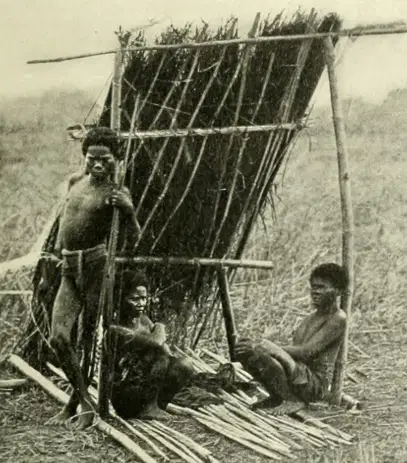
shelters anchored to angled poles—easy to assemble, move, or abandon.
Lean-to shelters
Arboreal shelters
Rock shelters
Cave shelters
Less enclosed than caves, rock shelters served as temporary sleeping spaces—ideal for groups that roamed the land.
Lean-to shelters
Arboreal shelters
Rock shelters
Cave shelters
Found among communities vulnerable to raids and animal threats, these shelters are perched 20– 60 feet high in trees offered protection and clarity of surrounding
Lean-to shelters
Arboreal shelters
Rock shelters
Cave shelters
A simple windscreen used by the Mamanua people of NE Mindanao when hunting
Dait dait
Hawong
Lepa
Lumah
Typical lean-to shelter of the Pinatubo Aeta
Dait dait
Hawong
Lepa
Lumah
This type of architecture is characterized by the sue of local materials and traditional building techniques, which are often influenced by the geographic and climatic conditions of the regions.
Vernacular Architecture
Philippine Architecture
Folk Architecture
Native Architecture
Latin word for "south wind"
(a)
Greek word for "island"
(a)
Seafaring people from Taiwan & SE Asia; they migrated across the Pacific, Indian Ocean,
and Southeast Asia.
Austronesians
Australians
Austrians
Pacificans
These are all common features of Austronesian Architecture, except:
Stilt houses
Steep thatched roofs
Limited ventilation to keep heat
Portable, repairable designs
One basic building principle of Austronesian Architecture is that they are reminiscent of boats.
True
False
One basic building principle of Austronesian Architecture is that they do not have defensive structure for earthquakes.
True
False
One basic building principle of Austronesian Architecture is that they have space underneath for storage or domestic animals
True
False
A central architectural symbol that reflected the Austronesians' identity as seafaring people.
boats
rocks
water
sand
"house" in early Austronesian terms
Rumaq
Balay
Lepaw
Kamalir
Banua
"public building", "community house", or "guest house" in early Austronesian terms
Rumaq
Balay
Lepaw
Kamalir
Banua
"hut", "field hut", or "granary" in early Austronesian terms
Rumaq
Balay
Lepaw
Kamalir
Banua
"bachelor's house" or "men's house” in early Austronesian terms
Rumaq
Balay
Lepaw
Kamalir
Banua
"inhabited land" or "community territory" in early Austronesian terms
Rumaq
Balay
Lepaw
Kamalir
Banua
Islam first arrived in the Philippines in the 13th century through which Arab missionary?
Tuan Masha'ika
Karimul Makhdum
Deshret
Rukkhadevata
Which Arab scholar solidified Islam in 1380 in the Philippines?
Tuan Masha'ika
Karimul Makhdum
Deshret
Rukkhadevata
The Islam faith spread peacefully through intermarriage with local datus and royalty, leading to the formation of powerful sultanates.
True
False
What is the traditional house of Maranao royalties?
(a)
The Torogan was built exclusively for the datu and their families and was a symbol of authority.
True
False
By the time the Spanish arrived in the 16th century, Islam was not yet established in Mindanao and Sulu.
True
False
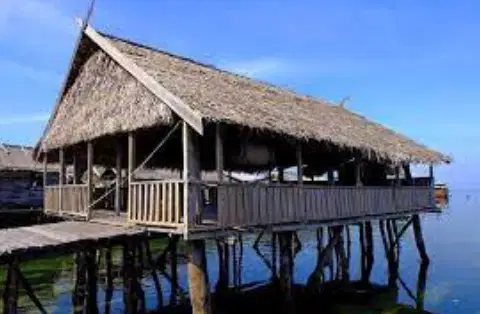
These are the oldest form of mosque in the Philippines.
Langgal/ranggar
Pagoda-style Mosque
Onion-domed/Arabianstyle Mosque
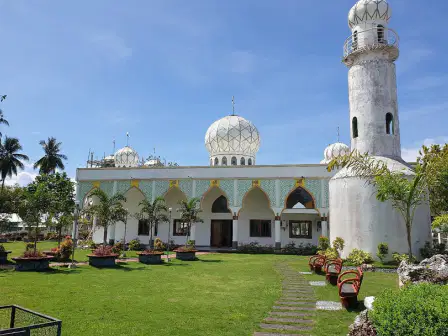
Used by Muslims throughout Islamic areas in the Philippines prior to the importation of the Arabian-style mosque architecture.
Langgal/ranggar
Pagoda-style Mosque
Onion-domed/Arabianstyle Mosque
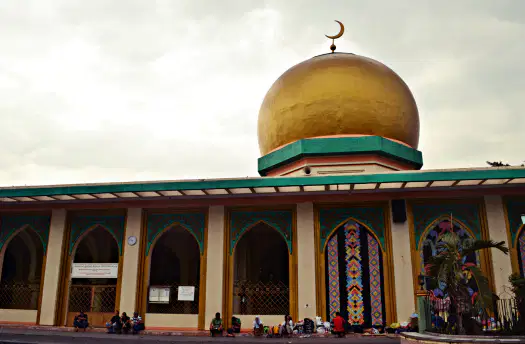
Currently the most prominent and widespread style used in building mosques in the Philippines.
Langgal/ranggar
Pagoda-style Mosque
Onion-domed/Arabianstyle Mosque
The mandatory annual pilgrimage to Mecca, Saudi Arabia, that every physically and financially able Muslim is obligated to perform at least once in their lifetime.
(a)
These are the 3 types of Islamic decoration, except:
Arabesque
Geometric patterns
Calligraphy
Fresco
A common architectural feature of mosques in the Philippines
(a)
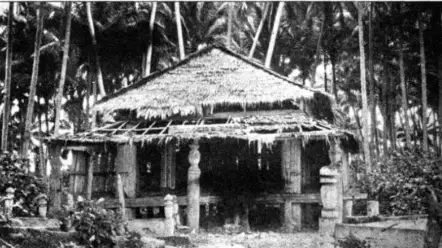
Recognized as the oldest mosque in the Philippines, established around 1380. It marks the introduction of Islam in the Philippines.
Sheik Karimul Makhdum Mosque
Sultan Haji Hassanal Bolkiah Mosque
Manila Golden Mosque
Masjid Al-Nasser Abpi
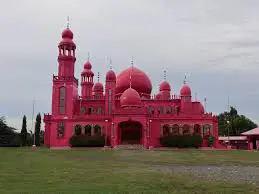
It was painted pink to represent his wife's favorite color and promote harmony between the Muslim and Christian communities.
Sheik Karimul Makhdum Mosque
Sultan Haji Hassanal Bolkiah Mosque
Dimaukom Mosque
Masjid Al-Nasser Abpi
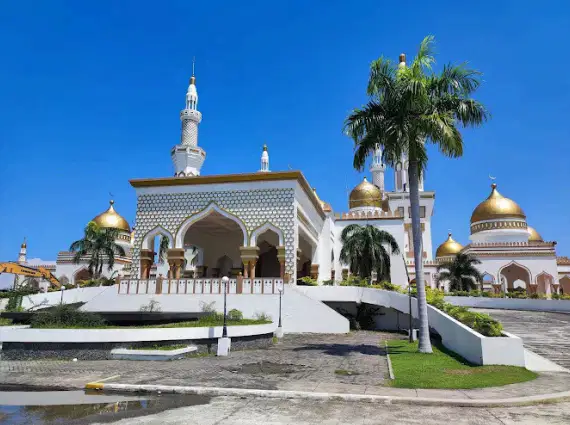
This mosque, the largest in the Philippines and a major landmark in Cotabato City, features grand golden domes and towering minarets.
Sheik Karimul Makhdum Mosque
Sultan Haji Hassanal Bolkiah Mosque
Manila Golden Mosque
Masjid Al-Nasser Abpi
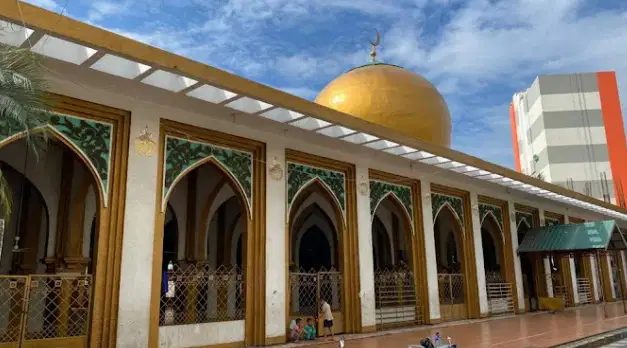
This mosque is known for its golden dome and is a prominent symbol of Islamic architecture in the city
Sheik Karimul Makhdum Mosque
Sultan Haji Hassanal Bolkiah Mosque
Manila Golden Mosque
Masjid Al-Nasser Abpi
It features geometric, floral, and flowing plant-like designs, reflecting Islamic values of non-figurative art while preserving local Austronesian artistry.
(a)
These are main features of a mosque, except:
minaret
domed roof
the star and crescent moon
golden domes
Projecting floor beams carved with okir carvings that signify high status
(a)
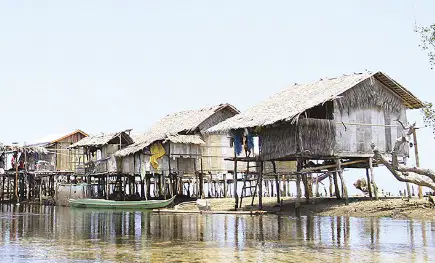
The traditional dwelling of the Tausug people of Sulu in Mindanao. Made of bamboo, wood, and nipa palm.
Tausug House
Maguindanao House (Walai)
Yakan House (Lumah)
Bay Sinug

A traditional vernacular dwelling of the Maguindanaon people in Mindanao. Symbolizes simplicity, spirituality, family, and hospitality.
Tausug House
Maguindanao House (Walai)
Yakan House (Lumah)
Bay Sinug
Refers to architectural and engineering structures such as government buildings, houses of ancestry, traditional dwellings, and their settings, and landscapes with notable historical and cultural significance.
Built Heritage
Historical Monuments
Historic Structures
Built HIstory

The Historical City of (a) is one of the best-preserved Spanish colonial towns in Asia. It was inscribed in the World Heritage List in 1999.
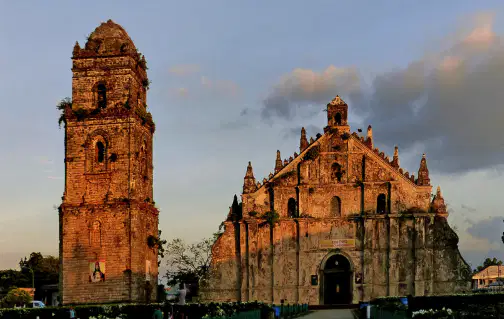
Represents a fusion of European Baroque with local building traditions, adapted to natural conditions. Declared as a National Cultural Treasure in 1973 and a World Heritage Site in 1993.
San Augustine Church of Paoay
Cologne Cathedral
San Pedro Cathedral
San Sebastian Church
Other than European Baroque, San Augustine Church of Paoay is also a prime example of which Baroque style?
Earthquake Baroque
Ottoman Baroque
Early Baroque
High Baroque
The umbrella agency for culture and heritage, and implements and oversees the National Cultural Heritage Act (R.A. 10066).
NCCA
NHCP
NM
NLP
This agency focuses on historical sites, landmarks, and buildings, and oversees restoration and conservation of structures linked to significant events and persons in Philippine history.
NCCA
NHCP
NM
NLP
This agency declares and safeguards National Cultural Treasures and Important Cultural Properties
(including buildings and archaeological finds), and conducts research, curation, and conservation of tangible heritage.
NCCA
NHCP
NM
NLP
This agency conserves documentary heritage such as rare manuscripts, architectural plans, blueprints,
and maps. Also serves as a repository of cultural memory that supports built heritage conservation.
NCCA
NHCP
NM
NLP
This agency focuses on contemporary cultural and artistic heritage, and engages in heritage when linked to artistic spaces and cultural districts, helping sustain historic venues as cultural hubs.
NCCA
CCP
NAP
NLP
This agency safeguards official records, manuscripts, and historical documents, and ensures legal and historical documentation of properties for conservation purposes.
NCCA
CCP
NAP
NLP
Which agency created the National Endowment Fund for Culture and the Arts (NEFCA)?
NCCA
CCP
NAP
NLP
Foundation of all heritage laws; The State must conserve, promote, and popularize the nation’s historical and cultural heritage.
1987 Constitution
Article XI Section 14
R.A. 10066 (2009)
R.A. 4846 (1966, amended)
P.D. 260
National Cultural Heritage Act; Mandates NCCA, NHCP, National Museum, LGUs to protect heritage.
1987 Constitution
Article XI Section 14
R.A. 10066 (2009)
R.A. 4846 (1966, amended)
P.D. 260
Cultural Properties Preservation and Protection Act; Penalizes destruction, alteration, or export of cultural items without approval
1987 Constitution
Article XI Section 14
R.A. 10066 (2009)
R.A. 4846 (1966, amended)
P.D. 260
Declared and recognized important historical sites, buildings, churches, and monuments as National Cultural Treasures.
1987 Constitution
Article XI Section 14
R.A. 10066 (2009)
R.A. 4846 (1966, amended)
P.D. 260
How many years old should heritage buildings be if they are to be registered under R.A. 10066 (2009)?
(a)
Amended and reinforced the provisions of R.A. 4846 on cultural property, granting the National Museum greater authority and police powers to implement preservation and protection measures.
P.D. 374
R.A. 7356 (1992)
R.A. 10086 (2010)
R.A. 8492 (1998)
Established the National Commission for Culture and the Arts (NCCA).
P.D. 374
R.A. 7356 (1992)
R.A. 10086 (2010)
R.A. 8492 (1998)
It mandates historical research and the promotion of history to strengthen and
preserve national identity; Strengthens the powers and functions of the NHCP to safeguard and promote the country's historical and cultural legacy.
P.D. 374
R.A. 7356 (1992)
R.A. 10086 (2010)
R.A. 8492 (1998)
Reorganized and strengthened the National Historical Institute (NHI) and renamed it as the National Historical Commission of the Philippines (NHCP).
P.D. 374
R.A. 7356 (1992)
R.A. 10086 (2010)
R.A. 8492 (1998)
The Strengthening People's Nationalism Through Philippine History Act of 2010
P.D. 374
R.A. 7356 (1992)
R.A. 10086 (2010)
R.A. 8492 (1998)
National Museum Act; Established the National Museum of the Philippines as a permanent, autonomous institution under the Office of the President
P.D. 374
R.A. 7356 (1992)
R.A. 10086 (2010)
R.A. 8492 (1998)
Local Government Code of 1991; Devolved power and resources from the national government to LGUs, granting them genuine local autonomy
P.D. 374
R.A. 7160 (1991)
P.D.. 1505 (1978)
R.A. 8492 (1998)
Strengthens the protection of national shrines, monuments, and historic sites by prohibiting unauthorized alterations, and grants the National Historical Institute authority to oversee preservation, restoration, and enforcement.
P.D. 374
R.A. 7160 (1991)
P.D.. 1505 (1978)
R.A. 8492 (1998)
Cultural Mapping and Enhanced Heritage Conservation Act; Mandates all LGUs to conduct cultural mapping of heritage properties within their jurisdiction.
P.D. 374
R.A. 7160 (1991)
P.D. 1505 (1978)
R.A. 11961 (2023)

