
Font size
 Worksheets
RELIGION CLASS TEST STUDY GUIDE: GRADE 6-8
Total questions: 28
Worksheet time: 16mins
The Penitential Rite takes place during which part of the Mass?
Introductory Rites
Liturgy of the Word
Liturgy of the Eucharist
Concluding Rites
The prayer recited during the Liturgy of the Eucharist before the Sign of Peace is:
The Lord's Prayer
The Nicene Creed
The Gloria
The Agnus Dei
The part that follows immediately after the First Reading in the Liturgy of the Word is:
The Responsorial Psalm
The Gospel Acclamation
The Second Reading
The Homily
Select the option that is NOT part of the Concluding Rites.
Final Blessing
Dismissal
Liturgy of the Eucharist
Closing Song
On Sundays and Holy Days of Obligation, the additional prayer included in the Introductory Rites is:
The Gloria
The Creed
The Our Father
The Hail Mary
The Feast of the Assumption is primarily commemorating:
the Virgin Mary's being taken up into heaven
the birth of Jesus Christ
the resurrection of Jesus
the ascension of Jesus
The dogma of the Assumption of Mary was officially defined in which year?
1950
1854
1962
1870
The early Christians explained the empty tomb of Mary by:
Believing she was assumed into heaven
Thinking her body was stolen
Claiming she never existed
Saying she moved to another city
A significant difference between Christ's and Mary's ascension to heaven is that:
Christ ascended by his own power, while Mary was assumed by God's power.
Both Christ and Mary ascended by their own power.
Mary ascended before Christ.
Christ was assumed into heaven, while Mary ascended by her own power.
In the United States, the Feast of the Assumption is observed by Catholics in which of the following ways?
By attending Mass and participating in religious processions
By fasting for forty days
By lighting fireworks and having parades
By exchanging gifts with family members
Carlo Acutis used which modern technology to spread his faith and create a significant impact on the Catholic Church?
Internet and websites
Television broadcasting
Radio programs
Printed newspapers
Carlo Acutis had a special devotion to which aspect of Catholic faith?
The Eucharist
The Rosary
Saint Francis of Assisi
The Sacred Heart
Carlo Acutis passed away at what age and from what illness?
At age 15 from leukemia
At age 20 from cancer
At age 17 from pneumonia
At age 14 from heart disease
What unique distinction makes Carlo Acutis particularly relatable to modern youth?
He was a teenager who used technology and the internet to spread his faith.
He was the youngest pope in history.
He was a famous musician.
He was a professional athlete.
Pier Giorgio Frassati was known for which significant charitable activity during his life?
Helping the poor and sick
Building churches
Writing religious books
Leading political movements
Pier Giorgio actively participated in which organization as a young Catholic?
St. Vincent the Paul Society
Red Cross
Scouts Association
Rotary Club
Pier Giorgio Frassati's motto that reflected his deep faith was:
Verso l'alto (To the heights)
Carpe Diem (Seize the day)
Ad astra per aspera (To the stars through difficulties)
Veni, vidi, vici (I came, I saw, I conquered)
Pier Giorgio Frassati contracted his fatal illness in which way?
By caring for a sick person
By eating contaminated food
By traveling to a foreign country
By being bitten by an animal
Pier Giorgio particularly enjoyed and used which recreational activity as a form of spiritual expression?
Mountain climbing
Painting
Swimming
Dancing
Eucharistic Adoration is:
the practice of worshipping the consecrated Eucharist outside of Mass
a type of church music performed during Mass
a celebration of the birth of Jesus
the reading of the Gospel during Mass
A monstrance is:
a vessel used in the Catholic Church to display the consecrated Eucharistic host
a type of musical instrument used in religious ceremonies
a ceremonial robe worn by priests during Mass
a candle holder used during church processions
Transubstantiation is:
the change of the substance of bread and wine into the body and blood of Christ during the Eucharist
the belief that bread and wine symbolize the body and blood of Christ
a ritual of blessing bread and wine in Christian ceremonies
the process of fermenting bread and wine for religious use
The proper way to show respect during Eucharistic Adoration is:
Kneeling or genuflecting in reverence
Talking loudly with others
Eating and drinking in the chapel
Using your phone for entertainment
The purpose of Eucharistic Adoration is:
to worship and spend time in the presence of the Blessed Sacrament
to celebrate a wedding ceremony
to perform a baptism
to read passages from the Old Testament

Identify the item shown in the image and fill in the blank
(a)

Identify the item shown in the images and describe the purpose during Mass.
(a)
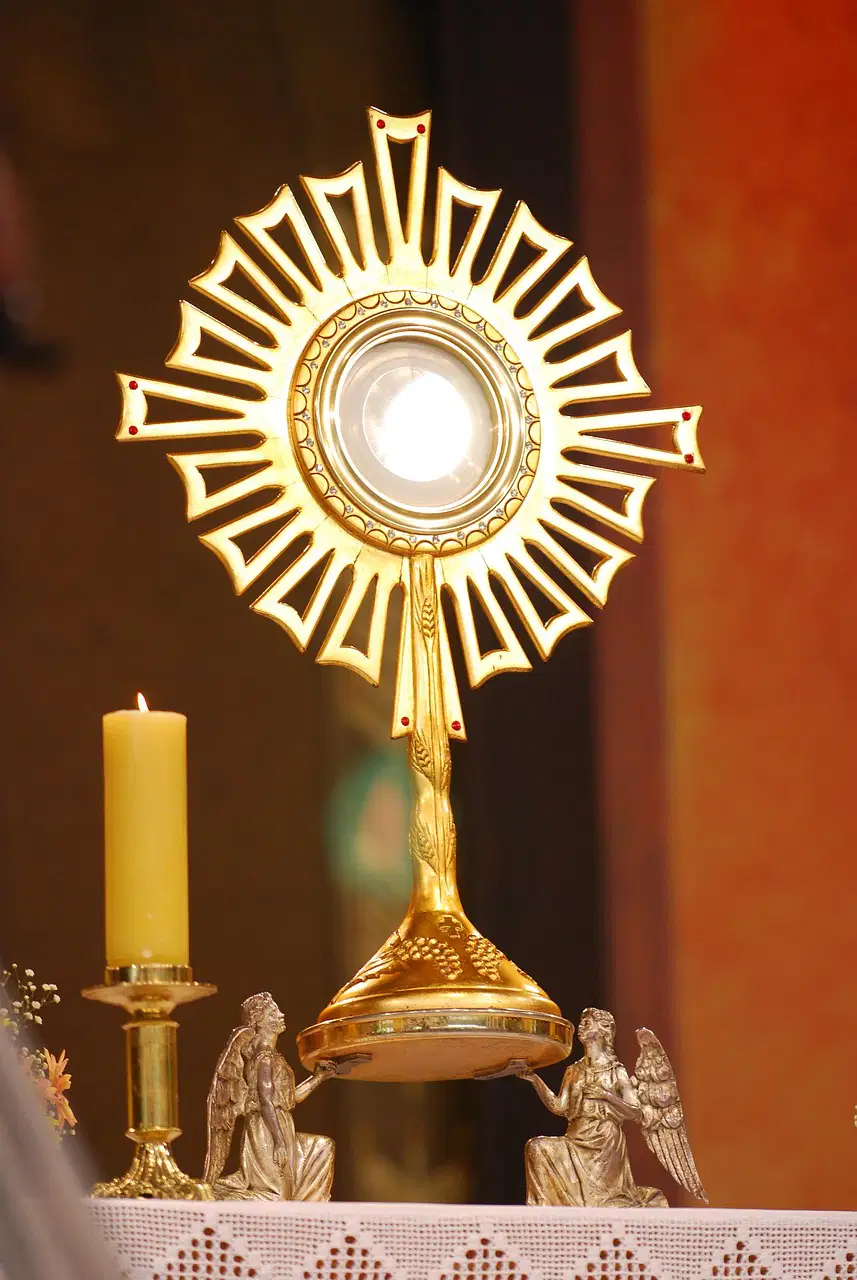
Identify the item shown in the image and fill in the blank
(a)
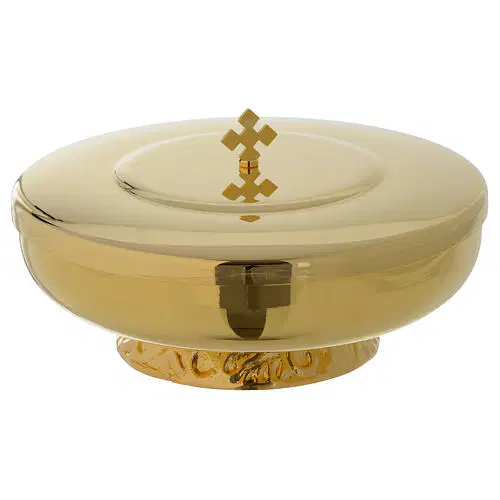
Identify the item shown in the images and fill in the blank
(a)

