
 Worksheets
Preparatory Remediation
Total questions: 41
Worksheet time: 29mins
A document created by the National Highway Traffic Administration (NHTSA) that outlines the skills performed by various EMS providers.
National EMS Scope of Practice Model
National Registry
State Boards
Skill Sheets
A 47 year old patient who was involved in a high speed motor vehicle collision will need to be transferred to which specialty hospital?
Pediatric Center
Trauma Center
Cardiovascular Care Center
Stroke Center
When your assessment of a patient trapped in wreckage reveals that the patient is suffering from an immediate threat to life, you would initiate which type of patient movement?
Emergency move
Urgent Move
Immediate move
Rapid move
Which of the following conditions is not one that permits the use of an emergency move?
The scene is hazardous
Care of life-threatening injuries requires repositioning
The patient's position is hampering a police investigation
You must reach other patients
During a first aid training session, Emily, Lucas, and Isabella are learning about the direct ground lift technique. What is the primary purpose of this technique?
To move a patient with a suspected spinal injury
To lift a patient from the ground to a stretcher
To carry a patient over rough or uneven terrain
To transfer a patient from a bed to a stretcher
Which of the following techniques is considered to be an emergency move?
Extremity lift
Supine transfer
Firefighter's drag
Direct ground lift
Written standing orders and protocols which authorize EMS personnel to perform emergency skills WITHOUT actually talking to the doctor
off-line medical direction
on-line medical direction
medical oversight
scope of practice
Online medical control requires __________.
A. written protocols approved by medical control
B. phone or radio contact with the medical director
C. the presence of an advanced-level provider
D. a physician's presence on the scene of the call
Medical Director is a physician who assumes the ultimate responsibility for:
standards, protocols, and evaluation of patient care
certification and licensure of EMRs
staffing decisions and hiring
answering and dispatching 911 calls
Written standing orders and protocols which authorize EMS personnel to perform emergency skills WITHOUT actually talking to the doctor
off-line medical direction
on-line medical direction
medical oversight
scope of practice
Emergency moves are used to
move a patient from an unsafe environment
move an unstable patient
move a patient to the ambulance
move patients with suspected c-spine injuries
Urgent moves are used to
move patients from unsafe environments
move patients with life-threatening illnesses or injuries
move patients into the ambulance
move patients onto a stretcher
What is the first step an emergency medical responder should take upon arriving at the scene of an accident?
Begin CPR immediately
Ensure scene safety
Call for additional resources
Check for patient responsiveness

Write the name of the correct emergency move being depicted in the space provided.
Pack Strap Carry
Blanket Drag
Firefighter Carry
1 Person Assist
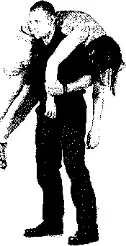
Write the name of the correct emergency move being depicted in the space provided.
Clothes drag
Firefighter's carry
Ankle Drag
Shoulder Drag
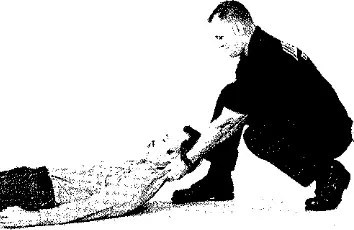
Write the name of the correct emergency move being depicted in the space provided.
Firefighter's carry
Ankle Drag
Shoulder Drag
Clothes Drag
Which emergency move would be appropriate to use for a patient with a possible neck injury?
Clothes drag
Firefighter's carry
Ankle drag
Shoulder drag
When preparing to move the patient, which of the following would be the most important for you to do?
Make sure that a stretcher is readily available.
Be aware of your own physical abilities.
Keep your knees rigidly straight.
Twist your back to reach the patient.
When assisting patients at a scene, you demonstrate your understanding of body mechanics when you:
Lift with your back, not with your legs.
Keep the patient’s weight away from, not close to, your body.
Move backward rather than forward.
Maintain a low center of gravity.
When using the clothes drag technique, you would be moving in which direction?
Forward
Backward
To the right
To the left
You reach under the patient’s armpits from the back and grasp the patient’s forearms to drag them. You are using which emergency move?
Clothes drag
Blanket drag
Shoulder drag
Ankle drag
As an Emergency Medical Responder, your first consideration at any emergency should be
providing immediate patient care.
notifying the communications center of your status.
ensuring your own safety.
ensuring the patient's safety.
Which of the following is the best resource for Emergency Medical Responders at the scene of a hazardous material incident?
The Internet
Emergency Response Guidebook
Poison Control Center
Medical direction
A ____________ is a sign used to display information pertaining to contents inside a transport container.
due regard
HAZWOPER
placard
extrication
Which of the following terms refers to the legally allowed duties and skills of an EMS provider?
evidence-based practice
scope of practice
standing order
research
What does the acronym EMS stand for
Emergency Mobile Services
Emergent Medical Services
Emergency Medical Services
Emerge Minor Services
Direct (online) medical control:
can be accessed by an 800 number.
gives information regarding a physician's training and certification.
is usually done by two-way radio or wireless telephone.
helps to eliminate negligence lawsuits.
The four basic goals of EMR training are to know what not to do, know how to use the EMR life support kit, know how to ________________, and know how to ________________ other EMS providers.
assist; communicate with
diagnose; treat
drive; transport
prescribe; supervise
Select the correct list of the 10 standard components of an EMS system.
Public access, Communication systems, Clinical care, Human resources, Medical direction, Legislation and regulation, Evaluation, Information systems, Transportation, Facilities
Public access, Fire safety, Clinical care, Human resources, Medical direction, Legislation and regulation, Evaluation, Information systems, Transportation, Facilities
Public access, Communication systems, Clinical care, Human resources, Medical direction, Legislation and regulation, Evaluation, Information systems, Transportation, Equipment
Public access, Communication systems, Clinical care, Human resources, Medical direction, Legislation and regulation, Evaluation, Information systems, Transportation, Disaster response
Education and training standards developed by the National Highway Traffic Safety Administration
National EMS Education Standards
Research
Scope of Practice
Public Health System
A hospital that is capable of providing specialized services such as trauma care, pediatric care, burn care, cardiac care, stroke care.
medical director
specialty hospital
public service answering point
scope of practice model
The medical director’s specific instructions for specific medical conditions/injuries
standing orders
medical oversight
research
continuous quality improvement
Knowing what you know and knowing what you do NOT know. Being able to ask for help.
Careful Delivery of Care
Self-motivation
Time Management
Self-Confidence
Respect
Match the move with the correct move type
Blanket drag
Emergency move
Direct ground lift
Non-urgent move
Clothing drag
Emergency move
Draw-Sheet Transfer
Non-urgent move
Shoulder drag
Emergency move
Abigail, Aria, and Priya are participating in a relay race. They need to pass the baton using the correct power grip technique. Which of the following is the correct technique for the power grip they should use?
Palms down, hands about 10 inches apart
Palms up, hands about 10 inches apart
Palms up, hands close together
Palms down, hands close together

What might a person say or do in the "Denial" stage?
"No, this can't be happening to me"
They might accuse the doctor of being incompetent or wrong.
They might get a second opinion from another doctor.
They start crying and begging God for his forgiveness.
They get angry at the doctor and sue him.
A patient who has just been diagnosed with a terminal illness tells the nurse, "I can't believe this is happening to me. Why me?" What stage of grief is the patient likely experiencing?
Anger
Denial
Bargaining
Depression
Acceptance
Which of the following would be the most appropriate response by the nurse when explaining advance directives to a patient?
"Advance directives are only for elderly patients and are not necessary for you at this point."
"Advance directives will limit the care you receive and will prevent you from getting necessary treatments."
"Advance directives are legal documents that allow you to specify what medical treatments you would like to receive or not receive in the event that you are unable to make those decisions for yourself."
"You don't need to worry about advance directives right now. Let's focus on your current treatment plan."

