
 Worksheets
Marketing Fundamentals Worksheet
Total questions: 76
Worksheet time: 38mins
Establishing a strong customer base is important for a business to (a) .
To ensure long-term success and growth
To increase employee turnover
To reduce product quality
To avoid using technology
According to the AOS Outline, what does marketing encompass?
A wide range of management practices
Only advertising techniques
Just financial planning
Only product development
Which of the following are included in the 7Ps of marketing?
Product, Price, Place, Promotion, People, Process, Physical evidence
Profit, Planning, Performance, Policy, People, Price, Place
Product, Policy, Planning, Promotion, People, Price, Process
Profit, Price, Place, Promotion, People, Process, Physical evidence
Which impact is considered in the study of marketing practices?
The impact of rapidly changing technology
The impact of government policies
The impact of employee satisfaction
The impact of natural disasters
What is one benefit of effective public relations strategies for a business?
They can bring benefits to the business.
They increase production costs.
They reduce customer satisfaction.
They eliminate the need for marketing.
What is the main function of marketing according to the provided material?
To create advertisements for products
To provide the link between producers or providers of goods and services and consumers
To manufacture goods for businesses
To manage financial accounts for companies
Which of the following is NOT listed as an example of a service in the context of marketing?
Car rental businesses
Dentists
Food commodities
Accountants
Marketing extends to which of the following categories?
Only goods and services
Only experiences and personalities
Goods, services, experiences, and personalities
Only goods and experiences
Which of the following is an example of an experience that marketing can extend to?
A visit to a museum
Buying groceries
Consulting a doctor
Renting a car
According to the material, which of the following personalities is mentioned as having their own marketing team?
Nigella Lawson
Bill Gates
Elon Musk
Oprah Winfrey
What is the main function of marketing?
To provide the link between producers or providers of goods and services and the consumers of these
To manufacture products
To manage employee relations
To handle financial accounts
Which of the following best describes a brand?
A powerful business asset that creates awareness, desirability, and power.
A type of marketing strategy.
A customer loyalty program.
A financial investment.
What does the marketing concept focus on?
Satisfying the needs of the customer or consumer rather than just selling a product or service.
Reducing production costs.
Increasing employee satisfaction.
Expanding into new markets only.
What is a market-oriented approach?
A business strategy that focuses on the needs and wants of consumers and develops products to meet them.
A strategy to reduce marketing expenses.
A way to increase employee productivity.
A method for financial planning.
Who makes up the customer base of a business?
The people or entities that regularly purchase products or services from a business.
The employees of the business.
The suppliers of raw materials.
The competitors in the market.
What does the Pareto Principle (80/20 rule) state in the context of business revenue?
Approximately 80 percent of business revenue is generated by approximately 20 percent of the customer base.
80 percent of products are sold to 80 percent of customers.
20 percent of employees generate 80 percent of the work.
80 percent of the marketing budget is spent on 20 percent of products.
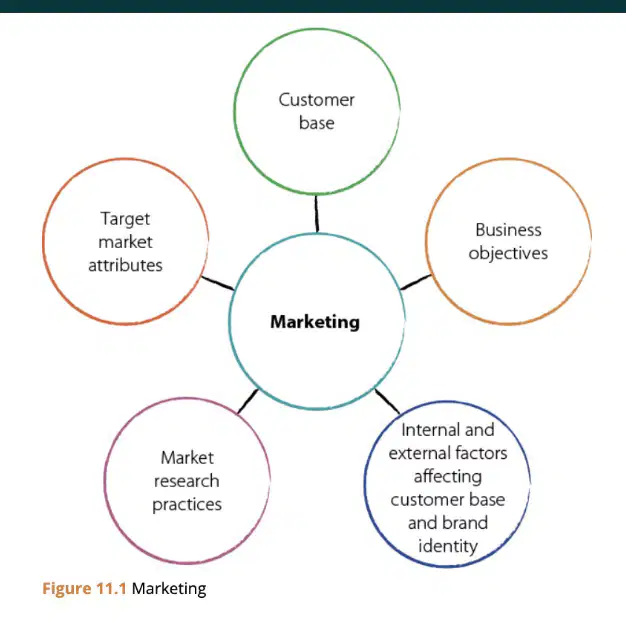
Which of the following is NOT one of the key elements related to marketing as shown in the diagram?
Customer base
Business objectives
Financial accounting
Market research practices
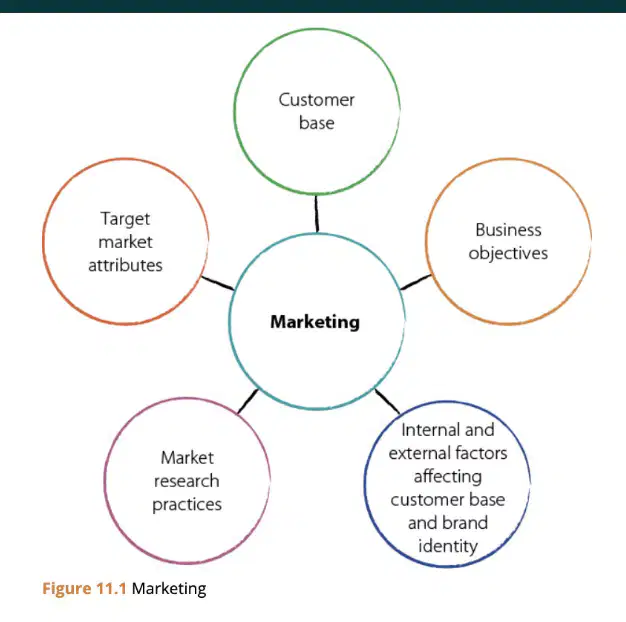
According to the diagram, which factor affects both the customer base and brand identity?
Market research practices
Target market attributes
Internal and external factors
Business objectives
(a) is directly connected to marketing in the diagram.

What is the main topic at the center of the diagram?
Sales
Marketing
Finance
Operations
Match each marketing focus with its correct description.
Satisfying customer and consumer needs
The main focus of the marketing concept
Maximizing production output
The main focus of the production concept
Reducing employee turnover
The main focus of the human resources concept
Increasing advertising budgets
The main focus of the promotional strategy concept
Which of the following is NOT one of the four essential elements of the marketing concept?
Increasing product prices
Customer satisfaction
Totally integrated effort by business
Key performance indicators (KPIs) to measure achievement
Why does the marketing concept reduce the risk of product failure?
Because market research is conducted before production
Because products are always sold at a discount
Because only one department is involved
Because it ignores customer needs
Which element of the marketing concept involves measuring achievement?
Key performance indicators (KPIs)
Customer satisfaction
Business objectives established
Totally integrated effort by business
What does an integrated and market-oriented approach in the marketing concept aim to achieve?
Meeting customer needs while achieving business goals
Reducing the number of employees
Focusing only on product quality
Ignoring market research
Which of the following is an essential element of the marketing concept?
Business objectives established
Random product launches
Ignoring customer feedback
Focusing only on profits
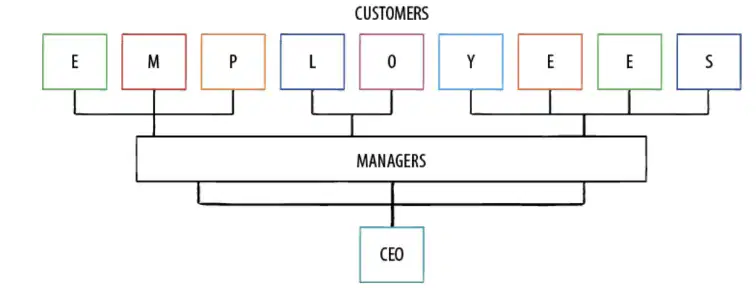
Match the following statements with the correct idea related to reversing the traditional organisation chart as described in the image.
To place customers at the top of the chain of command
Main idea of reversing the traditional organisation chart
To give more power to the CEO
Purpose of increasing CEO authority in the reversed chart
To reduce the number of employees
Goal of reducing workforce in the reversed chart
To eliminate the role of managers
Objective of removing managers in the reversed chart
Match each management purpose with its description according to the customer-oriented organisation chart.
To help employees take care of customers
Management's role is to support staff in serving clients
To make all decisions without employee input
Management does not seek feedback from employees
To focus only on increasing profits
Management's sole aim is financial gain
To report directly to the CEO
Management's main responsibility is to communicate with the CEO
Why are customers considered important in a customer-oriented organisation chart?
They provide the main source of revenue to the business
They manage the employees directly
They are responsible for hiring managers
They set the company’s internal policies

What does the Pareto Principle (80-20 Rule) state in the context of business revenue?
80% of the revenue comes from 20% of your customer base.
20% of the revenue comes from 80% of your customer base.
80% of the customers are new customers.
20% of the customers are loyal customers.
According to the marketing concept described, what mindset should a business adopt to prioritize the customer?
Customer comes first
Profit comes first
Product comes first
Competition comes first
Why is building strong customer relationships especially important for small businesses?
It leads to loyalty and repeat business without costly marketing.
It increases the need for expensive advertising.
It reduces the importance of customer service.
It focuses only on attracting new customers.
What does the Pareto Principle highlight as important for businesses?
Building a loyal customer base
Attracting only new customers
Reducing customer service
Focusing on product development only
What is the main topic of Lesson 2 as shown in the image?
Factors affecting the establishment of a customer base and the creation of a brand identity
The history of marketing strategies
How to manage business finances
The importance of teamwork in organizations
Which of the following is NOT a factor that affects how a business establishes its customer base and brand identity?
Internal business environment
External (macro and operating) environment
The color of the office walls
Customer base
What is one of the key elements in building a relationship with customers for a business?
Lowering prices
Establishing a brand identity
Hiring more employees
Increasing advertising budget
Which of the following is NOT involved in determining a brand for a business?
The attributes of the product or service
The positioning of the brand
The color of the packaging
A desirable benefit and strong belief in its value
Why should a business register its brand symbol as a trademark?
To increase sales immediately
To protect the brand and name for the future
To reduce production costs
To attract more employees
Match each business decision with the appropriate action after creating a brand identity.
Whether to launch as a manufacturer’s brand, private brand, or licensed brand
Decision about product branding strategy
Whether to increase employee salaries
Decision about employee compensation
Whether to change the company logo
Decision about visual brand elements
Whether to open new stores
Decision about business expansion
According to the text, what is at the heart of how a business and its staff behave?
The internal culture of a business
The external environment
The financial performance
The location of the business
Why is it important for businesses to seek and value customer feedback?
It helps put customers at the heart of the business.
It increases the price of products.
It reduces the need for marketing.
It eliminates competition.
What can happen if a business fails to meet community and customer expectations?
It can become a large threat to both the customer base and brand.
It will automatically increase profits.
It will expand internationally.
It will receive government support.
How can social media and the 24-hour news cycle benefit a business that conducts itself well?
They can help the business get its message to the community very quickly.
They can reduce the need for employees.
They can increase production costs.
They can eliminate all competition.
What is a potential risk of using communication tools like social media for businesses?
The public can use them to criticize a business if its actions are harmful or unethical.
They always guarantee positive publicity.
They reduce the need for customer service.
They automatically increase sales.
What must business owners and managers possess to establish their customer base and brand identity?
The required skills and knowledge
A large amount of money
International connections
Government approval
How do larger businesses typically handle marketing?
By employing a marketing manager and team
By ignoring marketing altogether
By relying only on word of mouth
By outsourcing all operations
What might smaller businesses do if they lack marketing knowledge?
Seek assistance from external consultants or rely on their own abilities.
Close down the business.
Only sell to friends and family.
Move to a different country.
Why is it important for employees to provide polite, friendly, and efficient service?
It helps ensure a positive relationship with customers.
It increases the cost of products.
It reduces the need for training.
It guarantees instant profits.
What is one reason businesses should consider current economic conditions?
To affect their customer base and brand identity.
To increase their product prices.
To reduce their workforce.
To avoid paying taxes.
What might a business do if economic conditions are strong?
Expand its customer base.
Reduce its marketing efforts.
Lay off employees.
Decrease product quality.
How should a business respond during more difficult or challenging economic times?
Change its strategy to provide more value for money to its customer base.
Increase prices for all products.
Stop advertising completely.
Ignore customer feedback.
How have technological developments impacted businesses?
They have helped businesses develop their customer base and brand identity.
They have made businesses less efficient.
They have reduced the need for customer service.
They have eliminated the need for marketing.
What is one way social media can affect a business?
It can provide customers with unprecedented access to information about businesses.
It can prevent customers from learning about new products.
It can stop businesses from expanding.
It can reduce the need for technology.
What is a potential negative impact of social media on businesses?
A business can be negatively impacted by customer dissatisfaction due to a bad review.
A business can increase its profits instantly.
A business can avoid competition.
A business can ignore customer needs.
The main purpose of legislation at both federal and state levels regarding businesses in Australia is to (a) .
Which Act regulates fair trading in Australia and is administered by the Australian Competition and Consumer Commission (ACCC)?
Competition and Consumer Act 2010
Fair Trading Act 2012
Australian Securities and Investments Act
Australian Prudential Regulation Act
Which organization began legal proceedings against Telstra, Optus, and TPG in 2021 for allegedly misleading claims about NBN plans?
Australian Competition and Consumer Commission (ACCC)
Consumer Affairs Victoria
Australian Securities and Investments Commission (ASIC)
Australian Prudential Regulation Authority (APRA)
Who administers the Australian Consumer Law and Fair Trading Act 2012 in Victoria?
Consumer Affairs Victoria
Australian Competition and Consumer Commission (ACCC)
Australian Securities and Investments Commission (ASIC)
Australian Prudential Regulation Authority (APRA)
What is the role of the Australian Securities and Investments Commission (ASIC) and the Australian Prudential Regulation Authority (APRA)?
To act as corporate watchdogs to protect consumers from misleading statements by businesses.
To regulate international trade agreements.
To set prices for consumer goods.
To manage the Australian stock exchange.
Which of the following generations is NOT mentioned as part of the four generations of people in the workforce with disposable income?
Generation X
Generation Y (millennials)
Generation Z (iGeneration)
Silent Generation
Why is it important for businesses to avoid a 'one size fits all' approach to marketing?
It may not reach all potential customer bases and could alienate important demographics.
It is more expensive to create multiple marketing strategies.
It is required by law to have different marketing approaches.
It increases the risk of product defects.
What is one major benefit for businesses that offer product customisation?
It allows businesses to charge a higher price and increases customer loyalty.
It reduces production costs.
It guarantees government subsidies.
It eliminates the need for marketing.
What negative effect can mistreating customers have on a business?
It can lead to a detrimental effect, such as customers choosing competitors.
It increases customer loyalty.
It guarantees higher sales revenue.
It improves the business’s reputation.
What was Origin Energy accused of in 2021?
Making a unilateral change to customers' hardship plans and failing to consider their ability to repay.
Offering free customisation to all customers.
Lowering energy prices for all customers.
Expanding into international markets.
What has been a key strategy for major Australian supermarket chains to attract customers since the arrival of ALDI in 2001?
Reducing everyday shelf prices on popular products
Increasing the number of store employees
Expanding internationally
Focusing only on online sales
According to Roy Morgan Research, what percentage of the Australian supermarket market did ALDI capture?
12.4%
32.9%
26.5%
20%
How many stores does ALDI operate in Australia as mentioned in the text?
570
1000
800
400
Which two supermarket chains are mentioned as ALDI's main competitors in Australia?
Woolworths and Coles
IGA and FoodWorks
Costco and Target
Big W and Kmart
In 2021, what recognition did ALDI receive from the CANSTAR Survey?
Rated as customers' favourite supermarket for the fourth consecutive year
Awarded for best advertising campaign
Recognized for having the most stores in Australia
Named the oldest supermarket chain
(a) was NOT mentioned as a reason for ALDI's high customer satisfaction.
Who is the CEO mentioned in the intro video about marketing masterclass?
Terence Reilly
John Smith
Sarah Johnson
Emily Brown
What is the main topic of the intro video?
Why All Brands Should Study Stanley Cup CEO Terence Reilly's Marketing Masterclass
How to Start a Business
The History of Marketing
Branding Strategies for Small Businesses
Match the following business actions with their corresponding purposes or outcomes.
To develop and analyze new and existing information for decision-making
Main purpose of market research
To increase the price of products
Reason for raising product prices
To reduce the number of employees
Purpose of downsizing staff
To eliminate competition completely
Goal of monopolistic strategies
Which of the following is NOT a benefit of market research for a business?
Reducing the level of risk or uncertainty attached to introducing a new product or service
Assessing current products, advertisements, and packaging
Predicting future changes or trends in a product or service
Guaranteeing immediate profit for every product launched
How does market research help businesses with their products and services?
By determining whether changes need to be made to current products, advertisements, and packaging
By increasing the cost of production
By ignoring customer needs
By focusing only on existing customers
Market research helps businesses to satisfy the needs of which groups?
Only potential customers
Only existing customers
Both potential and existing customers
Only business owners

