
 Worksheets
Exam 1 Quizziz
Total questions: 210
Worksheet time: 3hrs 10mins
Which of the following is a property of water that makes it essential for life?
It is non-polar
It has a high specific heat capacity
It is a good conductor of electricity
It is a solid at room temperature
What type of bond involves the sharing of electron pairs between atoms?
Ionic bond
Covalent bond
Metallic bond
Hydrogen bond
The atomic number of an element is determined by the number of:
Neutrons
Protons
Electrons in the outer shell
Nucleons
Which of the following best describes a hydrogen bond?
A bond between two hydrogen atoms
An attraction between a hydrogen atom and an electronegative atom
A bond formed by sharing electrons
A bond formed by transferring electrons
What is the mass number of an atom with 11 protons and 12 neutrons?
11
12
23
1
Which element is the most electronegative?
Oxygen
Fluorine
Nitrogen
Chlorine
Which of the following is a polar molecule?
O2
CO2
H2O
N2
What type of bond is formed when one atom donates an electron to another atom?
Covalent bond
Ionic bond
Metallic bond
Hydrogen bond
Which property of water allows it to dissolve many substances?
Its non-polar nature
Its polarity
Its high density
Its low boiling point
Which of the following best describes electronegativity?
The ability of an atom to lose electrons
The ability of an atom to attract electrons in a bond
The number of protons in an atom
The mass of an atom
Which of the following is an example of a non-polar covalent bond?
H2O
NaCl
O2
NH3
If an atom has 17 protons and 18 neutrons, what is its mass number?
17
18
35
1
Which of the following statements about hydrogen bonds is true?
They are stronger than covalent bonds
They are responsible for water’s high boiling point
They involve the transfer of electrons
They only occur in ionic compounds
Why does ice float on liquid water?
Ice is denser than liquid water
Ice is less dense than liquid water
Ice and liquid water have the same density
Ice contains more protons than liquid water
How does the electronegativity of elements change across a period in the periodic table?
It decreases from left to right
It increases from left to right
It remains constant
It increases and then decreases
Which of the following molecules would you expect to have the highest boiling point due to hydrogen bonding?
CH4
NH3
CO2
O2
Given the atomic number and mass number, how do you calculate the number of neutrons in an atom?
Subtract the atomic number from the mass number
Add the atomic number and mass number
Subtract the mass number from the atomic number
Divide the mass number by the atomic number
Why is water considered a universal solvent?
It is non-polar and dissolves all substances
It can dissolve both polar and ionic substances due to its polarity
It has a low boiling point
It forms covalent bonds with solutes
Which of the following best explains why ionic compounds tend to dissolve in water?
Water molecules are non-polar
The positive and negative ions are attracted to the partial charges of water molecules
Water forms covalent bonds with ions
Ionic compounds are non-polar
Which of the following statements best explains the significance of the atomic number?
It determines the number of neutrons in an atom
It identifies the element and its position in the periodic table
It is always equal to the mass number
It determines the number of isotopes
A molecule of H2O is held together by which type of bond?
Ionic bond
Polar covalent bond
Non-polar covalent bond
Metallic bond
Which of the following best describes the trend of electronegativity down a group in the periodic table?
It increases
It decreases
It remains the same
It fluctuates
Which of the following is a consequence of hydrogen bonding in water?
Water has a low surface tension
Water has a high heat of vaporization
Water is a poor solvent
Water molecules are non-polar
Which of the following best explains why water has a high specific heat capacity?
Water molecules are non-polar
Hydrogen bonds absorb heat when they break and release heat when they form
Water has a low molecular weight
Water is an ionic compound
Predict which of the following pairs of atoms would form a non-polar covalent bond.
Na and Cl
H and O
O and O
C and O
Given the following elements: Na , Cl , O , and F , which pair would form the most polar covalent bond? Explain your reasoning.
Na and Cl
O and F
Cl and F
H and F

Hydrogen bond
weak attraction between two molecules (ex: water to water) that is formed due to positive and negative charges attracting
Strong attraction between two molecules.
Weak attraction between two molecules that is formed due to charges repelling.
Strong attraction due to repelling of charges.

hydrophobic
water absorption
Water evaporating
Water fearing
Water saturation
Hydrogen bond
weak attraction between two molecules (ex: water to water) that is formed due to positive and negative charges attracting
Strong attraction between two molecules.
Weak attraction between two molecules that is formed due to charges repelling.
Strong attraction due to repelling of charges.
hydrophobic
water absorption
Water evaporating
Water fearing
Water saturation

hydrophilic
Repelled by water
Attracted to water
on top of water
anti water

Cohesion
repelling of molecules of the same substance
Saturation of molecules
attraction between molecules of the same substance

Adhesion
An attraction of water molecules
A repulsion of water molecules
Repulsion between molecules of different substances
An attraction between molecules of different substances

Surface Tension
A measure of the surface strength of a liquid
A measure of the strength of a liquid
A measure of the strength of a solid
A measure of the surface strength of a gas

Acid
any substance that forms H+ ions in solution (pH less than 7)
Any substance that forms H+ ions in solution (pH greater than 7)
Neutral on the pH system

Base
A substance that is neutral on a pH system
a substance that produces hydroxide ions in solution (pH more than 7)
a substance that produces less hydroxide ions in a solution (pH less than 7)
What you step on in baseball.

How does capillary action happen?
water is polar
it drags other water molecules up the tubes
it sticks to the tubes
ALL OF THESE REASONS
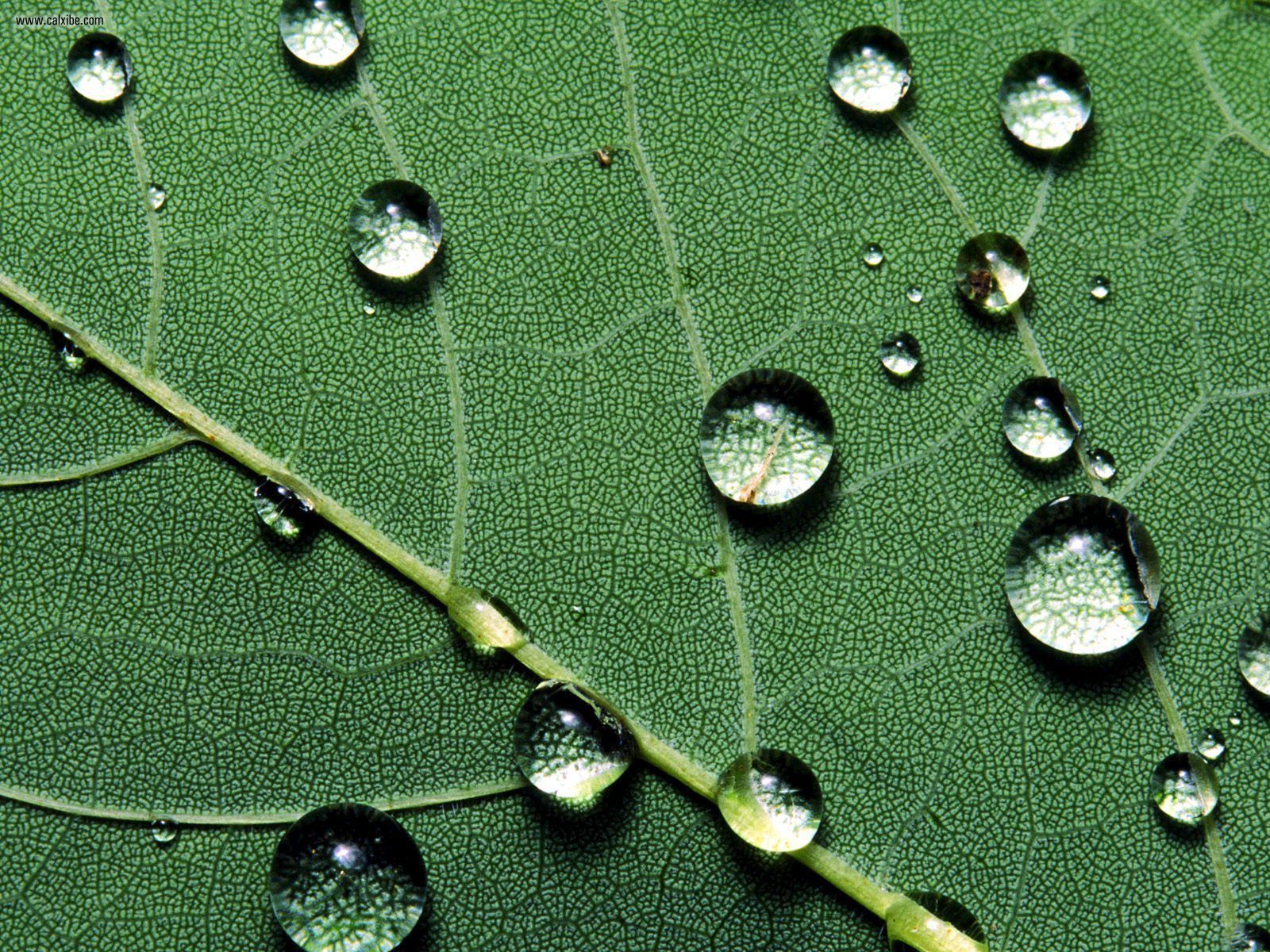
Refer to the picture of water sticking to a leaf; this is occurring because of:
Adhesion
Cohesion

What property of water allows water to flow against gravity?
Polarity
Cohesion
Capillary Action
Adhesion
A high specific heat means...
It heats up quickly with energy added
It requires more energy to change temperature
Which term refers to water having partial positive and a partial negative charge?
cohesion
surface tension
polarity
adhesion
Water is a universal solvent because it...
It can be found anywhere
It freezes when it gets cold
floats when frozen
Dissolves most substances
Why does ice float?
As water freezes, it expands and its density decreases.
As water freezes, it takes up more hydrogen from the atmosphere, causing it to have a greater buoyancy.
As water freezes, air becomes trapped between the hydrogen bonds of water molecules.
As water freezes, it takes up more oxygen from the atmosphere, causing it to have a greater buoyancy.

What elements generally make an ionic bond ?
Metal and nonmetal
2 or more nonmetals
2 or more metals
2 elements

An ionic bond is formed when
Valence electrons are shared.
Valence electrons surround the cations.
Valence electrons are transferred between atoms.
Valence electrons are completely transferred between two metals.
What is a valence electron?
an electron that is found in the outermost shell of an atom
an electron found in the innermost shell of an atom
an electron found in the middle shell
an electon found in the nucleus

What is the number of valence electrons of Oxygen?
1
2
6
8

Predict the bond that will form between Se and Cl
Ionic-bond
Covalent-bond
Metallic-bond
Hydrogen-bond

Predict the bond formed between Be and F
Covalent-bond
Ionic-bond
Metallic-bond
Hydrogen-bond
What is the charge on a Hydrogen ion?
+1
1
2

Why don't noble gases form bonds?
Noble gases do form bonds
They all have a full octet
They only bond with each other

Which of the following structures is found in all prokaryotic cells?
Nucleus
Cell membrane
Mitochondria
Chloroplast
What is the primary function of the mitochondria in eukaryotic cells?
Protein synthesis
Energy production
Photosynthesis
Storage of genetic material
Which organelle is present in plant cells but not in animal cells?
Ribosome
Chloroplast
Nucleus
Golgi apparatus
Which structure is responsible for controlling what enters and leaves an animal cell?
Cell wall
Cell membrane
Nucleus
Vacuole
Which of the following is a characteristic shared by both Bacteria and Archaea?
Presence of a nucleus
Lack of membrane-bound organelles
Peptidoglycan in cell walls
Ability to perform photosynthesis
Which evidence supports the endosymbiont theory?
Mitochondria have their own DNA
Ribosomes are found in the cytoplasm
Nucleus contains chromosomes
Lysosomes digest waste
What is the main function of ribosomes in a cell?
DNA replication
Protein synthesis
Lipid storage
Energy production
Which of the following is NOT found in prokaryotic cells?
Cell wall
Nucleus
Cytoplasm
Ribosome
Which organelle is responsible for packaging and modifying proteins in eukaryotic cells?
Endoplasmic reticulum
Golgi apparatus
Lysosome
Nucleolus
Which of the following is a unique feature of Archaea compared to Bacteria?
Presence of peptidoglycan in cell walls
Ability to survive in extreme environments
Lack of ribosomes
Presence of mitochondria
Which organelle is responsible for photosynthesis in plant cells?
Mitochondria
Chloroplast
Nucleus
Ribosome
Which structure provides support and protection to plant cells but is absent in animal cells?
Cell wall
Cell membrane
Nucleus
Lysosome
Which of the following best describes the genetic material in prokaryotic cells?
Enclosed in a nucleus
Circular DNA in the cytoplasm
Linear chromosomes in the nucleus
Found in mitochondria
Which organelle is responsible for breaking down waste in animal cells?
Chloroplast
Lysosome
Ribosome
Nucleolus
Which of the following is a function of the Smooth endoplasmic reticulum?
Producing ATP
Synthesizing lipids/Filtering the body
Digesting cellular waste
Synthesizing Proteins
Compare the cell walls of Bacteria and Archaea. Which statement is correct?
Both have peptidoglycan in their cell walls
Only Bacteria have peptidoglycan; Archaea do not
Only Archaea have peptidoglycan; Bacteria do not
Neither has a cell wall
A scientist observes a cell with a nucleus, mitochondria, and chloroplasts. What type of cell is it?
Prokaryotic cell
Animal cell
Plant cell
Bacterial cell
Which organelle would you expect to be more numerous in a muscle cell compared to a skin cell, and why?
Chloroplasts, because muscle cells need to photosynthesize
Mitochondria, because muscle cells require more energy
Lysosomes, because muscle cells digest more waste
Nuclei, because muscle cells have more DNA
If a cell lacks a nucleus and membrane-bound organelles, which type of cell is it?
Plant cell
Animal cell
Prokaryotic cell
Fungal cell
Why do plant cells have large central vacuoles, while animal cells do not?
To store water and maintain cell shape
To produce energy
To perform photosynthesis
To digest food
Which feature distinguishes eukaryotic cells from prokaryotic cells?
Presence of ribosomes
Presence of membrane-bound organelles
Presence of a cell wall
Ability to reproduce
How does the endosymbiont theory explain the origin of mitochondria in eukaryotic cells?
Mitochondria evolved from the cell membrane
Mitochondria were once free-living bacteria engulfed by a host cell
Mitochondria formed from the nucleus
Mitochondria are formed by the Golgi apparatus
A cell is observed to have a cell wall, no nucleus, and circular DNA. What type of organism is it most likely from?
Animal
Plant
Bacterium
Fungi
Which of the following best explains why antibiotics are effective against bacteria but not against Archaea?
Archaea have a different cell wall structure
Archaea have mitochondria
Bacteria lack ribosomes
Bacteria are eukaryotic
A mutation causes a plant cell to lack chloroplasts. What is the most likely consequence?
The cell cannot produce proteins
The cell cannot perform photosynthesis
The cell cannot divide
The cell cannot store water
Given that mitochondria and chloroplasts have their own DNA and ribosomes, what can you infer about their evolutionary history?
They likely originated from symbiotic bacteria
They are unrelated to prokaryotes
They evolved from the endoplasmic reticulum
They are formed by the Golgi apparatus
A researcher finds a single-celled organism living in a hot spring with no peptidoglycan in its cell wall. What is the most likely classification of this organism?
Bacterium
Archaean
Plant cell
Animal cell
Explain why animal cells are more flexible in shape compared to plant cells.
Animal cells have a rigid cell wall
Animal cells lack a cell wall, allowing flexibility
Plant cells have more mitochondria
Plant cells lack a cell membrane
A scientist is comparing two cells: one has a nucleus and mitochondria, the other does not. What reasoning can the scientist use to classify these cells?
The cell with a nucleus is prokaryotic; the other is eukaryotic
The cell with a nucleus is eukaryotic; the other is prokaryotic
Both are prokaryotic
Both are eukaryotic
If a eukaryotic cell's lysosomes are not functioning properly, what effect would this have on the cell?
The cell would be unable to produce energy
The cell would accumulate waste and damaged organelles
The cell would not be able to photosynthesize
The cell would lose its shape
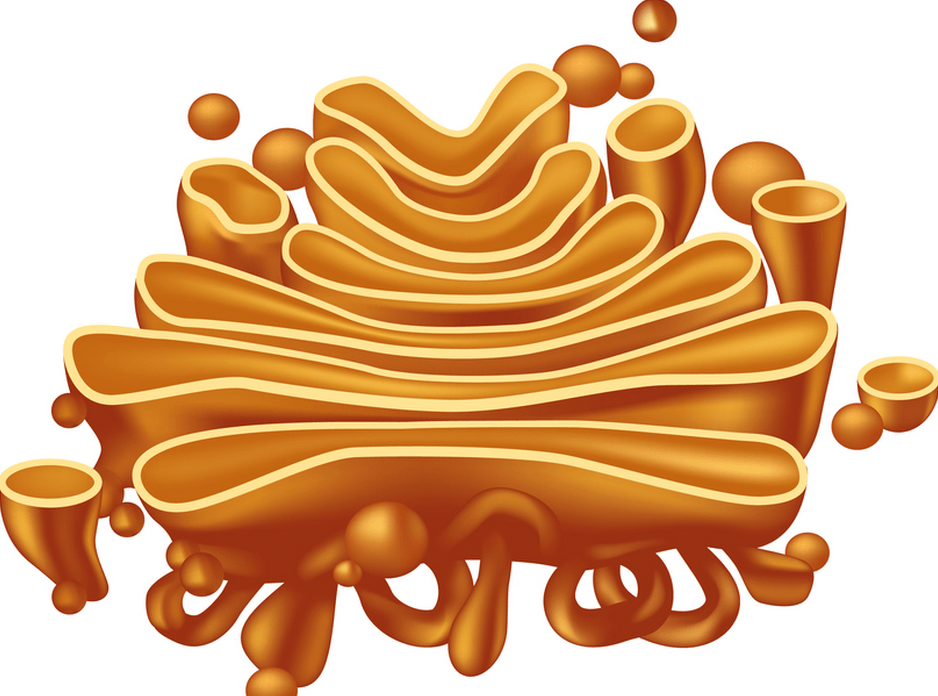
I am a protein packaging and shipping machine! Who am I?
vacuole
ribosome
mitochondrion
golgi apparatus

I make proteins for the cell. What am I?
ribosome
cell membrane
nucleus
chloroplast

In what organelle is the genetic material found inside?
cell membrane
chloroplast
nucleus
ribosome

The Golgi apparatus _____.
packages cell products for export
eliminates waste
stores DNA
makes energy
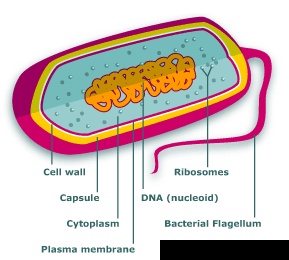
Which type of cell?
Prokaryote
Eukaryote

Using this image, what organelle is C?
Cell Wall
Mitochondria
Large Cell Vacuole
Chloroplast

Identify the structure that is indicated by the arrow in the image.
cell wall
central vacuole
chloroplast
cell membrane

The arrow is showing the fluid inside the cell that surrounds the cell organelles. What is the arrow pointing to in the cell?
cytoplasm
mitochondria
ribosomes
nucleus
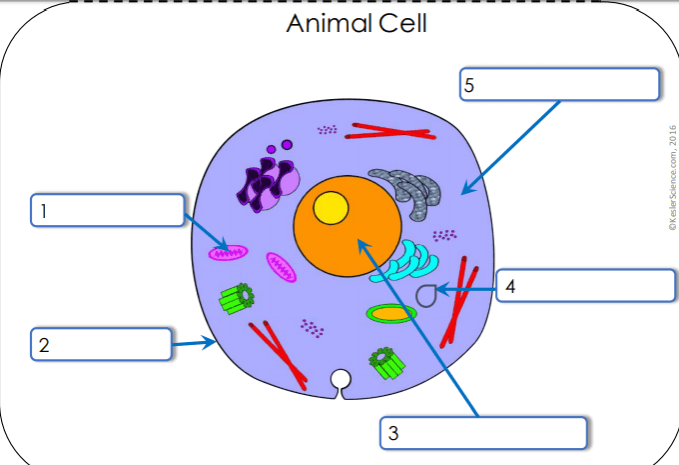
What is #1 in the diagram?
nucleus
cell wall
cytoplasm
mitochondrion

Using this image, what organelle is D?
Endoplasmic Reticulum
Flagella
Rough ER
Smooth ER

Name structure #6.
rough ER
Golgi body
Smooth ER
cytoplasm
These form the basis of the "skeleton" inside the cell.
Cillia
Cytosol
Cytoplasm
Microtubles
Which of these are functions of the cytoskeleton?
It helps to maintain cell shape.
It provides a place for chemical reactions to occur.
It plays important roles in both the intracellular movement of substances and in cell division.
It holds organelles in place, and for some cells, it enables cell movement.
It creates new proteins, lipids, and other organic molecules
Which of these are cytoskeleton fibers?
microtubules
intermediate filaments
microfilaments
cytoplasm
microflagella
These are hollow cylinders and are the thickest of the cytoskeleton structures and most commonly made of filaments which are polymers of tubulin.
microtubles
intermeadiate filaments
microfilaments
cytoplasm
These are made of two thin actin chains that are twisted around one another. They are found in almost every cell, and are numerous in muscle cells and in cells that move by changing shape
microtubles
intermeadiate filaments
microfilaments
cytoplasm
These organize the inside structure of the cell by holding organelles and providing strength. They are also structural components of the nuclear envelope. Some are made of the protein keratin are found in skin, hair, and nails cells.
microtubles
intermeadiate filaments
microfilaments
cytoplasm
Which of the following is a characteristic shared by all living organisms?
Ability to photosynthesize
Response to stimuli
Having a backbone
Living in water
What is the correct order of the levels of biological organization from smallest to largest?
Cell, organ, tissue, organism
Cell, tissue, organ, organism
Organism, organ, tissue, cell
Tissue, cell, organ, organism
Which step comes first in the scientific method?
Forming a hypothesis
Making observations
Conducting an experiment
Drawing conclusions
Which of the following best defines a hypothesis?
A proven fact
A testable prediction
A list of materials
A scientific law
Which of the following is NOT a characteristic of living things?
Growth and development
Reproduction
Ability to move
Response to environment
Which level of biological organization is directly above the cell?
Organ
Tissue
Organ system
Organism
What is the main purpose of a control group in an experiment?
To provide a comparison
To increase the sample size
To test multiple variables
To collect more data
Which of the following is an example of homeostasis?
A plant growing toward light
Sweating to cool the body
A bird flying south for winter
A fish swimming in water
Which of the following is the correct sequence of steps in the scientific method?
Hypothesis, observation, experiment, conclusion
Observation, hypothesis, experiment, conclusion
Experiment, observation, hypothesis, conclusion
Conclusion, experiment, hypothesis, observation
Which of the following is an example of a population?
All the fish, plants, and insects in a pond
All the frogs in a pond
All the ponds in a city
All the water in a pond
A scientist wants to test the effect of sunlight on plant growth. Which variable should be kept constant?
Amount of sunlight
Type of plant
Height of the plant
Growth rate
Which of the following best describes the relationship between tissues and organs?
Tissues are made up of organs
Organs are made up of tissues
Tissues and organs are the same
Organs are smaller than tissues
If a student wants to test whether fertilizer affects plant height, what should be the independent variable?
Amount of water
Amount of fertilizer
Plant height
Type of plant
Which of the following is an example of applying the scientific method?
Reading about plant growth
Measuring plant height after adding fertilizer
Guessing why plants grow
Drawing a picture of a plant
Which scenario best illustrates the concept of adaptation?
A bird eating seeds
A cactus storing water in its stem
A fish swimming in a pond
A dog barking
A student observes that bread mold grows faster in warm temperatures. Which step of the scientific method is this?
Forming a hypothesis
Making an observation
Conducting an experiment
Drawing a conclusion
Which of the following best explains why a control group is important in an experiment?
It allows for more data to be collected
It provides a baseline for comparison
It increases the number of variables
It ensures the experiment is faster
Which of the following is an example of a community in an ecosystem?
All the rocks in a river
All the fish, plants, and insects in a river
All the water in a river
All the fish in a river
A student wants to know if the type of soil affects plant growth. Which is the dependent variable?
Type of soil
Amount of water
Plant growth
Amount of sunlight
Which of the following best describes the difference between a hypothesis and a theory?
A hypothesis is a testable prediction; a theory is a well-supported explanation
A hypothesis is proven; a theory is not
A hypothesis is a law; a theory is a guess
A hypothesis is an observation; a theory is an experiment
A researcher observes that a certain plant species only grows in acidic soil. She hypothesizes that soil pH affects plant growth. What should be her next step?
Publish her results
Design an experiment to test the hypothesis
Change her hypothesis
Ignore the observation
You are given a mixture of living and non-living things. How would you determine which are living?
Check if they can move
Test for all characteristics of life, such as growth, reproduction, and response to stimuli
See if they are green
Measure their temperature
A student conducts an experiment to test the effect of light on plant growth. She finds that plants in the dark grew taller but were weaker. What is the best conclusion?
Plants do not need light
Light affects both the height and strength of plants
Plants grow better in the dark
Light has no effect on plants
A scientist wants to test if a new drug reduces fever. She gives the drug to one group and a placebo to another. What is the independent variable?
The group receiving the drug
The presence of fever
The temperature of the patients
The placebo
If a student wants to test the effect of temperature on enzyme activity, which would be an appropriate control?
Using different enzymes
Keeping the enzyme concentration constant
Changing the pH
Using different substrates
A group of students wants to investigate whether salt affects the boiling point of water. Which is the best experimental design?
Boil water with different amounts of salt and measure the boiling point each time
Boil water with the same amount of salt each time
Boil water without measuring the temperature
Boil water and salt separately
A scientist observes that a certain bacteria can survive in extreme heat. She hypothesizes that the bacteria have special proteins. How should she test her hypothesis?
Compare the proteins in these bacteria to those in bacteria that cannot survive heat
Grow the bacteria in cold temperatures
Ignore the observation
Change the bacteria’s environment
A student wants to know if music affects plant growth. She plays music to one group of plants and not to another. What is the dependent variable?
Type of music
Plant growth
Number of plants
Amount of water
A researcher finds that a certain chemical increases the rate of cell division in plants. What is the best way to confirm this result?
Repeat the experiment several times
Change the chemical used
Use a different plant species
Stop the experiment
A student hypothesizes that sugar will dissolve faster in hot water than in cold water. She tests this by dissolving sugar in both hot and cold water and timing the process. What is the best way to ensure her results are valid?
Use the same amount of sugar and water in each test
Use different types of sugar
Change the amount of water each time
Use different containers
Which of the following is a characteristic of life that allows organisms to maintain a stable internal environment?
Metabolism
Homeostasis
Evolution
Adaptation
Which example best demonstrates the characteristic of life known as metabolism?
A plant bending toward sunlight
A dog panting to cool down
A human digesting food to obtain energy
A bird migrating south for the winter
Which of the following is the monomer unit of proteins?
Nucleotide
Amino acid
Monosaccharide
Fatty acid
What type of bond links amino acids together in a protein?
Glycosidic bond
Peptide bond
Hydrogen bond
Phosphodiester bond
Which macromolecule is primarily responsible for storing genetic information?
Protein
Lipid
Nucleic acid
Carbohydrate
Which of the following best describes a saturated fat?
Contains double bonds between carbon atoms
Contains only single bonds between carbon atoms
Is liquid at room temperature
Is a polymer of amino acids
What is the primary structure of a protein?
The sequence of amino acids
The folding into alpha helices and beta sheets
The overall 3D shape
The arrangement of multiple polypeptide chains
Which reaction results in the breakdown of polymers into monomers?
Dehydration reaction
Hydrolysis reaction
Condensation reaction
Oxidation reaction
Which group is unique to each amino acid and determines its properties?
Amino group
Carboxyl group
R group
Phosphate group
What is the main function of carbohydrates in cells?
Store genetic information
Provide energy
Catalyze reactions
Form cell membranes
Which of the following best describes the secondary structure of a protein?
The sequence of nucleotides
The folding into alpha helices and beta pleated sheets
The joining of two monosaccharides
The arrangement of phospholipids
Which bond forms between nucleotides in a nucleic acid?
Peptide bond
Glycosidic bond
Phosphodiester bond
Disulfide bond
Given a diagram of a phospholipid bilayer, identify the hydrophobic and hydrophilic regions.
Both tails are hydrophilic, heads are hydrophobic
Both heads are hydrophilic, tails are hydrophobic
Both heads and tails are hydrophobic
Both heads and tails are hydrophilic
Compare the structure of alpha and beta glucose. Which statement is correct?
They have different molecular formulas
They differ in the orientation of the hydroxyl group on carbon 1
Alpha glucose is a lipid, beta glucose is a protein
Beta glucose has more carbons than alpha glucose
Which process would you use to join two monosaccharides into a disaccharide?
Hydrolysis
Dehydration synthesis
Denaturation
Phosphorylation
Explain how chaperone proteins assist in protein folding.
They break peptide bonds
They prevent incorrect folding by stabilizing intermediate structures
They add phosphate groups to proteins
They hydrolyze ATP to form amino acids
Which of the following best explains why unsaturated fats are liquid at room temperature?
They have more hydrogen atoms
Their double bonds create kinks, preventing tight packing
They are made of amino acids
They have a higher melting point
A protein loses its shape and function when exposed to high heat. What is this process called?
Hydrolysis
Denaturation
Polymerization
Dehydration
Given a sequence of amino acids, predict how a change in the R group of one amino acid might affect the protein’s tertiary structure.
It will have no effect
It could alter the folding and function of the protein
It will only affect the primary structure
It will turn the protein into a carbohydrate
Analyze why hydrolysis reactions are important in digestion.
They build new proteins from amino acids
They break down macromolecules into absorbable monomers
They create peptide bonds
They form phospholipid bilayers
Evaluate the impact of a mutation that changes a hydrophobic amino acid to a hydrophilic one in the core of a protein.
The protein will become more stable
The protein may misfold or lose function
The protein will not be affected
The protein will become a nucleic acid
Given a diagram of a DNA double helix, explain how phosphodiester bonds and hydrogen bonds contribute to its structure.
Phosphodiester bonds hold the two strands together, hydrogen bonds link nucleotides in a strand
Phosphodiester bonds link nucleotides within a strand, hydrogen bonds hold the two strands together
Both bonds only occur in proteins
Both bonds are found in carbohydrates
What is the function of Carbohydrates?
Long-term energy
Muscle development
Short-term energy
enzyme activity
Which macromolecule has amino acids as monomers?
Carbohydrates
Lipids
Proteins
Nucleic acids
Which one of the macromolecules are instrumental in the cell membrane?
Carbohydrates
Lipids
Proteins
Nucleic acids
This macromolecules is responsible for providing our genetic material. Choose the macromolecule that best fits.
Carbohydrates
Lipids
Proteins
Nucleic acids
My monomers are glycerol and fatty acids. Which macromolecule am I?
Carbohydrates
Lipids
Proteins
Nucleic acids
My monomers are monosaccharides. Which macromolecule am I?
Carbohydrates
Lipids
Proteins
Nucleic acids
My monomers consist of a phosphate group, a sugar, and a nitrogenous base. Which macromolecule am I?
Carbohydrate
Lipids
Proteins
Nucleic Acids
Which of the following is a simple sugar or monosaccharide?
glucose
starch
protein
lipid
The building blocks or monomers of carbohydrates (sugars) are?
amino acids
fatty acids
monosaccharides
nucleotides
What are the building blocks or monomers for nucleic acids?
monosaccharides
amino acids
nucleotides
fatty acids
Dehydration reaction joins monomers and makes a polymer. True/ False
True
False
What is the function of lipids?
Perform cell's functions/tasks
Fast energy
Energy storage
Alter other biomolecules
Store information for cells

Is found in the cell membrane as a bilayer.
lipids
protein
nucleic acid
carbohydrate
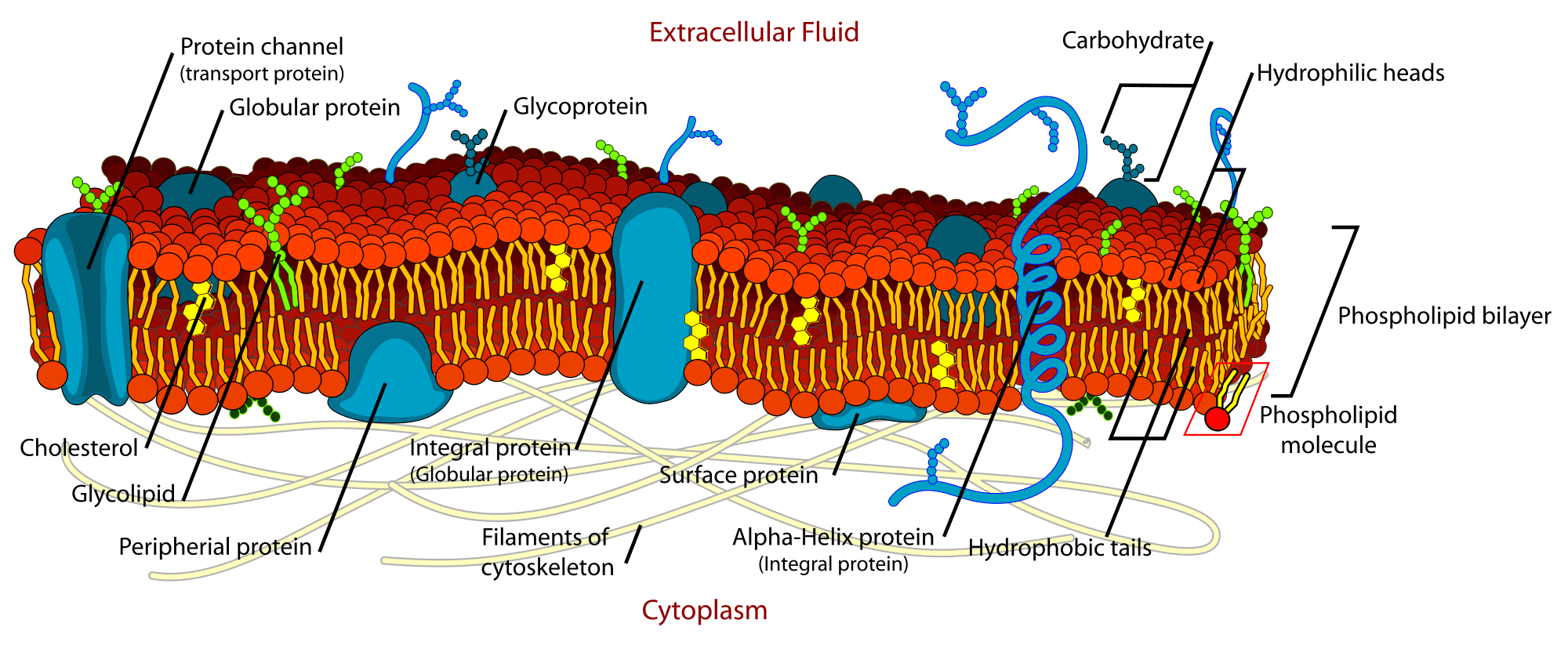
What is this image?
cell membrane
mitochondria
golgi apparatus
endoplasmic reticulum

When something is 'water fearing' it is....
Hydrophobic
Hydrophilic
Hydroelectric
Hydrochloric

When something is 'water loving' it is.....
Hydrophobic
Hydrophilic
Hydroelectric
Hydroloric
Lipids do not dissolve in water because they are _______________
polar
water soluble
non-polar

The C-O-O-H on the end of a fatty acid structure is called a _______
carboxyl group
R group
fatty acid
amino acid

In the phospholipid, the polar head is considered what type of structure?
hydrophobic
insoluble
hydrophilic

What type of fat is this?
saturated fatty acid
unsaturated fatty acid
steroid
wax
Waxes, oils and fats are examples of
Carbohydrates
Lipids
Proteins
Nucleic Acids

Carbon, Hydrogen, Oxygen and Nitrogen are elements in what biomolecule?
Carbohydrate
Lipid
Protein
Nucleic acid

Glycerol and fatty acids combine to form...?
Carbohydrates
Lipids
Proteins
Nucleic Acids

What type of macromolecule is being represented in this image?
carbohydrate
lipid
protein
nucleic acid

Which major macromolecule is being represented in this image?
carbohydrate
lipid
protein
nucleic acid

Examine the structure of this monomer. Which macromolecule group does it belong to?
carbohydrates
lipids
nucleic acids
proteins

Examine the structure of this monomer. Which macromolecule group does it belong to?
carbohydrates
lipids
nucleic acids
proteins
Which function(s) listed below do lipids provide for living things?
short-term energy storage
long-term energy storage
store genetic information
build cell walls
Which function(s) listed below do proteins provide for living things?
short-term energy storage
long-term energy storage
store genetic information
structural support
speed up chemical reactions
Which function(s) listed below do carbohydrates provide for living things?
short-term energy storage
long-term energy storage
store genetic information
build cell membranes
Which function(s) listed below do nucleic acids provide for living things?
short-term energy storage
long-term energy storage
store genetic information
structural support
speed up chemical reactions
Saturated fats are ___ at room temperature whereas unsaturated fats are ___ at room temperature.
There are 20 different amino acids, what differs between them?
the presence/absence of an amino group
the presence/absence of a carboxyl group
the R side chain
all of the above
An amino acid that has only carbon & hydrogen in its R side chain would be classified as?
nonpolar
polar
charged
What is the primary structure of a protein?
the length of the amino acid chain
the sequence of amino acids in the chain
amino acids connected via peptide bonds
all of the above
Which of the following is NOT a type of secondary structure found in proteins?
antiparallel double helix
alpha helix
beta pleated sheet
What interactions can cause a protein to fold into its tertiary structure?
opposite charge attractions between side chains
nonpolar interactions between side chains
hydrogen bonding between side chains
all of the above
A protein that is comprised of two or more subunits has (a) structure as its highest level.


Why is folding so important in proteins?
It gives them a unique, functional shape
It makes them look tidier
It makes every protein molecule different from the next even if they are the same type
The folding is random so is not that important at all
The chain of amino acids folds and coils on itself
Primary
Secondary
Tertiary
Quaternary
The entire polypeptide forms a three-dimensional structure
Primary
Secondary
Tertiary
Quaternary
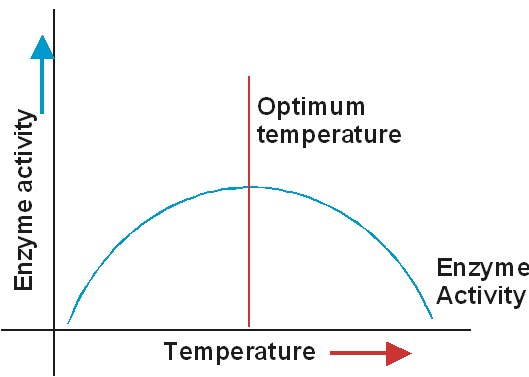
Which of the following is directly responsible for the shape of an enzyme/protein?
The amino acid sequence of the protein and the properties of the amino acids that make up the protein.
The temperature of the surrounding environment.
The pH of the surrounding environment.
The amount of substrate present.
During the tertiary folding stage, polar amino acids will orient themselves on the ____________ of the molecule.
interior
exterior
positive side
negative side

What is the primary role of chaperone proteins in cells?
To degrade misfolded proteins
To assist in the folding of proteins into their normal shapes
To transport proteins across cell membranes
To synthesize new proteins