
 Worksheets
Par-Ici-Methode-de-Francais-A1 Episode 9 - Au quotidien
Total questions: 49
Worksheet time: 25mins
Associez chaque activité à la fréquence à laquelle elle est généralement réalisée.
Voyager à l'étranger
Quelque chose que vous pourriez faire une fois par an
Prendre des repas
Quelque chose que vous pourriez faire tous les jours
Grimper des montagnes
Quelque chose que vous pourriez faire occasionnellement
Écrire des romans
Quelque chose que vous pourriez faire sur plusieurs années
Laquelle de ces questions pourriez-vous poser à propos de votre routine quotidienne ?
Quelle est la capitale de la France ?
Quelles activités faites-vous chaque jour ?
Comment résolvez-vous des équations algébriques ?
Qui a gagné le dernier match de football ?
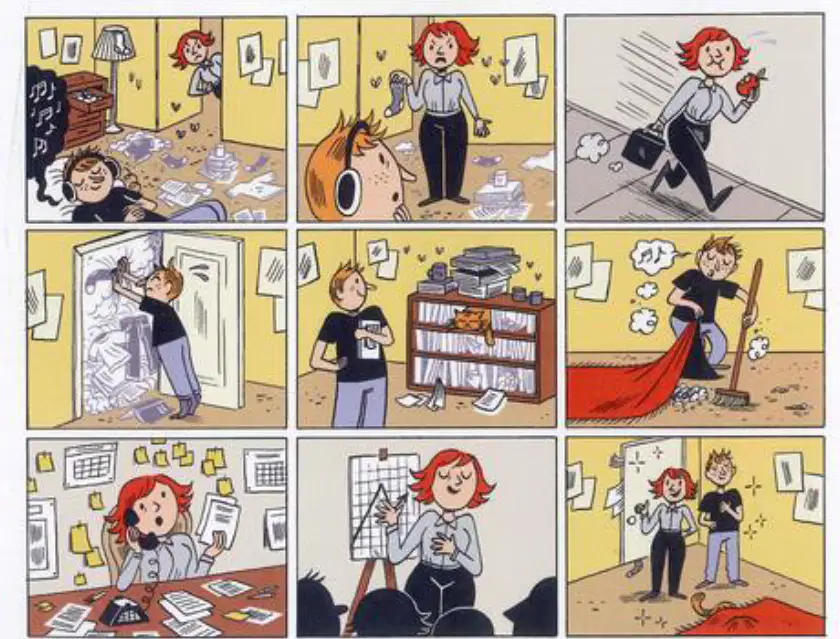
Quel est le thème principal illustré par la bande dessinée dans le matériel d'apprentissage ?
L'importance du sport
Un emploi du temps quotidien chargé
Préparer des vacances
Apprendre une nouvelle langue
Which of the following is the correct French pronoun for "the person who is speaking" (1st person singular)?
tu
il
je
on
What is the correct present tense form of "parler" (to speak) for "nous" (we)?
nous parlez
nous parlons
nous parlezons
nous parlont
Which verb means "to listen to music" in French?
Étudier
Écouter de la musique
Travailler
Cuisiner

Which activity is being performed in the image described above?
Laver la vaisselle
Regarder la télévision
Relaxer
Parler au téléphone
What is the correct present tense form of "travailler" (to work) for "il/elle/on"?
il/elle/on travaille
il/elle/on travaillons
il/elle/on travailles
il/elle/on travaillez
Which pronoun would you use in French to refer to "the person you are talking to" (2nd person singular)?
je
tu
il
on
What is always the same for each pronoun when conjugating regular -er verbs in the present tense?
The subject
The verb ending
The verb meaning
The tense
Which of the following is the correct present tense form of "écouter" (to listen) for "ils/elles"?
ils/elles écoutez
ils/elles écoutent
ils/elles écoutons
ils/elles écoute
Which pronoun would you use to refer to a group of women in French?
ils
elle
elles
il
What is the correct present tense form of "faire" for "nous"?
fais
faisons
fait
font

Match each activity in French with its corresponding English description.
Doing the laundry
Faire la lessive
Taking a nap
Faire une sieste
Walking a dog
Promener un chien
Shopping for groceries
Faire les courses
If you want to say "She prepares lunch" in French, which pronoun and verb form would you use?
Il prépare le déjeuner
Elle prépare le déjeuner
Elles prépare le déjeuner
Tu prépares le déjeuner
What is the French expression for "to do the laundry"?
Faire la vaisselle
Faire le lavage
Faire l’épicerie
Faire une promenade
Which pronoun would you use for "Marc et Paul" in French?
il
ils
elle
elles
To say "We do the shopping" in French, you would write: (a)
Which of the following is the correct present tense conjugation of the verb "aller" for "nous"?
nous allons
nous allez
nous va
nous vont
What is the correct preposition to use with a masculine noun when using the verb "aller"?
au
à la
à l'
aux
Which of the following sentences correctly uses the verb "aller" with a feminine noun?
Je vais à la piscine.
Je vais au parc.
Je vais aux toilettes.
Je vais à l'hôtel.
If you are going to the library, which preposition should you use with "aller"?
à la
au
aux
chez
Which of the following is the correct way to say "I go to my parents' house" in French?
Je vais chez mes parents.
Je vais à mes parents.
Je vais au parents.
Je vais à la parents.
What is the correct form of "aller" for "ils" or "elles" in the present tense?
vont
va
vas
allez
The preposition used with plural nouns when using "aller" is (a) .

Which activity is most likely associated with this image?
Aller à la piscine
Aller au cinéma
Aller à la bibliothèque
Aller à l'hôtel
When using "aller" before a singular noun starting with a vowel or mute h, which preposition is used?
à l'
au
à la
chez
Which of the following is an example of using "aller" with a profession or person's name?
Aller chez le dentiste
Aller au parc
Aller à la plage
Aller à la banque
What is the correct way to indicate an approximate time in French, as shown in the material?
Vers
Après
Pendant
Avant
Which verb form is used for "nous" (we) in the present tense of "prendre"?
prenons
prenez
prends
prend
To say "I take the bus at 7:30" in French, you should use the structure (a) .
Which of the following is an example of using "avant" (before) with a meal and an action, as described in the material?
Je lave la vaisselle après le dîner.
Je prends l’autobus à 7 h 30.
Je regarde la télévision après le souper.
Je mange du pain le matin.
What is the correct present tense form of "prendre" for "ils" (they)?
prennent
prenez
prends
prend
Which of the following actions would most likely be done "après le souper" (after dinner)?
Regarder la télévision
Prendre l’autobus
Boire du café
Déjeuner
If you want to say "At 5:30, I prepare dinner" in French, which structure should you use?
Heure + action
Action + heure
Action + repas
Repas + action
Which demonstrative determiner is used to indicate a specific week in French?
Ce
Cet
Cette
Ces
Which of the following best describes the difference between "action habituelle" and "action ponctuelle" as explained in the material?
Habitual actions happen once, punctual actions happen regularly.
Habitual actions are repeated, punctual actions are specific and one-time.
Habitual actions are always in the future, punctual actions are in the past.
Habitual actions are for weekends, punctual actions are for weekdays.
Lequel des exemples suivants est une « action ponctuelle » parmi les exemples donnés ?
Je regarde la télévision le soir.
Je vais à l'école le mardi.
Je vais au cinéma mardi après-midi.
Je travaille le week-end.
What is the purpose of using "Ce", "Cet", and "Cette" in the context of the material?
To indicate habitual actions
To indicate the time of day
To indicate a specific or punctual action
To indicate the subject of the sentence
Which of the following is an example of using the "tu" interrogatif in French to ask a question informally?
Tu vas-tu au travail à pied?
Nous allons au travail à pied?
Ils vont au travail à pied?
Vous allez au travail à pied?
What is the correct present tense conjugation of the verb "lire" for "nous"?
nous lisons
nous lisez
nous lis
nous lit
Which of the following is NOT a way to form a question in French using the "tu" interrogatif?
Using rising intonation: Tu vas au travail à pied?
Using "est-ce que": Est-ce que tu vas au travail à pied?
Inverting subject and verb: Vas-tu au travail à pied?
Adding "ne" before the verb: Ne tu vas au travail à pied?
You should NOT use the "tu" interrogatif with verbs conjugated with (a) and "vous".

L'activité montrée dans les images fournies dans le matériel est (a) .
If you want to ask someone if they listen to the radio in their car using the "tu" interrogatif, which is the correct question?
Ecoutes-tu la radio dans ton auto?
Ecoute-vous la radio dans ton auto?
Ecoute-il la radio dans ton auto?
Ecoute-nous la radio dans ton auto?
Why is it important to use different structures for closed questions in French, as shown in the examples?
To adapt to different levels of formality and clarity in communication
To make sentences longer
To confuse the listener
To avoid using verbs
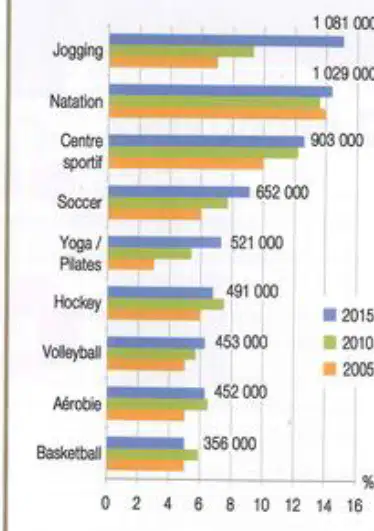
Selon le graphique « Les activités sportives des Québécois », quel sport avait le taux de participation le plus élevé en 2015 ?
Natation
Jogging
Soccer
Basketball
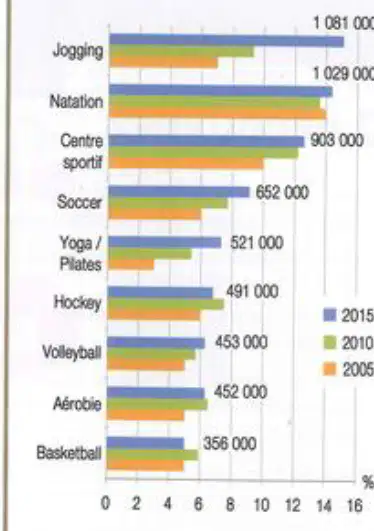
D'après le graphique à barres, quelle activité a connu une augmentation significative de la participation entre 2005 et 2015 chez les Québécois ?
Basketball
Hockey
Jogging
Volleyball
Si vous vouliez demander à un camarade de classe quelles sont ses activités quotidiennes, laquelle des questions suivantes serait appropriée ?
Quelle est ta couleur préférée ?
Fais-tu du sport ?
Quel âge as-tu ?
Quel est ton film préféré ?

