
 Worksheets
Cosmos
Total questions: 99
Worksheet time: 3hrs 56mins


What is the smallest terrestrial planet?
The farther a planet is from the sun, the
less time it will take to revolve around the sun
more time it will take to revolve around the sun
distance does not play a role
One astronomical unit (1 AU) is the
average distance from the sun to Earth
average distance from the sun to Earth's moon
average distance from the sun to Mars
A random number made up by astronomers

If we are able to obtain orbital period from transit data, we can calculate _____ using Kepler's 3rd Law.
Orbital eccentricity
Average distance between the planet and its host star
Percentage of water vapor in the planet's atmosphere
The probability for advanced life
Even though Pluto's average distance from the Sun is much farther than Neptune's, Pluto is sometimes located closer to the Sun than Neptune because ____.
Neptune is more affected by the Gravitational pull of Jupiter
Pluto is traveling at a faster orbital velocity
Pluto's orbital eccentricity is greater than Neptune's
Pluto's orbital eccentricity is less than Neptune's
Each planet's orbit about the Sun is an ellipse. The Sun's center is always located at one focus of the orbital ellipse.
Kepler's 1st Law
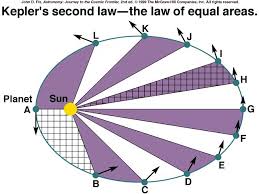
Kepler's 2nd Law
Kepler's 3rd Law
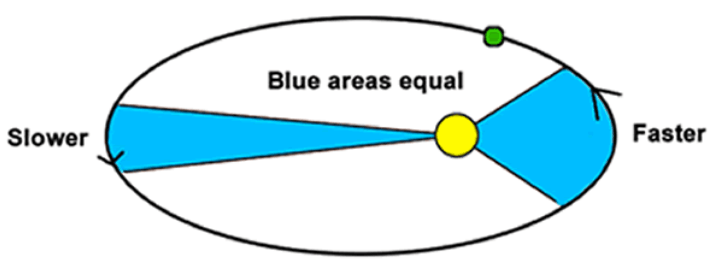
A planet moves in its ellipse so that the line between it and the Sun placed at a focus sweeps out equal areas at equal times.
Kepler's 1st Law
Kepler's 2nd Law
Kepler's 3rd Law
The square of a planet's orbital period is proportional to the cube of the length of the semi-major axis of its orbit.
Kepler's 1st Law
Kepler's 2nd Law
Kepler's 3rd Law
The mean distance from the center of the earth to the center of the sun.
Astronomical Unit
Heliocentric Theory
Kepler's 1st Law
Planetary Revolution
The path of the earth around the sun, which is one complete cycle of an orbit, is approximately 365.2425 days in length.
Astronomical Unit
Heliocentric Theory
Kepler's 1st Law
Planetary Revolution
There are two points inside of an ellipse. The sun is one point in our solar system.
Astronomical Unit
Heliocentric Theory
Foci
Planetary Revolution
Planets revolving around a fixed point, the sun.
Astronomical Unit
Heliocentric Theory
Foci
Geocentric Theory
Planets revolving around a fixed point, the earth.
Astronomical Unit
Heliocentric Theory
Foci
Geocentric Theory
The combining of several small nuclei into one large nucleus with the subsequent release of huge amounts of energy.
Astronomical Unit
Nuclear Fusion
Foci
Nuclear Fission
The splitting of an atom into smaller parts.
Astronomical Unit
Nuclear Fusion
Foci
Nuclear Fission
Energy that is transferred by electromagnetic radiation, such as light, X-rays, gamma rays, and thermal radiation, which may be described in terms of either discrete packets of energy, called photons, or continuous electromagnetic waves.
Astronomical Unit
Nuclear Energy
Radiant Energy
Nuclear Fission
The northern lights, one of several astronomical phenomena called polar lights (aurora polaris), are shafts or curtains of colored light visible on occasion in the night sky.
Astronomical Unit
Nuclear Energy
Aurora Borealis
Nuclear Fission
A change in the orientation of the rotational axis of a rotating body.
Nutation
Precession
Barycenter
Nuclear Fission
Is the center of mass of two or more bodies that orbit one another and is the point about which the bodies orbit.
Nutation
Precession
Barycenter
Nuclear Fission
A periodic oscillation of the earth's axis that causes the precession of the poles to follow a wavy rather than a circular path.
Nutation
Precession
Barycenter
Nuclear Fission
Earth's spin around its own axis. Causes day and night.
Nutation
Rotation
Barycenter
Revolution
The Earth's orbital motion around the sun. Takes 365 days.
Nutation
Rotation
Barycenter
Revolution
A tide just after the first or third quarters of the moon when there is least difference between high and low water.
Neap
Rotation
Spring
Revolution
A tide just after the new or full moon when there is the greatest difference between high and low water.
Neap
Rotation
Spring
Revolution
The orbits of the planets are ellipses with the Sun at one focus, though all except Mercury are very nearly circular.
Planetary Orbit
Kepler's 3rd Law
Neap Tide
Rotation

What is the direction of the velocity at point B, if the ball is revolving clockwise?
up
right
down
left
The velocity is always _____ to the line of a circle.
outwards
towards the center
tangent
perpendicular
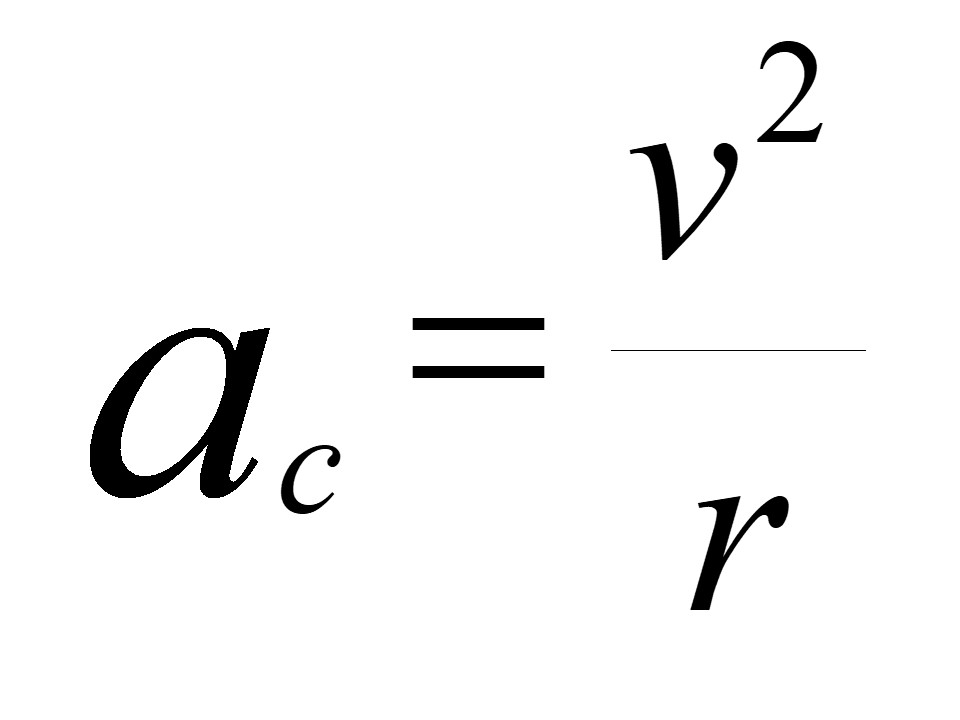
What's the centripetal acceleration of an object traveling 2.3 m/s around a circle of diameter 0.6 m?
5.00 m/s2
17.6 m/s2
10.0 m/s2
8.81 m/s2

If the radius of the string is 0.3 meters long and the stopper makes 5 revolutions per second, what is the speed of the stopper? (Hint: C=2πr)
9.4 m/s
6.8 m/s
11.7 m/s
3.5 m/s

Centripetal acceleration always points
in the direction of the object's motion
in the opposite direction of the object's motion
towards the center of the circle
towards the outside of the circle
The time taken for one complete cycle from starting point back to starting point is called the
period
frequency
angular velocity
amplitude

Which of the following depict the speed of the blowing ball?
A
B
C
D

Calculate the amount of centripetal force it takes for a softball pitcher Jenny Finch to rotate a ball with a velocity of 31 m/s if the ball weighs .12 kg and her arm is .65 meters long.
177.4 N
57.2 N
.572 N
1.774 N
What states that "every object in the universe attracts every other object"?
Law of Universal Gravitation
Newton's First Law of Motion
Law of Conservation of Mass
Law of Inertial Reference
In the Law of Universal Gravitation, the force of gravity is inversely proportional to
mass
weight
distance
time

What would the force between them be if the distance between them were doubled?

What are the factors which combine to to keep celestial bodies in orbit?
Air Resistance and Gravity
Gravity and Inertia
Inertia and Orbital Speed
Orbital Speed and Gravity

What did Kepler discover about planets and their orbital speed?
Planets closest to the Sun will orbit with the fastest orbital speed.
Planets with the greatest mass will orbit the Sun with the fastest orbital speed.
Planets furthest from the Sun will orbit with the fastest orbital speed.
Planets with the least mass will orbit the Sun with the fastest orbital speed.

According to Kepler’s discoveries, planets orbit around the Sun
in an oval shape.
in perfect circles.
in an ellipse.
in a rectangular shape.

An ellipse is drawn around two points called
aphelion
perihelion
foci
axis


The major axis is:
The shorter axis of an ellipse
The longer axis of an ellipse
The closest point closest to the Sun
The farthest point closest to the Sun

Who was the scientist who expanded upon the ideas of gravity mathematically to include time-space?
Newton
Einstein
Kepler
Galileo

Which of the following scientists does not belong to this group?
Galileo Galilei
Tycho Brahe
Nicolaus Copernicus
Robert Boyle
Are there other planets out there in the universe besides the ones in our solar system?
It depends on which country you are in.
Yes
No
Maybe
What is the problem with seeing planets orbiting other stars?
They are faint
They are sitting right on top of their parent star
They are really far away
All of these answers are correct
How can you discover planets outside of our solar system?
Directly
Indirectly
What is reflexive motion?
The bigger object of a pair of orbiting objects making a huge circle as the smaller objects gravity pulls on it.
The smaller object of a pair of orbiting objects makes no circle as the bigger objects gravity pulls on it.
The smaller object of a pair of orbiting objects making a small circle as the bigger objects gravity pulls on it.
The bigger object of a pair of orbiting objects making a small circle as the smaller objects gravity pulls on it.
The first planets that were discovered outside of our solar system were found orbiting what? And what year were they discovered?
A Red Giant in 1992
A pulsar in 1972
A pulsar in 1992
A Red Giant in 1972
What are planets outside our solar system officially called?
Ecoplanets
Exoplanets
Alien Worlds
Exoworlds
What was the name of the first Sun-like star to have an exoplanet discovered and what year was it discovered?
51 Peg in 1995
41 Peg in 1995
51 Peg in 1994
41 Peg in 1992
What is one way exoplanets are indirectly detected?
The Hubble Space Telescope
Infrared Waves
X-Rays
The doppler shift
What are large, short-period exoplanets called?
Big Hotties
Hot Jupiters
Hot Saturns
Hot Exoplanets
What is it called when a planet crosses directly in front of it's star?
a Hot Jupiter
an eclipse
a direct line
a transit
What is the name of the space telescope that was designed to search for exoplanets? And in what year was it launched?
Kepler in 1999
Exodetector in 2009
Kepler in 2009
Hubble in 1999
Have any exoplanets been seen directly and photographed?
Yes
No
How many exoplanets do scientists believe might there be in our galaxy?
Hundreds of millions
Hundreds of billions
Billions of billions
Millions of billions
How many earth-like exoplanets might there be in our galaxy?
1 billion
10 thousand
10 billion
10 million
What is the most successful way to discover exoplanets?
Transits
Spacecraft fly-bys
Direct pictures
Doppler Shift
Which of the following is NOT considered a terrestrial-planet?
Mars
Venus
Neptune
Mercury
The largest of the terrestrial planets is
Jupiter
Earth
Mars
Uranus
The densities of the Jovian planets are
not more than about 0.5 times the density of water.
not more than about 1.5 times the density of water.
from 3.9 to 5.5 times the density of water.
more than 5.5 times the density of water.
According to scientists, the solar system formed from
colliding planetesimals.
rotating stars.
colliding nebulae.
a rotating disk of dust and gases.
Which of the following is one difference between the way terrestrial planets and Jovian planets formed?
The terrestrial planets formed only from bits of ice.
The Jovian planets formed only from bits of ice.
The terrestrial planets formed only from metals and silicate minerals.
The Jovian planets formed only from metals and silicateminerals.
How does the diameter of the terrestrial and Jovian planets compare?
The diameters of the Jovian planets are much larger.
The diameters of the terrestrial planets are much larger.
All but one of the terrestrial planets have diameters about equal to the diameters of the Jovian planets.
All but one of the Jovian planets have diameters about-equal to the diameters of the terrestrial planets.
The fact that Mercury has no atmosphere is evidence that it
reflects almost all of the sunlight that strikes it.
is composed almost entirely of gases.
is much farther from the sun than it appears.
reflects a small percentage of the sunlight that strikes it.
One reason that life as we know it is unlikely to exist on Venus is because
the surface temperature is too high.
the surface temperature is too low.
the surface has too much ice covering it.
there is no atmosphere.
When viewed from Earth, Mars appears to change colors. This most likely happens because
gases in the dense Martian atmosphere are constantly changing.
volcanic activity produces thick gas clouds.
dust storms lasting for weeks cause the atmosphere to change color.
active volcanoes on the Mars surface intermittently flood the surface with lava.
What is the mass of Jupiter?
2.5 times the mass of Earth
twice the mass of all the terrestrial planets
about half the mass of all the Jovian planets
2.5 times the mass of all the other planets and their moons
Which of the Jovian planets have rings?
only Saturn and Jupiter
Saturn, Jupiter, Uranus, and Neptune
only Saturn and Neptune
only Saturn, Jupiter, and Uranus
Which planet has the lowest surface temperature of any planet and an atmosphere comprised mostly of nitrogen?
Jupiter
Saturn
Neptune
Uranus
Which planet has an axis of rotation parallel with the plane of its orbit?
Jupiter
Saturn
Neptune
Uranus
Most asteroids lie between the orbits of
Jupiter and Saturn.
Mars and Jupiter.
Jupiter and Neptune.
Mars and Earth.
Which of the following is true about asteroids?
Asteroids rarely pass close to Earth.
Asteroids never actually collide with planetary bodies.
Recent impact craters on the moon were likely caused by asteroids.
Most asteroids are no larger than a grain of sand.
Which of the following is true about comets?
The orbits of comets do not take them past the Jovian planets.
Comets are held together by frozen gases.
All comets have long tails made of vaporizing gases.
The Oort cloud of comets is found between Neptune and Pluto.
The Kuiper Belt is a region beyond Neptune containing
comets with short orbit periods.
meteors smaller than 1 km across.
a dense collection of meteoroids.
comets with unusually large nuclei.
The nucleus of Halley’s comet is approximately
1 m wide.
1 km wide.
16 km by 8 km.
100 km wide.
Scientists have been able to estimate the age of our solar system by dating
comets
asteroids
meteors
meteorites
Which of the following is NOT a source of meteoroids?
rocky chunks from neighboring solar systems
leftover interplanetary debris
material from the asteroid belt
the solid remains of comets

