
Font size
 Worksheets
Macromolecule Vocabulary Review Homework
Total questions: 40
Worksheet time: 23mins
What are lipids primarily used for in the body?
Insulation and energy storage
Building cell walls
Carrying oxygen
Producing hormones
Which of the following is an example of a lipid?
Vegetable oil
Table salt
Glucose
Starch
Which macromolecule is made up of long chains of amino acids?
Proteins
Lipids
Carbohydrates
Nucleic acids
What type of bond is formed between amino acids?
Peptide bond
Hydrogen bond
Ionic bond
Glycosidic bond
Which of the following best describes a phospholipid?
Lipid that makes up the cell membrane
Protein that speeds up reactions
Sugar used for energy
Nucleotide in DNA
Which of the following is NOT a type of lipid?
Starch
Oil
Wax
Fat
What is the main structural difference between triglycerides and phospholipids?
Phospholipids contain a phosphate group, triglycerides do not
Triglycerides contain a phosphate group, phospholipids do not
Both contain three fatty acids
Both are made of amino acids
Which of the following best describes the structure of a protein?
Long chains of amino acids
Chains of fatty acids
Rings of glucose
Double helix of nucleotides
Which of the following is a correct description of peptide bonds?
Bonds formed between amino acids
Bonds formed between fatty acids
Bonds formed between sugars
Bonds formed between nucleotides
Which of the following is a correct match?
Triglyceride - Fat molecule
Peptide bond - Fatty acid
Protein - Phosphate group
Lipid - Amino acid
Which of the following is NOT a component of a triglyceride?
Phosphate group
Glycerol
Fatty acid
None of the above
Which of the following is a correct statement about lipids?
They are used for energy storage and insulation
They are made of amino acids
They are the main component of DNA
They are always solid at room temperature
Which of the following best describes the role of peptide bonds?
They connect amino acids in proteins
They connect fatty acids in lipids
They connect sugars in carbohydrates
They connect nucleotides in DNA
What is a monomer?
Subunits that can hook together
Chains of monomers
Sugars and starches
Chains of nucleotides
What is a polymer?
Chains of monomers
One sugar
Two sugars
Sugars and starches
Which of the following best describes a carbohydrate?
Sugars and starches
Chains of nucleotides
Long chains of sugar
Subunits that can hook together
Which of the following is an example of a monosaccharide?
Glucose
Sucrose
Starch
DNA
What are nucleic acids made of?
Chains of nucleotides
Chains of monomers
Sugars and starches
Long chains of sugar
Which of the following terms refers to a chain of monomers?
Polymer
Monomer
Disaccharide
Nucleic acid
Which of the following is a type of carbohydrate?
Starch
DNA
RNA
Nucleotide
Which of the following is NOT a function of nucleic acids?
Provide energy
Store genetic code
Make proteins
Chains of nucleotides
Which of the following is a chain of nucleotides?
Nucleic acid
Monomer
Disaccharide
Polysaccharide
Which of the following is a simple sugar?
Monosaccharide
Disaccharide
Polysaccharide
Nucleic acid
Which of the following is a genetic code?
DNA
Starch
Glucose
Sucrose
Which statement about catalysts is true?
They are not destroyed during the reaction
They are used up in the reaction
They slow down reactions
They are only found in plants
Which of the following is an example of a catalyst in biological systems?
Enzyme
Sugar
Lipid
Water
Which of the following best explains why enzymes are reusable?
They are not changed or destroyed during the reaction
They are made of lipids
They are used up in the reaction
They become part of the product
Which of the following is a true statement about activation energy?
It is required to start a chemical reaction
It is the energy released by the reaction
It is only needed for enzyme reactions
It is not important in biology
Which of the following is a correct description of the enzyme-substrate complex?
The enzyme binds to the substrate to form a temporary complex
The enzyme is destroyed by the substrate
The substrate becomes an enzyme
The enzyme and substrate never interact
Why is it important that enzymes are not destroyed during reactions?
So they can be reused for multiple reactions
So they can become products
So they can store energy
So they can act as reactants

Match the following letter with its correct name.
A
Enzyme-Substrate Complex
B
Substrate
C
Active Site
D
Enzyme
E
Product(s)
Which enzyme will bind with the substrate?

Which of these best represents a fatty acid molecule?
F
G
H
J

Which biomolecule makes up the cell membrane and hormones?
lipids
protein
nucleic acid
carbohydrate

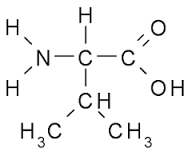

Proteins are polymers of __________.
amino acids
fatty acids
carboxylic acids
nucleic acids
These biomolecules are composed of repeating units of nucleotides. Its main function is to store and transmit genetic information. DNA and RNA are the most common examples.

Simple sugars like glucose can be used to make larger organic molecules. Identify a larger molecule made from simple sugars.

Carbon, hydrogen and oxygen make up this MONOMER of carbohydrates in a 1:2:1 ratio
Fatty Acids
Nucleotides
Monosaccharides
Amino Acids

