
 Worksheets
Diaphragm Metering Pumps - Introduction and Parts Identification
Total questions: 31
Worksheet time: 16mins
During suction, which valve opens in a diaphragm metering pump?
Inlet valve
Outlet valve
Both valves
Neither valve
During pressure, the ______ valve closes and the ______ valve opens to allow chlorine to be pumped out.
inlet, outlet
outlet, inlet
bypass, safety
safety, bypass
To adjust the amount of chlorine, you can change the stroke length using the ______ and adjust the pulse frequency using the ______.
stroke length adjustment key, pulse adjustment button
pulse adjustment button, stroke length adjustment key
stroke length adjustment button, pulse adjustment key
chlorine dial, frequency lever
What should you check for in the pump room before starting the operation?
The presence of water
The presence of electricity
The presence of tools
The presence of chemicals
What should you ensure about the chlorine tank before operation?
It is empty
It is filled and the suction tube is immersed inside as shown in the image below.
It is closed tightly
It is disconnected
What should you check regarding the circuit breaker in the pump room before starting the operation?
It is off
It is on as shown in the image below
It is disconnected
It is locked

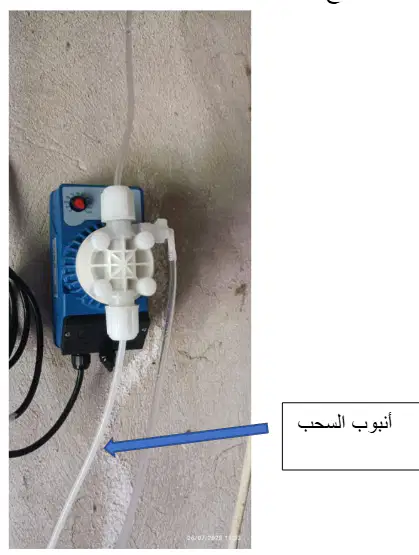
Identify the part labeled in the image: ________
Suction tube (أنبوب السحب)
Discharge pipe (أنبوب التصريف)
Impeller (المروحة)
Motor (المحرك)
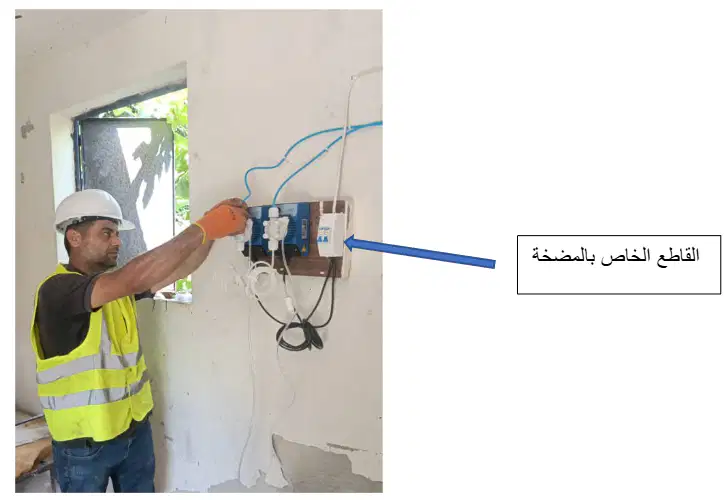
Identify the part labeled in the image: ________
The circuit breaker for the pump (القاطع الخاص بالمضخة)
The main power supply (مزود الطاقة الرئيسي)
The water level sensor (مستشعر مستوى الماء)
The control panel (لوحة التحكم)
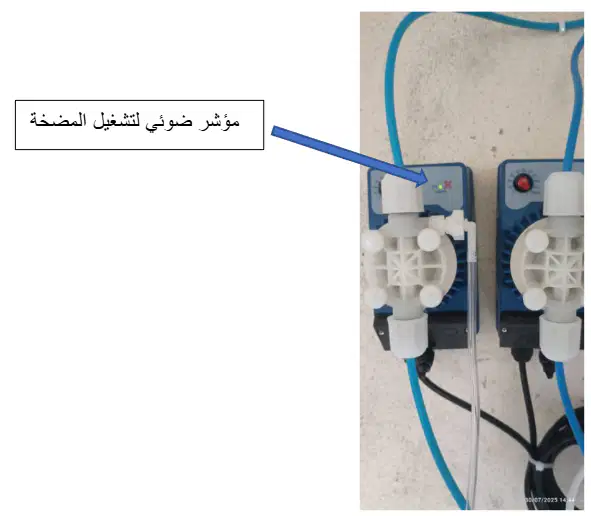
The operation of the pump means that the indicator specific to the pump works in green, and the indicator flashes as shown in the following image. What is the function of the light indicator shown in the image?
Light indicator for pump operation
Light indicator for low oil level
Light indicator for high temperature
Light indicator for power failure
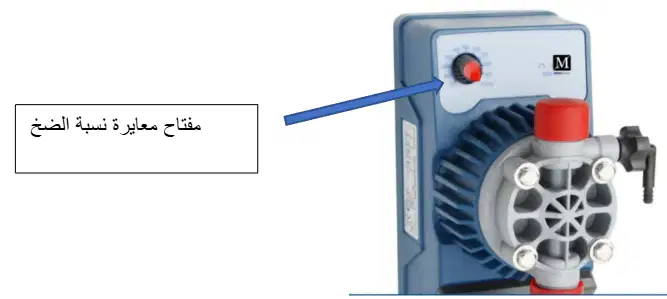
The pump is set to operate at different speeds through the dosing ratio adjustment knob shown in the following image until the liquid flows regularly. What is the function of the knob shown in the image?
Dosing ratio adjustment knob
Power switch
Pressure release valve
Flow direction lever
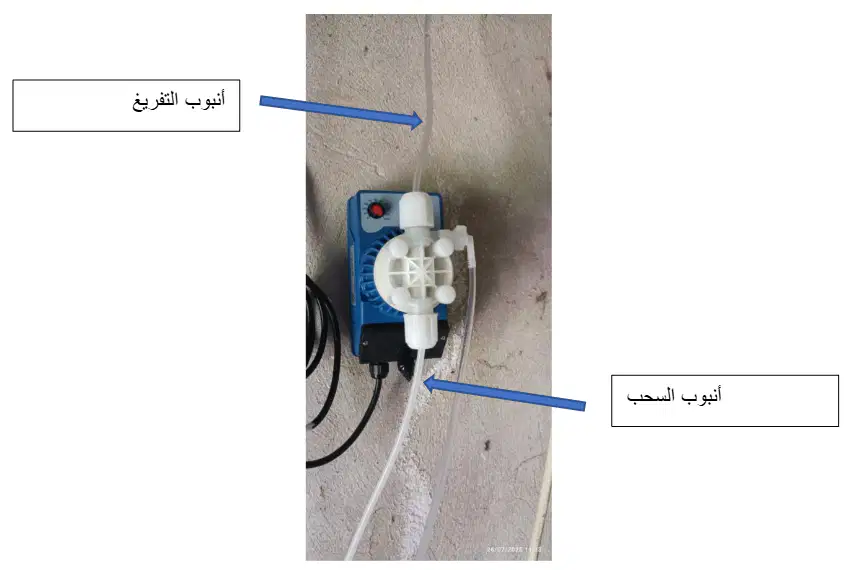
Which tube is the suction tube and which is the discharge tube?
The tube labeled 'أنبوب السحب' is the suction tube, and the tube labeled 'أنبوب التفريغ' is the discharge tube.
The tube labeled 'أنبوب التفريغ' is the suction tube, and the tube labeled 'أنبوب السحب' is the discharge tube.
Both tubes are suction tubes.
Both tubes are discharge tubes.
According to the table, what is the required quantity (in liters per hour) if the key standard is 20% and the pump capacity used is 10 L?
1.4 liters per hour
2.0 liters per hour
0.8 liters per hour
3.5 liters per hour
According to the table, what is the pump capacity used if the required quantity is 2.1 liters per hour and the key standard is 30%?
7 liters
3 liters
10 liters
5 liters
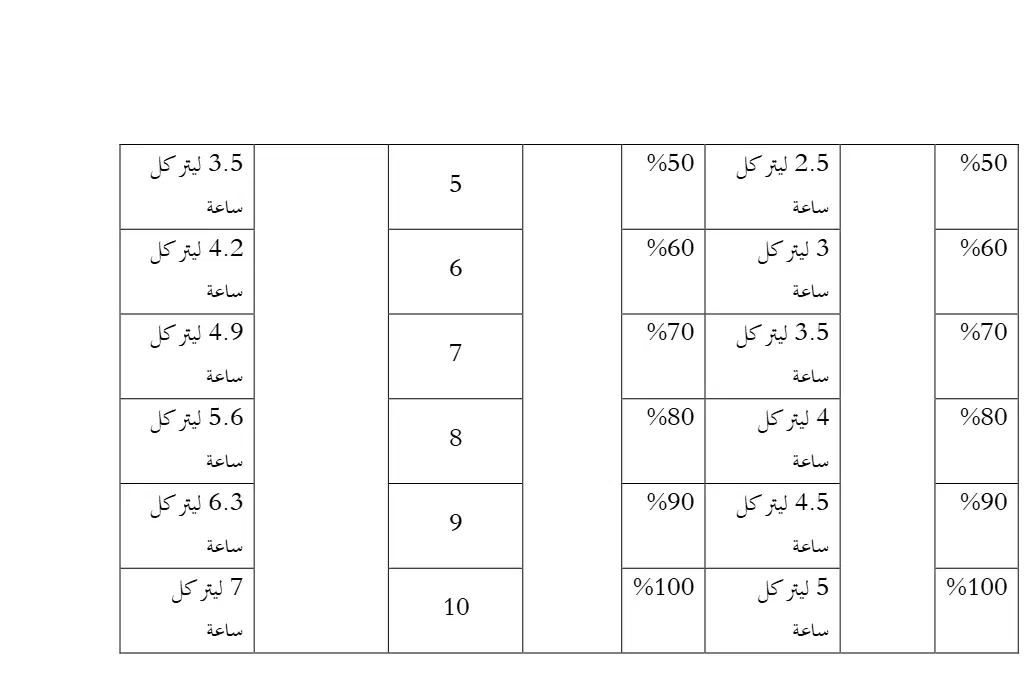
What is the liters per hour value corresponding to 70% as shown in the table?
3.5 liters/hour
2.0 liters/hour
4.0 liters/hour
5.5 liters/hour
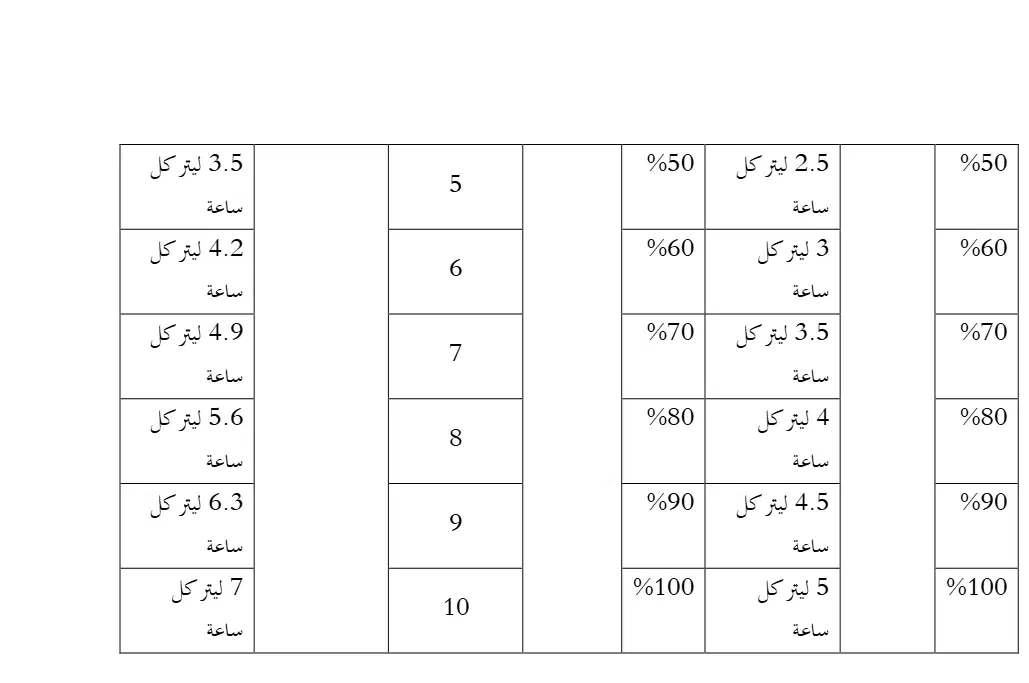
What percentage corresponds to 4 liters per hour as shown in the table?
80%
20%
50%
100%
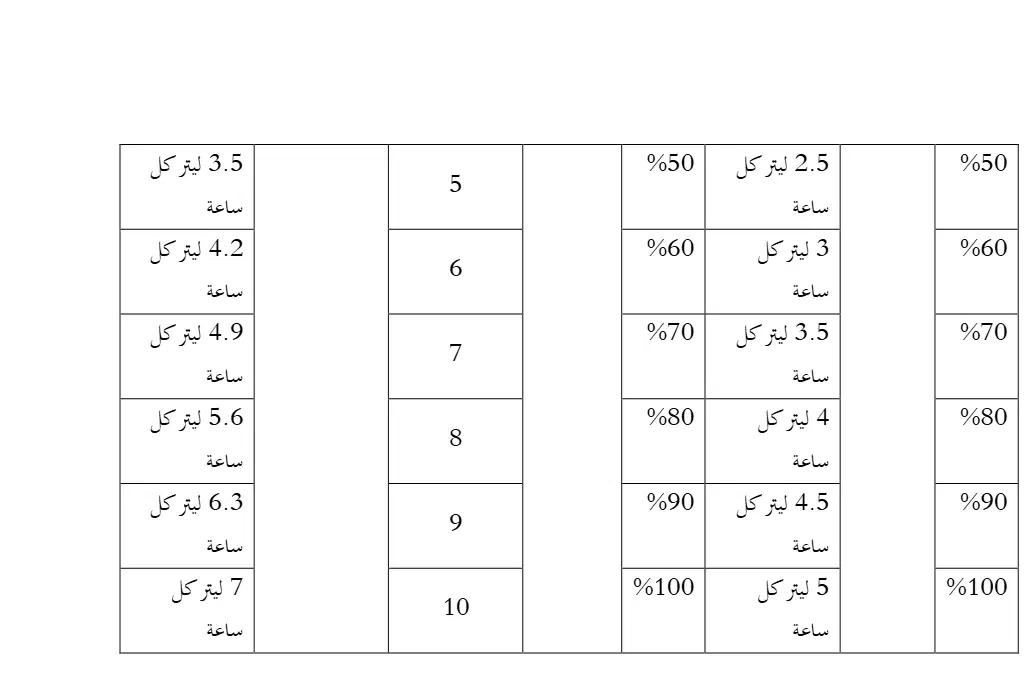
Which of the following is the correct liters per hour value for 100% as shown in the table?
4.5 liters/hour
5 liters/hour
6 liters/hour
3.5 liters/hour
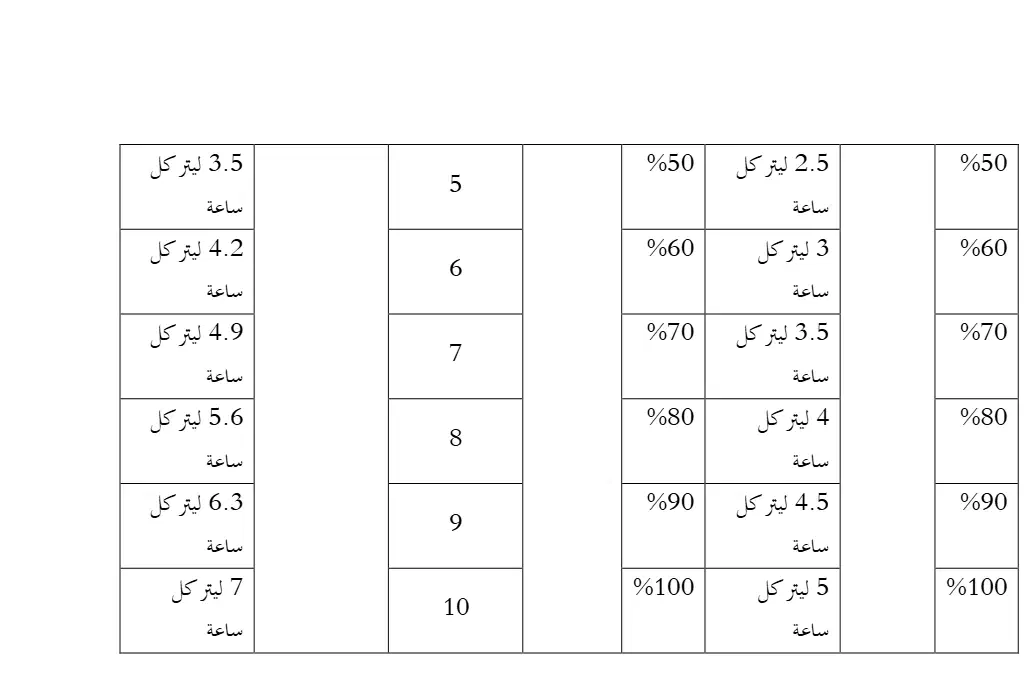
Fill in the blank: For 6 hours, the liters per hour value is ______ as shown in the table.
4.2 liters/hour
3.8 liters/hour
5.0 liters/hour
6.1 liters/hour

What is the name of the part indicated by the arrow?
Pump Membrane
Valve Plate
Diaphragm Spring
Pressure Chamber

What is the name of the part indicated by the arrow?
Suction Filter
Oil Cooler
Pressure Gauge
Relief Valve
What is the first step to check when troubleshooting for leaks in the chlorine system?
Replace the membrane
Check the diaphragm (Diaphragm) for cracks
Clean the filter
Fill the chlorine tank
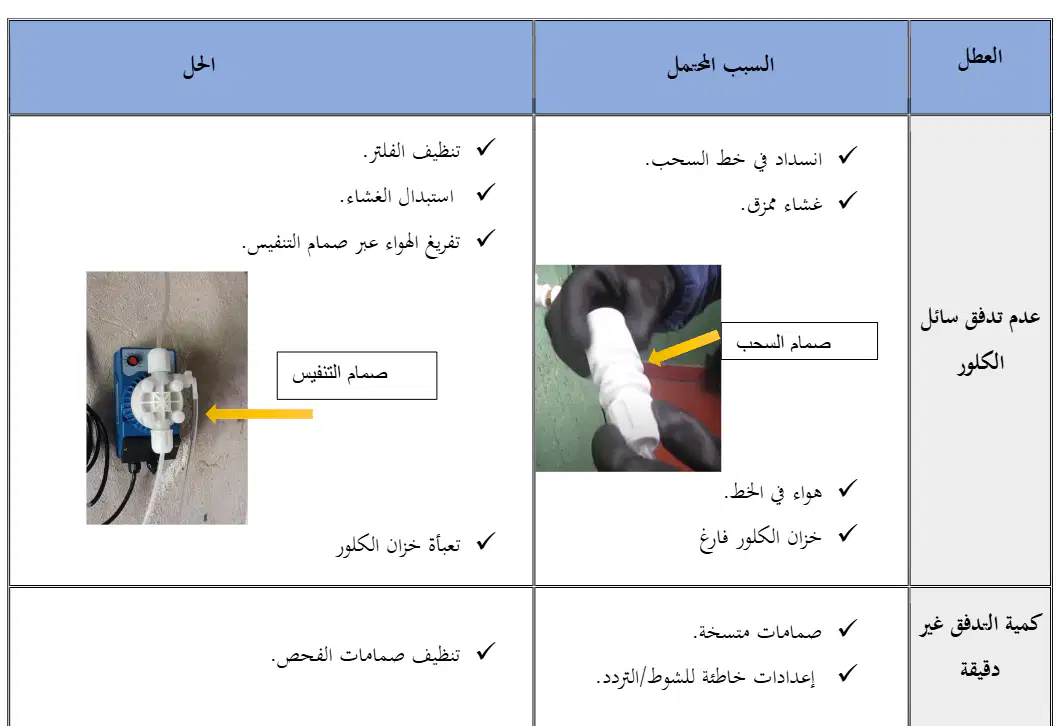
Identify the part labeled in the image:
Suction valve
Diaphragm valve
Vent valve
Chlorine tank
What is a possible cause for no flow of chlorine liquid?
Air in the line
Full chlorine tank
Clean filter
High pressure
Fill in the blank: One of the solutions for no flow of chlorine liquid is to ________ the suction valve.
clean
close
paint
remove
What should be done if the chlorine tank is empty?
Fill the chlorine tank.
Leave the tank as it is.
Add water to the tank.
Paint the tank.

Identify the part labeled in the image:
Suction valve
Diaphragm valve
Vent valve
Chlorine tank

What is the name of the part labeled in the image?
Discharge valve
Water pump
Pressure gauge
Filter
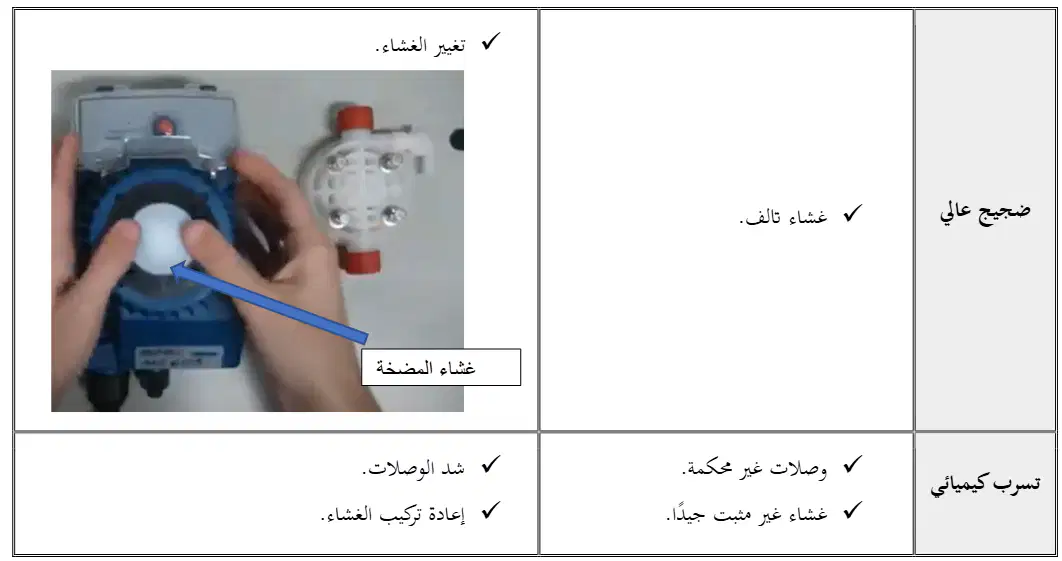
What is the solution for a 'High Correction' issue according to the troubleshooting table?
Tighten connections
Replace the membrane
Reinstall the membrane
Use a new device
Which of the following is a cause of a 'Chemical Leak' according to the troubleshooting table?
Faulty membrane
Loose connections
Dirty device
Overheating
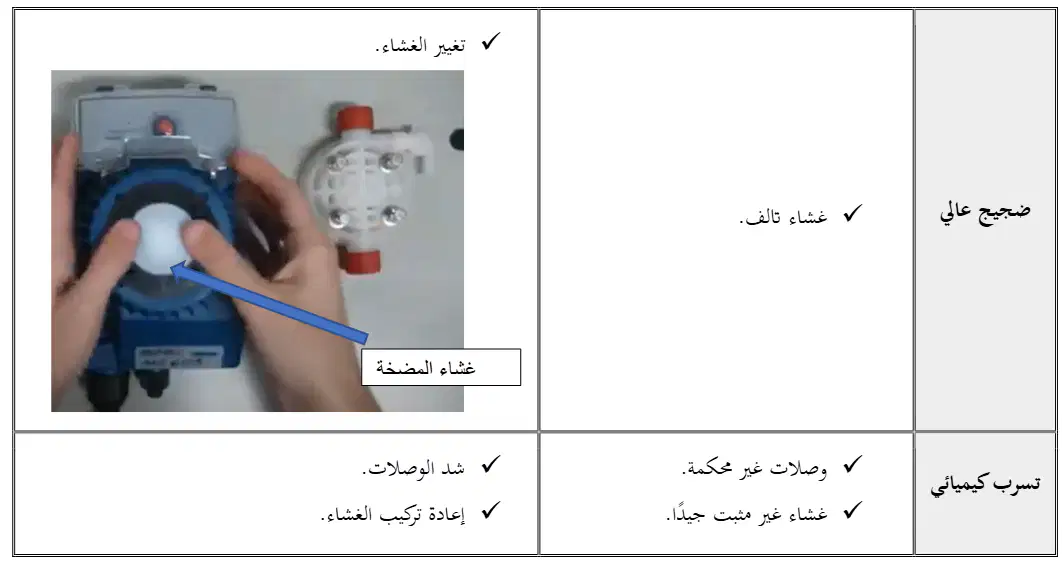
Fill in the blank: The part labeled in the image is the _________.
membrane cover
nucleus
cytoplasm
cell wall
What should you do if the membrane is not installed correctly according to the troubleshooting table?
Replace the device
Reinstall the membrane
Tighten the screws
Ignore the issue
According to the video link provided, what does the video demonstrate?
The video demonstrates how to disassemble the parts of the device for maintenance.
The video demonstrates how to assemble the device from scratch.
The video demonstrates the device in operation under different conditions.
The video demonstrates troubleshooting common device errors.

