
 Worksheets
Fiqh 1 - Tahara, Wudu, Qusul, Najasa, Hayd, Nifas
Total questions: 152
Worksheet time: 1hrs 16mins
What is meant by taharah (purification) in Arabic?
Cleanliness and keeping away from dirt and filth
A type of prayer
A form of meditation
A dietary practice
Which type of impurity affects the entire body and is removed by doing ghusl?
Major hadath
Minor hadath
Physical impurity
Metaphorical impurity
How is minor hadath removed according to the text?
By doing wudu
By taking a shower
By fasting
By praying
What are the two general categories into which water is divided?
Freshwater and saltwater
Pure water and impure water
Clean water and dirty water
Natural water and artificial water
Which of the following is an example of pure water?
Water from a polluted river
Water from a treated swimming pool
Water from a natural spring
Water from a factory outlet

What is the ruling on seawater according to the Prophet's words?
It is impure and should not be used
It is pure.
It is only pure if filtered
It is impure unless boiled
What happens when pure water is mixed with a pure substance that does not change its color, taste, or smell?
It becomes impure and cannot be used for purification.
It remains pure and is still called water.
It becomes something else and is no longer called water.
It can only be used for drinking, not purification.
According to the text, is it permissible to use impure water for purification ?
Yes, it is permissible.
No, it is not permissible
Yes, but only for purification
What happens if impure water is left to stand for a long time and the characteristics of impurity disappear?
It remains impure
It becomes pure
It becomes more impure
It evaporates
According to the text, when does water become impure ?
When it changes color, taste, or smell
When it is mixed with sand
When it is boiled
When it is left in the sun
What is the scholarly opinion on water that has not changed in its characteristics after an impurity falls into it?
It is always impure
It remains pure if the amount is large
It becomes impure if the amount is small
It is pure only if boiled
According to the text, why is it permissible to use expensive vessels made of rubies and diamonds?
They are more durable
They are more beautiful
There is no text indicating they are prohibited
They are cheaper than gold and silver
What is the ruling on using vessels made of gold and silver for eating and drinking?
It is encouraged
It is permissible
It is prohibited
It is optional

What is the consequence mentioned for drinking from a vessel of silver?
It brings good luck
It is a sign of wealth
It leads to the fire of Hell
It is a tradition
What is the ruling on using vessels that have been soldered with gold?
It is permissible to use them.
It is forbidden to use them.
It is recommended to use them.
It is optional to use them.
Under what condition is it permissible to use vessels soldered with silver?
If the soldering is large and unnecessary.
If the soldering is very small and there is a need for it.
If the vessel is made entirely of silver.
If the vessel is used for decoration only.
Is purification done with water from a vessel of gold or silver valid?
No, it is not valid.
Yes, it is valid.
Only if the vessel is gold.
Only if the vessel is silver.
What is the ruling on using vessels of disbelievers who are not known to use impure substances?
Their vessels are impermissible.
Their vessels are permissible.
Their vessels must be purified first.
Their vessels can only be used for decoration.
What should be done if there is no alternative to using vessels of disbelievers known to use impure substances?
Use them without washing.
Do not use them at all.
Wash them before use.
Use them only for storage.
What does "Istinja" mean?
Removing traces of dirt with water
Removing traces of dirt with pebbles
Using an even number of pebbles
Cleaning with soap
What does "Istijmar" mean?
Removing traces of dirt with water
Removing traces of dirt with pebbles
Using an even number of pebbles
Cleaning with soap
What is the recommended practice when performing Istijmar?
Use an even number of pebbles
Use an odd number of pebbles
Use water only
Use cloth only
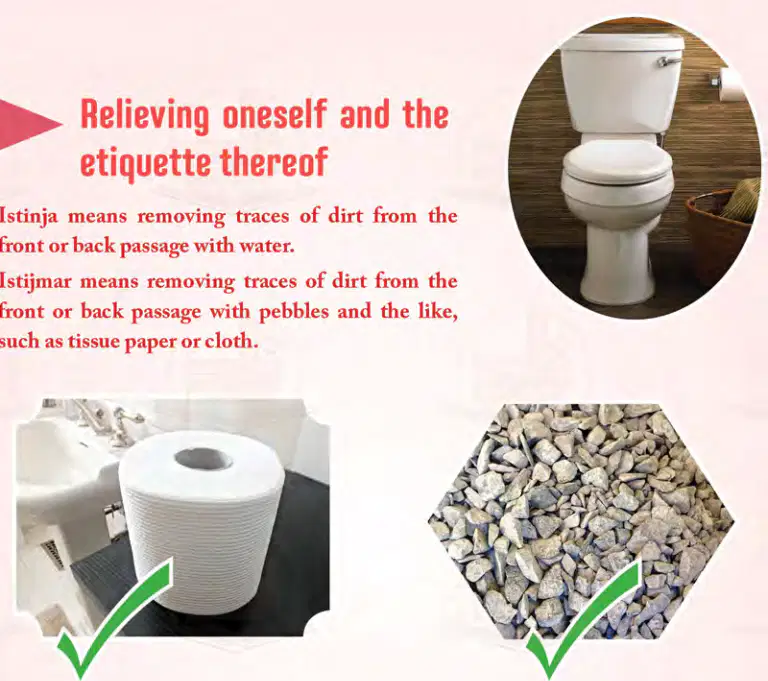
What should be done if water is not available for cleaning?
Wait until water is available
Use pebbles, tissues, or cloth
Use soap and water
Do not clean
What should one say when entering the bathroom according to the etiquette of relieving oneself?
Alhamdulillah
Subhanallah
Bismillah, Allahumma inni a'oodhu bika min al-khubthi wa'l-khaba'ith
Astaghfirullah
What is the recommended posture for urinating according to the etiquette of relieving oneself?
Standing
Sitting
Lying down
Kneeling
According to the etiquette of relieving oneself, which foot should enter the bathroom first?
Right foot
Left foot
Both feet together
It doesn't matter
What should one say when exiting the bathroom according to the etiquette of relieving oneself?
Alhamdulillah
Subhanallah
Ghufranak
Astaghfirullah
Why is it recommended to use the left hand when cleaning oneself?
It is more hygienic
It is a cultural tradition
The Prophet recommended it
It is easier
What is prohibited when relieving oneself according to the hadith of Abu Hurayrah?
Relieving oneself in a private bathroom
Relieving oneself in the road or in places where people seek shade
Relieving oneself in a forest
Relieving oneself in a desert
According to the hadith, what should one avoid when relieving oneself in the desert?
Facing towards the qiblah
Facing towards the sun
Facing towards the wind
Facing towards the mountains
What is the ruling on facing the qiblah when there is a barrier?
It is always prohibited
It is permissible if there is a barrier
It is permissible only in open land
It is prohibited in all situations
What did Ibn Umar do that was considered permissible regarding the qiblah?
He faced the qiblah in open land
He faced the qiblah with a barrier
He faced the qiblah in a mosque
He faced the qiblah in a forest
What is one reason it is considered makruh to face into the wind when relieving oneself?
It is disrespectful to nature.
It may cause the urine to blow back onto you.
It is forbidden in all circumstances.
It is a sign of poor hygiene.

What is a reason given for why urinating into a hole is makruh?
It is unsanitary.
It may harm an animal or disturb jinn.
It is difficult to aim properly.
It is a waste of resources.
According to the text, what is permissible to wipe over during wudu?
Only bare feet
Socks and boots that cover the ankles
Only sandals
Only bare hands
According to the text, when is using the siwak considered more important?
Before going to bed
During a meal
When doing wudu and entering the mosque
After exercising
What is the maximum time limit for leaving pubic hair untrimmed according to the hadith mentioned?
20 days
30 days
40 days
50 days
What does the term "Sunan al-Fitrah" refer to in the text?
Characteristics of natural inclination approved by Allah
A type of prayer
A specific diet plan
A historical event
Which of the following is NOT mentioned as part of the fitrah in the text?
Trimming the moustache
Letting the beard grow
Dyeing the hair
Clipping the nails
What is the significance of circumcision as mentioned in the text?
It is a modern practice
It is purifying and cleansing
It is optional
It is a cultural tradition
What is the purpose of plucking the armpit hair according to the text?
To follow a fashion trend
To prevent skin irritation
To stop bad smells and maintain cleanliness
To reduce sweating

According to Islamic terminology, which parts of the body are washed during wudu?
Hands, feet, chest, and back
Face, arms, head, and feet
Legs, arms, face, and neck
Head, shoulders, knees, and toes

What is one of the conditions for wudu to be valid?
Being wealthy
Being of sound mind
Being a scholar
Being a leader

Why is it important to remove anything that may prevent water from reaching the skin during wudu?
To ensure the water is cold
To maintain the ritual purity
To make the process faster
To avoid using too much water
What is the significance of having the intention (niyyah) in performing wudu?
It is optional and not necessary
It is a cultural tradition
It is required for the validity of wudu
It is only for special occasions
What is the first obligatory part of wudu mentioned in the text?
Washing the arms
Washing the face in its entirety
Wiping the head
Washing the feet
What is the correct procedure for wiping the head during wudu as described in the hadith of Abdullah ibn Zayd?
Wipe from the back to the front
Wipe with one hand only
Wipe from front to back, then back to the front
Wipe only the ears

What is the recommended practice for washing hands during wudu?
Wash hands once
Wash hands twice
Wash hands three times
Wash hands four times
How should one handle a thick beard during wudu according to the hadith?
Ignore the beard
Run fingers through the beard
Trim the beard before wudu
Use a comb on the beard
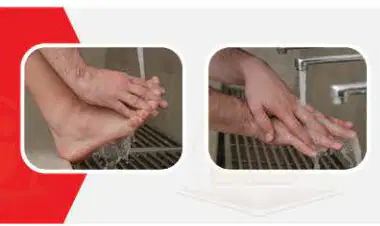
According to the hadith of Ibn Abbas, what should be done when performing wudu?
Rub between your fingers and toes
Wash your face first
Start with the left hand
Use cold water
What is the preferred method for washing the face, arms, and feet during wudu?
Wash each part once
Wash each part twice
Wash each part three times
Wash each part four times
Why is it preferred to start on the right when washing hands and feet during wudu?
It is easier
It is a cultural tradition
The Prophet liked to start on the right
It saves time
Which of the following invalidates wudu according to the text?
Light sleep
Deep sleep
Eating
Drinking
According to the hadith of Abu Hurayrah, what must one do if they invalidate their wudu?
Pray immediately
Do wudu again
Fast for a day
Give charity
According to the hadith mentioned, what should one do if they touch their private part with no barrier?
Do nothing
Perform wudu
Pray immediately
Wash hands only
What is the ruling on performing wudu after eating camel meat according to the hadith?
It is not necessary
It is optional
It is required
It is forbidden

What is a khuff?
A type of headwear
A type of footwear made of thin leather
A type of hand glove
A type of belt
What is one condition for wiping over the khuffs?
They must be worn in a state of impurity
They must be worn in a state of purity
They must be worn during the night
They must be worn only in cold weather
What should be done if the khuffs are contaminated with impurities?
Continue wearing them
Wipe over them
Remove them
Wash them with water
Under what condition can wiping over the khuffs be done?
In the case of major impurity
Only when traveling
In the case of minor impurity
Only during prayer
What is the time limit for wiping over the khuffs for someone who is traveling?
One day and one night
Two days and two nights
Three days and three nights
Four days and four nights

What is the time limit for wiping over the khuffs for someone who is not traveling?
One day and one night
Two days and two nights
Three days and three nights
Four days and four nights
Mention two of the conditions for wiping over the khuffs.
The khuffs must be worn after performing wudu.
The khuffs must be made of leather.
The khuffs must be worn for at least 24 hours.
The khuffs must be worn by a traveler.
Put a check mark or an X mark next to the following phrase: It is permissible to wipe over a plaster cast or surgical dressing when purifying oneself from major and minor impurity.
Check mark
X mark
Both A and B
Neither A nor B

What does "ghusl" mean in linguistic terms?
Pouring pure water over the entire body with the intention of removing impurity.
Letting water flow over the body.
Sprinkling water on the face and hands.
Immersing the body in a pool of water.
According to Islamic terminology, what does "ghusl" involve?
Pouring pure water over the entire body with the intention of removing impurity.
Sprinkling water on the face and hands.
Immersing the body in a pool of water.
Letting water flow over the body whilst rubbing the skin.
What is one of the conditions that make ghusl obligatory?
Eating before sunrise.
Emission of maniy (semen) forcefully, with feelings of pleasure.
Sleeping during the day.
Drinking water after sunset.
What did the Prophet say regarding ghusl after a wet dream?
It is not necessary.
Yes, if she sees a discharge.
Only if it happens during the day.
No, unless it is a recurring event.
What is the definition of an obligatory (Wajib/Fard) action in Islamic law?
An action that Allah commands strictly.
An action that Allah loves but did not make mandatory.
An action that is disliked by Allah.
An action that is neutral in Islamic law.
Which of the following is an example of a recommended (Mustahabb/Sunnah) action?
Performing the five daily prayers
Fasting in Ramadan
Using the miswak (tooth-stick)
Paying Zakah
What is the consequence of neglecting an obligatory action without a valid excuse?
There is no sin.
The person is sinful and may be punished.
The person is rewarded.
The action is considered neutral.
Which of the following is an example of a "Disliked (Makruh)" action?
Stealing
Eating with the left hand (when not forced)
Using technology for neutral purposes
Lying
What is the consequence of performing a "Permissible (Mubah)" action in Islam?
The person is sinful and may be punished.
The person is rewarded.
There is no reward or sin by default.
The person is strictly prohibited from doing it.
Which of the following actions is considered "Forbidden (Haram)" in Islam?
Sleeping before ‘Isha prayer
Drinking alcohol
Eating, drinking, walking, sleeping
Using technology for neutral purposes
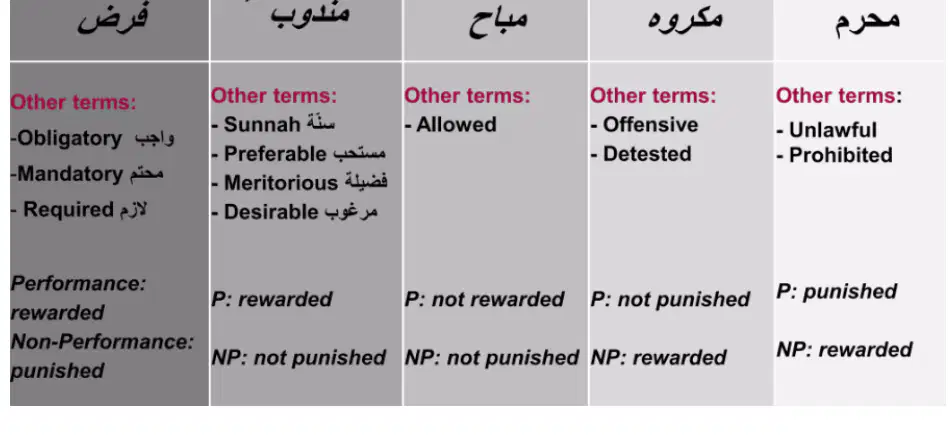
What is the term used for actions that are obligatory in the Rulings of Sacred Law?
Sunnah
Allowed
Obligatory
Offensive
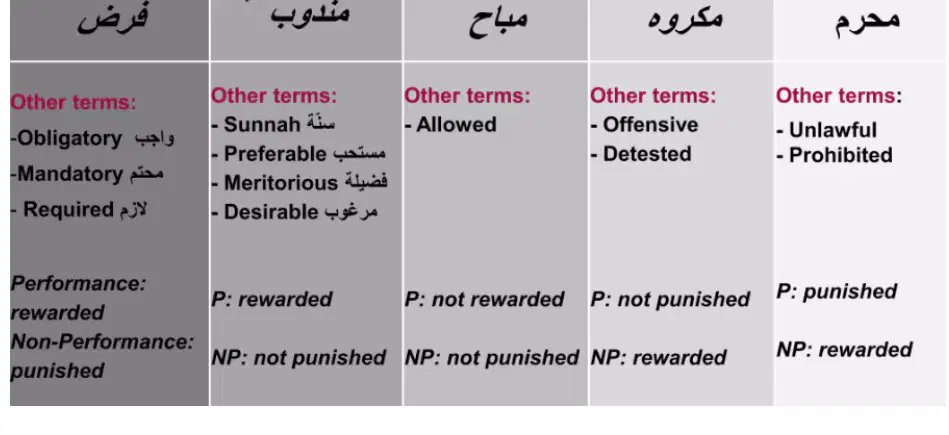
In the Rulings of Sacred Law, which category is associated with actions that are rewarded if performed but not punished if not performed?
Prescribed
Recommended
Permissible
Forbidden
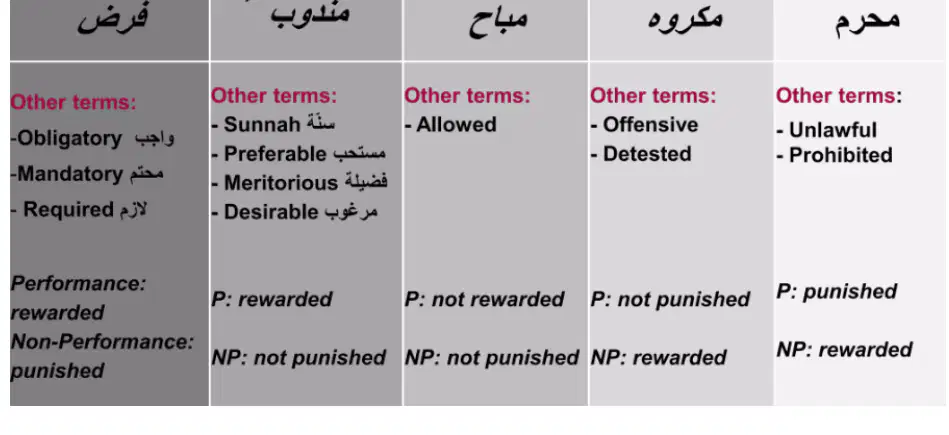
Which category in the Rulings of Sacred Law includes actions that are unlawful?
Disliked
Permissible
Forbidden
Recommended
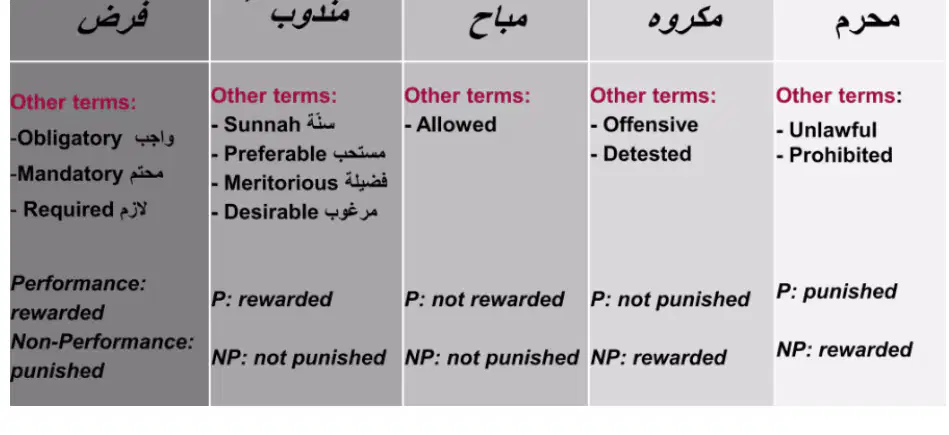
Analyze the implications of performing an action categorized as "Disliked" in the Rulings of Sacred Law.
Punished if performed
Rewarded if not performed
Not punished if performed
Rewarded if performed
What is one of the conditions of Wudu?
Being a non-Muslim
Being asleep
Being a Muslim
Being under the age of understanding
Which of the following is an obligatory act of Wudu?
Washing the face
Washing the hair
Washing the back
Washing the knees
Which of the following is NOT a condition of Wudu?
Using pure water
Having the intention (niyyah)
Being asleep
Being sane
Which of the following is a Sunnah of Wudu?
Eating camel meat
Saying Bismillah
Deep sleep
Apostasy
What is one of the actions that invalidate Wudu?
Using miswak
Rinsing the mouth three times
Deep sleep
Washing between fingers and toes
Which action is recommended to be done three times during Wudu?
Saying the du’a
Washing hands at the start
Eating camel meat
Touching the private parts
What is the English meaning of the term "Hayd"?
Menstruation
Postpartum bleeding
Irregular bleeding
Yellowish discharge
Which term refers to bleeding that occurs outside the time of Hayd or Nifas?
Nifas
Istihadah
Sufrah
Tuhur Mutakhalil
What is the Fiqh definition of "Nifas"?
Natural blood discharged during specific days of the month
Bleeding that occurs outside the time of Hayd or Nifas
Blood discharged after childbirth
Temporary cessation of bleeding during Hayd
What does "Sufrah and Kudrah" refer to in English?
Intermittent purity
Menstruation
Yellowish or brownish discharge
Postpartum bleeding
What is the significance of "Tuhur Mutakhalil" in the context of Hayd?
It is the regular menstrual cycle
It is the temporary cessation of bleeding
It is the postpartum bleeding period
It is the yellowish discharge after Hayd
What is the term for the total cessation of bleeding between two menstrual cycles?
Hayd
Complete purity /Tuhur Fasil
Sufrah
Kudrah
Which type of bleeding is considered natural monthly bleeding?
Postpartum Bleeding
Irregular Bleeding
Menstruation
Tuhur Fasil
What is the ruling for irregular bleeding in Islam?
It is treated the same as menstruation.
It requires fasting and praying to be stopped.
It is treated as pure, allowing prayer and fasting.
It is considered postpartum bleeding.
According to the rule, what is considered Hayd during the days of Hayd?
Only red discharge
Sufrah and Kudrah
Tuhur Fasil
Postpartum bleeding
What is the minimum duration of menstruation according to the Hanafi school of thought?
1 day
3 days
No minimum
15 days
According to most scholars, what is the maximum duration of menstruation?
10 days
12 days
15 days
20 days
What is the minimum purity period between two menstrual periods?
10 days
12 days
15 days
20 days
What is the maximum age of menstruation as mentioned in the document?
9 years
12 years
15 years
18 years
What is the maximum duration of postpartum bleeding according to the Hanafi and Hanbali schools?
30 days
35 days
40 days
45 days
What is forbidden for menstruating and postpartum women during their period?
Prayer
Eating
Sleeping
Reading
Which of the following must be made up later if missed during menstruation?
Prayer
Fasting
Tawaf
Marital relations
What must a woman with irregular bleeding perform for each prayer time?
Ghusl
Wudu
Tawaf
Fasting
If bleeding stops but ghusl has not been performed, what is still forbidden?
Eating
Marital relations
Sleeping
Traveling
During menstruation days, how is yellowish or brownish discharge considered?
Clean
Menstrual blood
Impure
Neutral
What is the definition of a woman with a regular menstrual cycle?
A woman who has a fixed pattern of menstruation each month.
A woman experiencing her first menstruation.
A woman who can distinguish between types of bleeding.
A woman with irregular menstrual cycles.
Which method is used for menstruation when some days of hayd bleeding are counted and others are skipped if blood mixes with purity?
Al-Tajmee (Combining Method)
Al-Talfeeq (Allocating Method)
Al-Taharah (Purity Method)
Al-Istihada (Irregular Bleeding Method)
In the case of a beginner woman in menstruation, what is the total number of Hayd days if there are 8 days of bleeding, 2 days of purity, and 4 days of bleeding?
10 days
12 days
14 days
16 days
What is the term for the 2 days of purity that do not break the Hayd in the given case?
Tuhur Mutakhalli
Al-Tajmee
Al-Talfeeq
Al-Istihada
A woman’s usual period lasts 5 days. If she experiences 8 days of black blood, 3 days of red blood, and 3 days of yellowish discharge, how many total days are considered Hayd?
8 days
11 days
14 days
16 days
What is the role of Tuhur Mutakhalli in the context of postpartum bleeding?
It separates periods of bleeding
It combines days of scattered bleeding
It marks the end of bleeding
It indicates the start of a new cycle
What is meant by "accidental impurity" in the context of physical impurities (najasah)?
When something pure becomes contaminated by an impure substance
When something is inherently impure
When an impurity cannot be purified
When an impurity is washed with water
What is the ruling on inherent impurity according to the text?
It can be purified by washing with water
It cannot be purified
It can be purified by using dust or earth
It can be purified by washing seven times

How should a place contaminated with the impurity of a dog be purified?
Washed three times with water
Washed seven times, the first with dust or earth
Washed once with soap
Washed with the water of the sea
Which substances in dust or earth are mentioned as effective in killing germs?
Tetracycline and tetracline
Tetracycline and tetralite
Tetracycline and tetracyte
Tetracycline and tetratide
According to the text, what should be done if an impure substance has physical mass?
It should be left to dry.
It should be removed first, then washed with water.
It should be covered with dust.
It should be ignored.
What did the Prophet instruct to be done after a Bedouin urinated in the mosque?
Leave it as it is.
Cover it with dust.
Pour a bucket of water over it.
Use a cloth to wipe it.
What is the method for purifying the urine of a baby boy who is not yet eating solid food?
Rubbing and squeezing the fabric
Sprinkling water without rubbing or squeezing
Using soap and water
Letting it dry naturally
What should you do if you are certain that an impure substance got on both spots?
Wash both of them.
Wash one of them.
Do not wash any.
Sprinkle with water.
If you think it is equally possible that an impure substance got on one of the two spots, what should you do?
Wash both of them.
Wash one of them.
Do not wash any.
Sprinkle with water.
What is considered a light impurity?
Urine of an infant boy not yet eating solid food.
Blood of menses.
Impurity of dogs.
Stools of human beings.
Which degree of impurity does the impurity of dogs fall under?
Severe
Light
Moderate
None
According to the text, what happens to a believer when they die?
They become impure.
They remain pure.
They become impure temporarily.
They become pure only after burial.

What is the ruling on insects that do not have flowing blood when they fall into water?
The water becomes impure.
The water remains pure.
The water becomes impure only if the insect is poisonous.
The water becomes pure after filtration.
According to the hadith of Abu Qatadah, what is said about cats?
They are considered impure (najis).
They are among those who go around among you.
They should be avoided in homes.
They are the same as dogs in terms of impurity.

What are the two main categories of blood mentioned in the document?
Blood of humans and blood of animals
Blood of cats and blood of dogs
Blood of birds and blood of fish
Blood of insects and blood of reptiles
What is the scholarly consensus regarding the blood of menses and nifas?
It is pure and can be ignored.
It is impure (najis) and requires purification.
It is only impure if mixed with other substances.
It is considered neutral and has no ruling.
What did the Prophet (peace be upon him) advise a woman to do if menstrual blood gets on her garment?
Discard the garment immediately.
Wash it with soap and wear it.
Scratch it, rub it with water, then rinse it, and pray wearing it.
Cover it with another cloth and ignore it.
What does "Hayd" (menses) mean in linguistic terms?
Flow
Stop
Cycle
Pause
According to Islamic teachings, what is Hayd (menses)?
Blood related to childbirth
Natural blood from the uterus not connected to childbirth
Blood from an injury
Blood from a disease
At what age can a female begin to menstruate according to the text?
Before nine years
After nine years
Before eight years
After ten years
What is the maximum duration of menses according to most of the fuqaha?
Ten days
Fifteen days
Twenty days
Five days
What type of blood is considered pure according to the most correct scholarly opinion?
Menstrual blood
Blood from the teeth
Blood from injuries
Blood from animals whose meat may be eaten
Which types of 'dead meat' are considered pure according to the Prophet?
Fish and locusts
Chicken and beef
Lamb and goat
Pork and shellfish

What is the status of blood from animals that died without being slaughtered in the prescribed manner?
Pure
Impure
Conditionally pure
Always pure
What is the ruling on a woman who menstruates for the first time if the bleeding lasts more than fifteen days?
It is considered menses.
It is considered istihadah.
It is considered normal.
It is considered a medical emergency.
According to the text, when is a woman's menses deemed to have ended?
When the bleeding becomes heavier.
When there is a cessation of bleeding or emission of white discharge.
When the bleeding changes color.
When the bleeding lasts for exactly fifteen days.
What is the significance of the white discharge mentioned in the text?
It indicates the start of menses.
It indicates the end of menses.
It indicates a health issue.
It indicates ovulation.
What is prohibited during menses according to the Prophet's teachings?
Praying
Eating
Sleeping
Traveling
What activity is not allowed for a menstruating woman according to the Prophet's guidance on fasting?
Eating
Fasting
Walking
Reading
What is the instruction regarding circumambulating the Kaaba during menstruation?
It is allowed
It is prohibited
It is encouraged
It is optional
What is the ruling on entering and staying in a mosque during menstruation?
It is allowed without restrictions
It is prohibited if there is a risk of contamination
It is encouraged
It is mandatory
What is the guidance regarding intercourse during menstruation?
It is allowed
It is prohibited
It is encouraged
It is optional
When is it permissible to divorce a wife according to the teachings mentioned?
During menstruation
When she is pregnant
When she is in a state of purity
Anytime
What should a woman do if she gets her menses after the time for a prayer has begun?
She should skip the prayer.
She must make up that prayer after her menses ends.
She should pray immediately.
She should wait until the next prayer time.
How does the blood of istihadah differ from menstrual blood?
It is the same as menstrual blood.
It has different characteristics and rulings.
It is thicker than menstrual blood.
It is lighter in color.
What should a woman suffering from istihadah do before praying?
She should wash her private part, put on a pad, and do wudu.
She should only wash her hands.
She should fast for a day.
She should pray without any preparation.
What is the maximum duration of nifas according to the text?
20 days
30 days
40 days
50 days
What must a woman do when the bleeding of nifas ends?
Perform wudu
Perform ghusl
Recite Quran
Fast immediately
How is nifas similar to menses in terms of what is permissible?
Both allow fasting
Both allow prayer
Both prohibit intercourse
Both allow remaining in the mosque
What is required for a woman who suffers from istihadah in terms of prayer?
No wudu is needed
Wudu is required for each prayer
Ghusl is required for each prayer
No prayer is allowed
What is the ruling on nifas in relation to menses?
Nifas is different from menses in all rulings.
Nifas is like menses in all rulings.
Nifas is only similar to menses in some rulings.
Nifas has no relation to menses.
What is the ruling on brownish and yellowish discharge connected to menses?
It is not part of menses.
It is part of menses.
It is only part of menses if it occurs before menses.
It is only part of menses if it occurs after menses.
Can a menstruating woman recite the Quran according to the scholarly view mentioned?
No, she cannot recite the Quran at all.
Yes, she can recite the Quran without any restrictions.
Yes, she can recite her hizb without touching the Mushaf.
No, she can only listen to the Quran.