
 Worksheets
Ch. 2 Machine element
Total questions: 15
Worksheet time: 8mins
Yield strength, Sy is the point where significant plastic deformation begins.
True
False
Ultimate strength, Su , is defined as the minimum stress on the stress-strain diagram.
True
False
Resilience is the capacity of a material to absorb energy within its elastic range.
True
False
Toughness is the capacity of a material to absorb energy without fracture.
True
False
Hooke’s law of elasticity defines the inverse relation between stress and strain by the Young’s Modulus, or modulus of elasticity E. σ = E/ε.
True
False
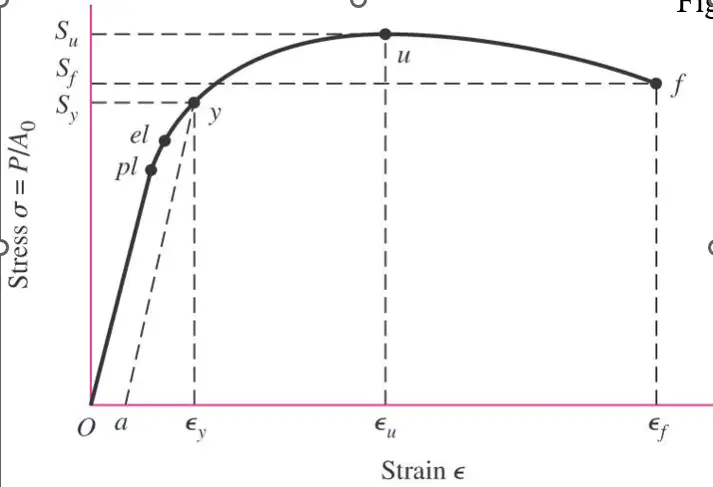
The main regions in the Stress-Strain diagram are:
Elastic Deformation
Uniform plastic deformation
Non-Uniform plastic deformation.
without deformation
What is the proportional limit, pl point in the Stress-Strain diagram?
Where stress and strain have a linear relation until this point
No permanent deformation until the this point.
What is the elastic limit, el point in the Stress-Strain diagram?
Where stress and strain have a linear relation until this point
No permanent deformation until the this point.
Hardness means the resistance of a material to penetration by a pointed tool.
False
True
Some of hardness measuring systems are:
Rockwell
Brinell
thermometer
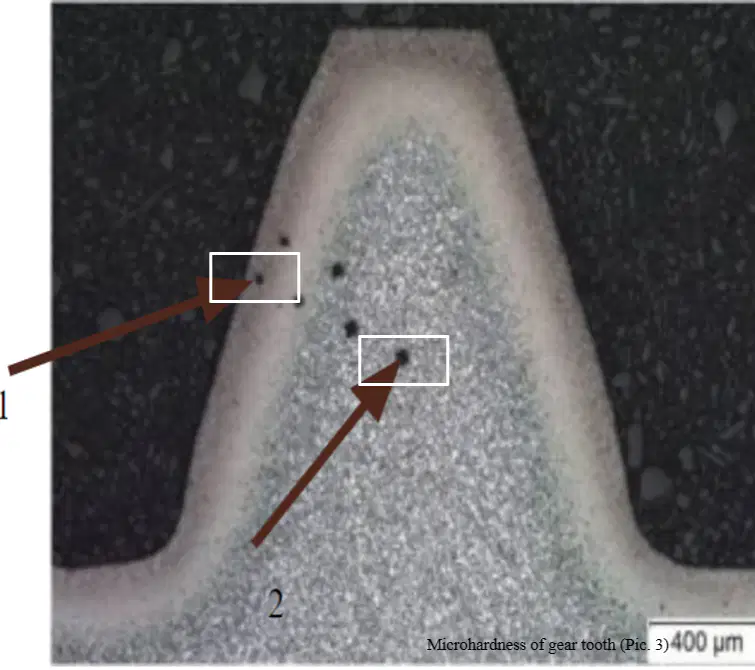
In which case (1 or 2) hardness is higher?
Upper point 1
Lower point 2
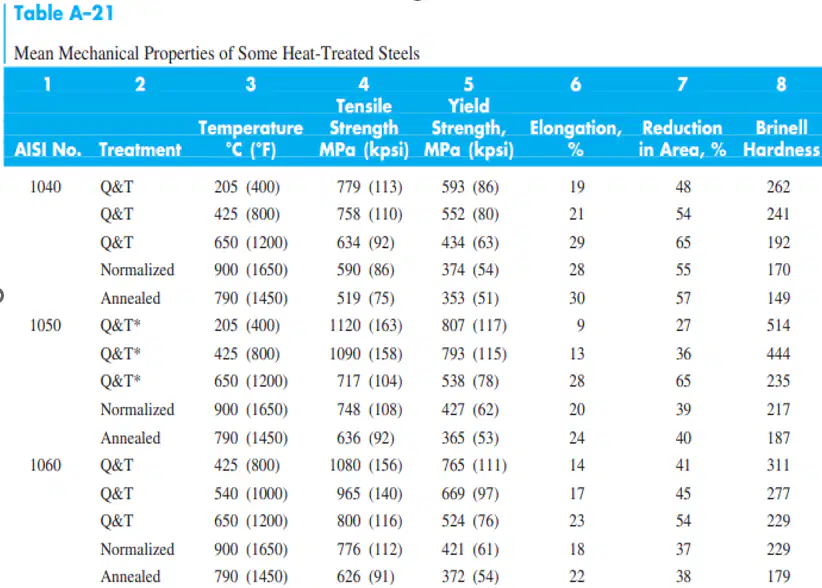
Assume you were specifying an AISI 1050 steel for an application. Using Table A-21:
a- How would you specify it if you desired to maximise the yield strength?
425 °C (800 °F)
650 °C (1200 °F)
205 °C (400 °F)
Assume you were specifying an AISI 1050 steel for an application. Using Table A-21:
b- How would you specify it if you desired to maximise ductility (elongation)?
425 °C (800 °F)
650 °C (1200 °F)
205 °C (400 °F)
Processes to increase the hardness on outer surface of materials:
Addition of carbon to the outer surface by exposure to high carbon
heat treating only the outer surface
by washing the surface with water
Casting is a manufacturing process in which a liquid material is usually poured into a mold, which contains a hollow cavity of the desired shape, and then allowed to solidify
True
False

