
 Worksheets
Unit 1 Review
Total questions: 57
Worksheet time: 44mins

What is a member of a community that owes loyalty to a government and, in turn, are entitled to its protection?
government
naturalization
citizen
citizenship

Why are citizens obligated to respond to such documents as jury summons?
To guarantee court hearings remain public
To protect the constitutional right to be tried by one's peers
To guarantee courts provide probable cause
To protect the constitutional right to confront one's peers

-Pay Taxes
-Attend school until 16
-Defend the Nation
-Obey Laws
-???
What is missing from the list of obligations above?
Vote
Volunteer
Stay informed
Serve on juries

Requirements for Naturalization
-Be of good moral character
-Read, write, and speak English
-Be at least 18 years old
-Been admitted lawfully into the U.S. (lawful permanent resident)
-???
Which requirement is missing from the list above?
Pay federal income taxes
Have a close relative who is a U.S. citizen
Have an annual income of $20,000 or more
Have lived/resided in the U.S. for five years

Why is it important to pay your taxes?
To make sure that laws are up-to-date
To pay for private universities
To make sure that people are good citizens
To provide money to pay for government services

Who of the following is a U.S. citizen?
Julia moved to the U.S. when she was 3 years old. She moved back to Mexico when she was 12.
Raymond was born in Canada and has been working in the U.S. the past 3 years.
Oscar was born in Spain. His mother is a citizen of Spain and his father is a U.S. citizen.
Nina is a foreign exchange student going to school in California.

Why does the government require qualified 18-year-old males to register for the selective service?
To allow the government to quickly draft them in times of crisis
To provide jobs for more people
To ensure that they are also registered to vote
To provide money for government services

The 14th Amendment allows for equal protection under the law and it defines citizenship. According to this amendment, who is a citizen?
Someone born or naturalized in the U.S.
Someone who lives in the U.S. and has a job
Someone who owns property in the U.S.
Someone going to school in the U.S.

Which of the following is an example of contributing to the common good?
Studying for a test so that you get a better grade.
Making a donation of food or money so that a local homeless shelter can feed the poor.
Participating on a recreational sports team.
Getting paid to cut the grass at a local nursing home.

An __________________ is a person who comes to a country to live permanently.
Emigrant
Resident Alien
Alien
Immigrant
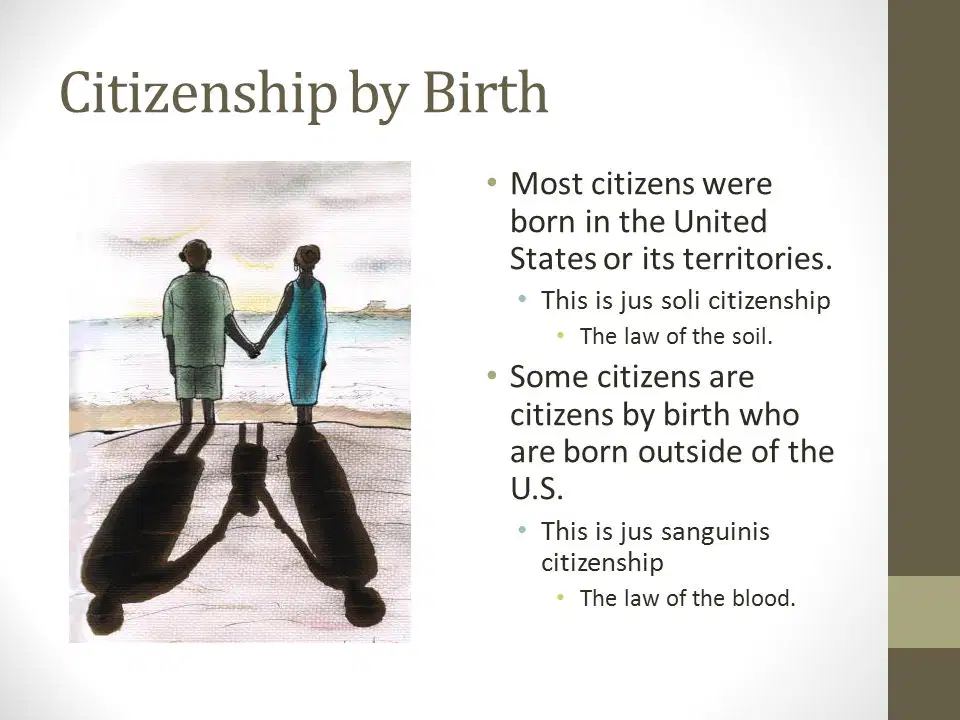
What two ways can a person be considered as a natural-born U.S. citizen?
be naturalized and serve in the miliary.
Law of blood and law of soil.
Permanent legal resident or have a work visa.
have a job or college visa.

The idea of citizenship began in
ancient China.
the United States.
ancient Greece and Rome.
ancient Egypt

"Governments are instituted among Men, deriving their just powers from the consent of the governed (the people)"

What is the term used in the Fourteenth Amendment to describe persons who are born or naturalized in the United States?
aliens
citizens
immigrant
residents

Athens, an ancient Greek city-state called a _______, was a self-governing community and known as the birthplace of democracy.
polis
Polling Place
Oligarchy
Acropolis

Which is an influence both Ancient Greece and Ancient Rome had on the American
government?
a polis
civic participation
a written constitution
separation of powers

The diagram below shows the impact of an important tradition.
Which of the following phrases BEST completes the diagram above?
Voting rights
Separation of Powers
Ethical ideas of justice
Representative government
Democracy means ruled by the __________
people
king
church
wealthy

When Thomas Jefferson wrote the Declaration of Independence, which democratic principle of the Ancient Greeks influenced him the most?
Term limits preventing anyone from staying in power too long
People have the fundamental right to rule themselves
Civic Participation is an important duty
That only the "best and brightest" should serve in government
Ancient Rome organized their government in the following way:
Assembly and a Senate
Two consuls
Judges who oversee the courts
Which Ancient Rome idea influenced the American government?
Legislative Bodies
Representative Governments
Separation of Powers
Written Constitution
Identify a way Judeo-Christian influenced America's constitutional republic.
Legislative bodies
Written constitution
Separation of powers
Personal responsibility
This is an excerpt from a book Benjamin Franklin wrote in 1736.
"God helps them that help themselves"
Based on the quote, what quality of the American republic was influenced by the values of Christian Puritans who helped settle the 13 colonies?
personal responsibility
legal justice
equal rights
written constitution

6. This engraving shows Roman citizens reading the Twelve Tables of Roman Law.
What concept about the law did Rome develop with the Twelve Tables that was also incorporated into American government?
Citizens can read laws to be better informed when they give legislators feedback.
Citizens can read laws to better understand their rights.
Citizens can learn the law so that they can file complaints in court.
Citizens can learn the law to ensure that the rule of law is being upheld.
What type of government was established by America's Founders?
Monarchy
Constitutional Republic
Dictatorship
Oligarchy
Which document was created in 1776?
Constitution
Bill of Rights
Declaration of Independence
Magna Carta
Which phrase is associated with natural rights?
"Peace, love, and joy"
"Life, liberty, and the pursuit of happiness"
"Freedom, justice, and equality"
"Honor, courage, and commitment"
According to the Preamble, what is one of the goals for the United States?
To secure the Blessings of Liberty
To expand territory
To increase population
To establish a national religion
Who is known as the "Father of the Constitution"?
George Washington
Thomas Jefferson
James Madison
Benjamin Franklin
Which amendment of the Bill of Rights addresses religious liberty?
Second Amendment
Third Amendment
First Amendment
Fourth Amendment
The phrase "prohibiting the free exercise thereof" refers to which freedom?
Freedom of speech
Freedom of the press
Freedom of religion
Freedom of assembly
Separation of powers is a principle most closely tied to which of these other principles?
Religious liberty
Natural rights
Equality of mankind
Limited government
Under the Rule of Law, how is everyone treated?
Differently based on status
The same under the law
According to their wealth
Based on their age
What is meant by the legal system being "transparent"?
It is secretive
It is open and clear
It is confusing
It is hidden
The concept of "due process of law" is primarily associated with which amendment?
First Amendment
Fifth Amendment
Tenth Amendment
Second Amendment
What is a part of the rule of law?
Due process of law
Freedom of speech
Right to bear arms
Right to privacy

The statement below is an excerpt from Magna Carta (1215). Which right was guaranteed in this excerpt from Magna Carta?
no taxation without representation
freedom of the press
freedom of religion
trial by jury
The Declaration of Independence (1776) included the following statement: "We hold these truths to be self-evident, that all men ... are endowed by their creator with certain inalienable rights ..." Which of America's founding ideas was expressed in this statement?
rule of law
natural rights
due process of law
limited government


The chart demonstrates how colonists' political ideas were shaped by historical writings.
What statement best completes the diagram?
Limited the authority of the monarchy
Promoted the self-government of citizens
Protected against excessive punishments
Assured tolerance for uncommon religious practices
“Some people say that, because America has grown wealthy under Great Britain, the same will happen in the future. Nothing can be more false. . . . I answer that America would have become just as wealthy, and probably more, had no European power ever been involved.”
- Thomas Paine, 1776
Which of these is the MOST LIKELY purpose of this passage?
to convince the American colonies to separate from Britain
to convince the American colonies to remain under British rule
to convince the American colonies to support the British in the war against Germany
to convince the American colonies to dump British tea into Boston Harbor
"We hold these Truths to be self-evident, that all Men are created equal, that they are endowed by their Creator with certain unalienable Rights, that among these are Life, Liberty, and the Pursuit of Happiness."
This quote from the United States Declaration of Independence is MOST associated with which of these philosophers?
Plato
Socrates
John Locke
Thomas Hobbes
French political thinker Baron de Montesquieu (1689–1755) was one of the Enlightenment's most important thinkers. He is famous for saying that "when the [law making] and [law enforcement] powers are united in the same person... there can be no liberty."
To which principle of government is Montesquieu's statement MOST directly related?
Bill of Rights
Individual Rights
Popular Sovereignty
Separation of Powers
Man being born with a title to perfect freedom, and enjoyment of all the rights and privileges of the law of nature, equally with any other man, hath by nature a power, not only to preserve his life, liberty and estate, against the injuries and attempts of other men; but to judge of, and punish the breaches of that law in others.
- from Two Treatises of Government, John Locke, 1690
John Locke's writing MOST LIKELY reflects the ideals of which movement?
Enlightenment
Imperialism
Liberalism
Romanticism
English Bill of Rights
a government document written in 1689 that expanded the powers of the English Parliament and expanded the rights of the people, as well as further limited the rights of the king
a treaty signed in 1215 that established the principle of due process
a declaration of independence from the monarchy written in 1776
a constitutional amendment that granted women the right to vote in 1920
consent of the governed
the idea that government gains its power/authority from the people
a principle that allows citizens to overthrow their government
a theory that suggests government should operate without any input from citizens
a concept that emphasizes the importance of military power in governance
Mayflower Compact
an agreement between individuals that created a government that would provide order and protect the rights of the colonists; written by a group of English Puritans in Massachusetts in 1620
a treaty signed between Native Americans and European settlers in 1621
a document that established the first colony in Virginia in 1607
a declaration of independence from British rule written in 1776
Common Sense
a pamphlet published by Thomas Paine in 1776 to convince the American colonists to support becoming independent from Great Britain
a novel written by Mark Twain in 1884 about a boy's adventures
a speech delivered by George Washington in 1775 urging unity among the colonies
a declaration signed by the Founding Fathers in 1776 outlining the reasons for independence
self-government
A system where the government is run by a monarch
A popular or representative system where the people create and run their own government
A form of government where decisions are made by a small group of elites
A system where the military controls the government
Magna Carta
a government document that limited the power of the king of England and protected the rights of the nobility; written in 1215
a treaty that ended the Hundred Years' War
a declaration of independence from France
a constitution that established the Parliament of England
Baron de Montesquieu
A philosopher who believed in the divine right of kings
A philosopher who advocated for the separation of powers in government
A philosopher who supported absolute monarchy
A philosopher who promoted direct democracy
all men are created...
equal
unequal
superior
inferior
social contract
an implied agreement among the people of an organized society that defines the rights, duties, and limitations of the governed and the government
a formal document outlining the laws of a nation
a treaty between two or more countries
a set of guidelines for ethical behavior in society
natural law
a system of right or justice held to be common to all humans and derived from nature rather than from the rules of society
a legal system based solely on written statutes and regulations
a philosophical concept that denies the existence of any universal moral principles
a set of laws created by governments to regulate human behavior
separation of powers
a principle of government that sets up a structural division of responsibilities within distinct branches, each with their own powers and processes
a system where the government is run by a single entity without any divisions
a method of ensuring that all government decisions are made by popular vote
a framework that allows for the complete overlap of government functions across branches
consent of the governed
the idea that government gains its power/authority from the people
the belief that citizens should have no say in government
the principle that government can act without the people's approval
the notion that power is derived from military strength
John Locke
a philosopher who believed in natural rights and social contract
a political leader who advocated for monarchy
a scientist known for his work in physics
an economist who focused on capitalism
natural rights
Rights that can be given or taken by the government
Rights an individual is born with that cannot be given or taken by government (ex. life, liberty, pursuit of happiness)
Rights that are only applicable to citizens of a country
Rights that are determined by societal norms

