
 Worksheets
S8P1 Review
Total questions: 14
Worksheet time: 15mins
A sample of two or more atoms chemically combined held together by bonds
an element
a molecule
a homogenous mixture
a heterogenous mixture
an atom

When thermal energy is increased in a solid, what change in state is happening?
Melting
Evaporation
Freezing
Condensation

What phase change is represented and is energy added or removed?
condensation; removed
evaporation; added
evaporation; removed
freezing; removed
At the end of chemical reactions, what is the total mass of the reactants compared to the total mass of the products?
the product is doubled
the mass is the same
the product is half the mass of the reactants
the mass changes depending on the reaction

The faster molecules move,
the higher the temperature
the less temperature
the same temperature
I don't know
When the temperature of matter decreases the particles ...
speed up and move farther apart
speed up and move closer together
slow down and move farther apart
slow down and move closer together

Which two elements have similar properties?
Rubidium (Rb) and Fluorine (F)
Cesium (Cs) and Potassium (K)
Sodium (Na) and Chlorine (Cl)
Hydrogen (H) and Oxygen (O)

Which boxes contain any molecules?
Only box C
Boxes C, F and I
Boxes A, D and I
Boxes A, C, D and I
Boxes B, E, G, H

Which scenario would BEST explain the phase change shown in the picture?
A pot of water boils and forms steam.
Pond water freezes on a cold winter day.
Water droplets form on grass on a cool morning.
Snowman melts on a sunny day.

Which diagram(s) models a pure substance?
i and iv
ii and iii
v and vi
i and iii

Which diagrams are modeling mixtures?
i, iii, and iv
ii, iii, v, and vi
v and vi only
ii and iii only

Which two elements would have similar properties?
Ar - Argon and Xe - Xenon
Og - Oganesson and Lu - Lutetium
He - Helium and Lu - Lutetium
Ar - Argon and Se - Selenium
Which process could cause a material to change state from gas to liquid?
Adding heat
Adding energy
Removing particles
Removing energy
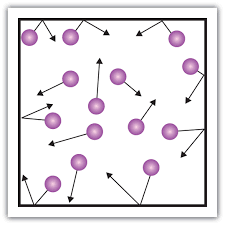
A gas typically consists of:
low energy particles that experience high attractive forces between them.
low energy particles that experience no attractive forces between them.
high energy particles that experience high attractive forces between them.
high energy particles that experience little attractive force between them

