
 Worksheets
Earth Science and Natural Processes Quiz
Total questions: 20
Worksheet time: 8hrs 45mins
What is the main difference between weathering and erosion?
Weathering can involve wind, rain, hail, or snow, while erosion involves only rain.
Weathering is completely natural, while erosion is man-made.
Weathering only affects rocks, while erosion only affects soil.
Weathering breaks down materials, while erosion moves them.
Camilla finds a rock in her backyard that has a large crack. She creates a model by filling the crack with water and placing it in her freezer. The next day, she removes the frozen rock from the freezer and lets it thaw. She repeats this process twenty times and notices that the crack in the rock has grown deeper and wider. The diagram shows Camilla's model. Which process is Camilla most likely trying to model?
erosion
deposition
weathering
sedimentation
Brian and Amy visited the Grand Canyon during the summer. Brian told Amy that a destructive force caused the formation of the Grand Canyon. Which destructive force would have caused the Grand Canyon?
Erosion
Earthquakes
Tornadoes
Volcanoes

The picture shows a flowing river. Which statement best describes how the collection of rocks and dirt along the river bank formed?
The river bank formed through the constructive process of deposition.
The river bank formed through the destructive process of compacting.
The river bank formed through the constructive process of weathering.
The river bank formed through the destructive process of sedimentation.
A student argues that a destructive force can change the surface of Earth. Which of the following could be used to support this claim?
A new island formed in the ocean.
A mountain grows taller over thousands of years.
A plain becomes a deep canyon due to erosion.
A sand dune forms on the beach.
Which of these processes caused the change in surface features resulting in Crater Lake, Oregon?
earthquake
weathering
volcano
flood control
Students were tasked with making a model of how natural forces can change the surface features of Earth. They make a pile of sand in front of an electric fan and turn it on. Which of the following would be a correct model for the fan and pile of sand?
The formation of a delta at the mouth of the river.
The building of a mountain on the edge of a continent.
The movement of dunes caused by blowing winds.
The creation of a canyon by flowing water.
Students placed two desk next two each other, and then pulled them apart. This demonstration best models which change that happen to the surface of the Earth?
Weathering changing the shape of a mountain.
Large cracks forming on the ground.
Waves making a beach smaller.
Sand dunes moving by winds.
A student models changes to Earth’s crust by spreading frosting on a plate and then placing two graham crackers next to each on top of the frosting. The crackers represent tectonic plates. In order to model how new mountain ranges form, what should the student do next?
Add more frosting underneath the edge of one cracker.
Push the edge of one cracker into the other until they form a ridge.
Slide one cracker left and the other cracker right.
Pull the two crackers apart until frosting begins to rise in the middle.
A seawall constructed along a length of oceanfront property can assist a coastal city by __________.
keeping water temperatures down.
providing a road for cars.
preventing animals from migrating.
slowing erosion of beach sand.
The technology of a seismograph is helpful to humans because it .
helps detect and measure earthquakes
determines the height of tidal waves
records historical temperature extremes
identifies locations with poor soil
Several dams were built across the Chattahoochee River. Which is one of the reasons they were built?
to prevent runoff
to prevent flooding downstream
to increase the flow of water in the river
to decrease the amount of water upstream
Anne is using sand to model Earth’s landforms. She is forming mountains and carving canyons for rivers. She is going to add water to the model. What will Anne demonstrate when she pours water into the model? Will it most likely be a constructive or a destructive process?
how groundwater seeps into the soil from the mountains, destructive
how evaporation and condensation affect mountains, constructive
how water runs off the mountains and erodes the earth to form river beds and canyons, destructive
how living things use water to create rivers, lakes, and oceans, constructive

The picture below shows sedimentary rock in layers. How were theses rocks formed?
lava was rapidly cooled
heat and pressure applied to granite
sediment was deposited slowly over time
magma from a volcano
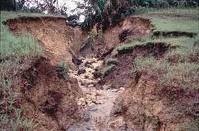
What is the movement of sediment from one place to another, often caused by wind and flowing water?
energy
weathering
work
erosion

Over many years, the depth of a lake gets more shallow. What could cause this change?
The climate in the area gets warmer.
Sediments are deposited in the lake.
The Sun evaporates the water.
A hurricane brings heavy rains.


The dropping off of sediments in a new place is called __________.
weathering
deposition
sedimentary rock
drop off zone


Sandstone arches, like the one shown in the figure, form in some desert environments.
Which of the following MOST LIKELY occurred to form this arch?
the cooling of lava
the blowing of wind
the rushing of water
the depositing of sediment

