
 Worksheets
Astronomy Review
Total questions: 50
Worksheet time: 54mins
On the diagram, label where the planet is moving the fastest, second fastest, and slowest.
fastest
second fastest
slowest
What does Kepler's second law state?
The area a planet sweeps in orbit will be the same for any two equal time periods.
The orbital speed of planets is faster when they are farther away from the Sun.
The orbital speed of planets is constant.
The area a planet sweeps in orbit will be different for any two equal time periods.
Why do planets move faster when they are nearer the Sun?
Because the Sun's gravity is accelerating the planets.
Because the Sun's gravity is constant.
Because the Sun's gravity is slowing the planets down.
Because the Sun's gravity has no effect on the planets.
Where will an object move at the greatest speed as it orbits the sun?
Perihelion
Aphelion
Between perihelion and aphelion
Planets travel around the sun in __ orbits
circular
rectangular
oval
elliptical
What is the law of ellipses?
A line that connects a planet to the sun sweeps out equal areas in equal time intervals.
Planetary orbits are shaped like ellipses, with the sun located at one of the two foci.
The law of ellipses 2. The law of equal areas 3. The law of harmonies
By observing the shape and size of their orbits, as well as the time it takes to complete one orbit.
What is the law of harmonies?
By observing the shape and size of their orbits, as well as the time it takes to complete one orbit.
The square of a planet's orbital period is directly proportional to the cube of its average distance from the sun.
T^2 = k * r^3, where T is the orbital period and r is the average distance from the sun.
The average distance between a celestial body and the sun throughout its elliptical orbit
As galaxies move away from our galaxy
a shift on the electromagnetic spectrum is noticed. This phenomena is
called _____________.
redshift
blueshift
How does Cosmic Microwave Background Radiation support the Big Bang Theory?
Microwaves are found everywhere in the universe.
Microwaves occurred at the time of the Big Bang
Microwaves are useful in our everyday lives
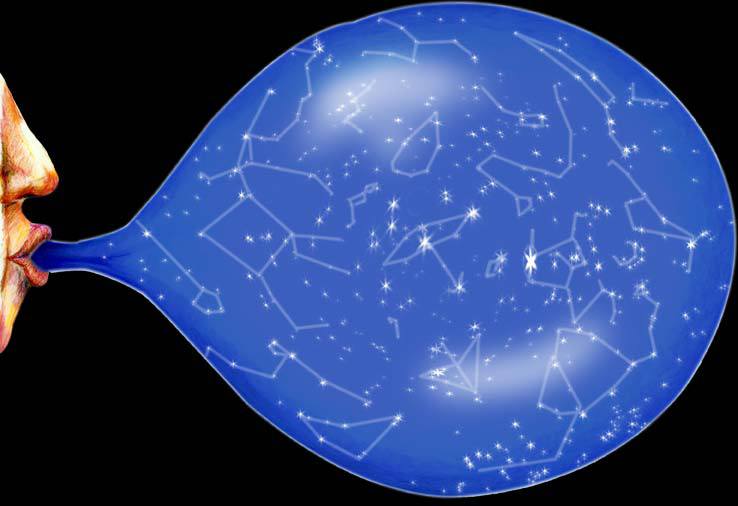
Who observed that most galaxies are moving away from us?
Edwin Hubble
Arno Penziaas
Robert Wilson
Albert Einstein

What best describes the doppler effect?
An apparent change in frequency of a wave due to the relative motion between a wave source and an observer
When sound changes pitch
When light changes color
An apparent change in the amplitude of a wave due to the relative motion between a wave source and an observer.

A galaxy showing BLUE SHIFT is ___.
very cold
moving TOWARDS OR TO us
dying
about to supernova
What are two important pieces of evidence we have for the Big Bang?
Ptolemy’s work on epicycles and Hubble’s law (the expansion of the Universe)
Doppler Effect (the redshifting of the Universe) and cosmic background radiation
The fact that we have multiple Universes to compare and study and cosmic background radiation (CBR)
The abundance of hydrogen, helium, and lithium found in the Universe and Ptolemy’s work on epicycles

The diagram below shows the spectral lines for an element.
Which diagram best represents the spectral lines of this element when its light is observed coming from a star that is moving away from Earth?


The diagram represents a standard spectrum (fingerprint) for an element.
The spectral lines of this element are observed in light from a distant galaxy. Which diagram represents these spectral lines?


Each element on the periodic table can be identified by its
classification as a solid, liquid or gas.
location on the table.
ability to react to form compounds.
unique spectral "fingerprint."

A sample of gas is analyzed, producing the spectrograph in the image. Identify which element the sample is mostly made-up of?
Hydrogen
Helium
Neon
Mercury

Which element(s) are found in the star's spectra below?
Hydrogen only
Hydrogen & Helium
Calcium only
Hydrogen & Calcium


An instrument called a (a) can be used to spread out wavelengths of light in a manner similar to a prism.

Identify Item #1
Continuous Spectrum
Emission Spectrum
Absorption Spectrum
Identify Item #2
Continuous Spectrum
Emission Spectrum
Absorption Spectrum
Identify Item #3
Continuous Spectrum
Emission Spectrum
Absorption Spectrum

Which elements can be found in this emission spectra?
Hydrogen
Helium
Lithium
Boron
Carbon

Which elements can be found in this emission spectra?
Hydrogen
Helium
Lithium
Boron
Carbon


What characteristics are used to classify stars?
Flammability, weight, and reactivity
Temperature/color and brightness
Conductivity, luster, and density
Malleability, distance, and viscoscity

Using the HR diagram, choose the color of Zeta Eridani
blue
white
yellow
red

Which star is hotter than Deneb
Procyon
Sun
Regel
Banard's Star

Which star is brighter than the sun?
Sirius B
Procyon B
Van Maanan's Star
Aldebaran

What is the color of the highest surface temperature?
Red
Orange
White
Blue
What is the color of the lowest surface temperature?
Red
Orange
White
Blue
Reorder the following for a low mass star:
Nebula
Protostar
Main-Sequence Star
White Dwarf
Black Dwarf

What is the final stage of a low mass star?
White Dwarf
Black Hole
Red Giant
Neutron Star
What is the final stage of a high mass star?
White Dwarf
Black Hole
Red Giant
Neutron Star
What is the final stage of a very high mass star?
White Dwarf
Black Hole
Red Giant
Neutron Star

Which mass of star will have the shortest life span?
Low Mass Star
Medium Mass Star
High Mass Star
Very High Mass Star

What is the name of the cosmic cloud of dust and gas that is the first stage in the birth of a star?
Protostar
Spiral Galaxy
Quasar
Stellar Nebula
How do main sequence stars like the sun make their energy?
fusion of hydrogen into helium
fission of hydrogen into helium
fusion of helium into hydrogen
fission of helium into hydrogen

