wayground logo

Free Printable Worksheets

Font size

S
M
L
XL
Worksheets

Earth Science Unit 2 Test

Total questions: 39

Worksheet time: 20mins

Name
Class
Date
1.
What characteristics are required to classify something as a mineral? Choose 2!
a)
Naturally formed
b)
Organic
c)
Made only of 1 element
d)
Crystal structure
e)
Metallic Luster
2.
Which environment is most likely to form a chemical sedimentary rock? Choose 2!
a)
Ancient oceans
b)
Caves
c)
On the surface of an active volcano
d)
Deep inside earth's crust
3.

How are rhyolite and granite alike? Choose 2!

Use your igneous rock ID scheme.

a)
light colored
b)
felsic
c)
mafic
d)
dark colored
e)
intermediate
4.

If Mackenzie has a sample that scratches fluorite, but is scratched by orthoclase, what is the mineral hardness (to the nearest whole number)?

(a)  

5.

What is the parent rock of Quartzite?

Use your sedimentary rock ID scheme.

(a)  
6.
Which of the following would fizz with acid? Choose 3!
a)
basalt
b)
calcite
c)
halite
d)
limestone
e)
marble
7.

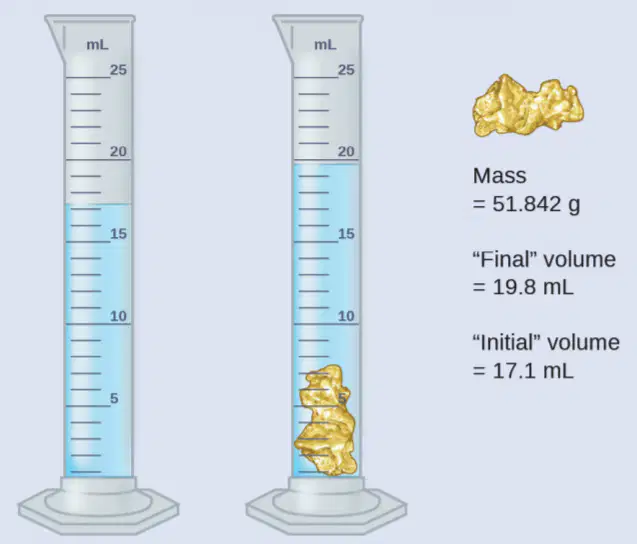
The density of the sample to the nearest tenths place is (a)   g/mL. NO UNIT. NUMBER ONLY
8.
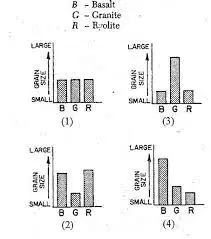
Which graph best represents the comparison of the average grain sizes in basalt, granite, and rhyolite? **Notice the graph numbers are a little out of order. 1 3 2 4
a)
Graph 1
b)
Graph 2
c)
Graph 3
d)
Graph 4
9.
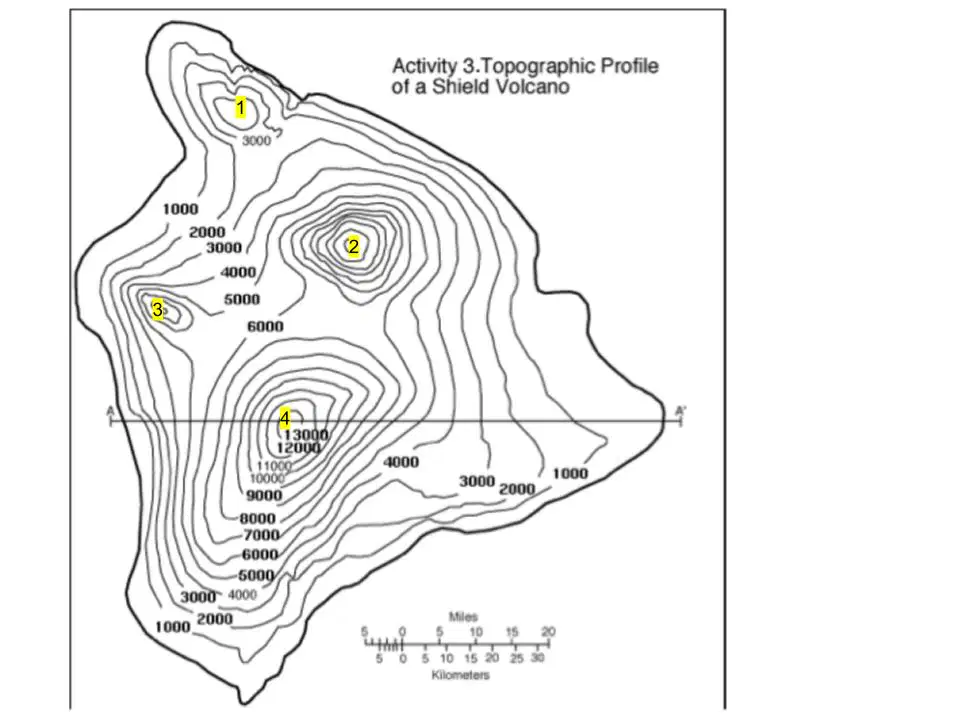
What peak is the shortest?
a)
Peak 1
b)
Peak 2
c)
Peak 3
d)
Peak 4
10.
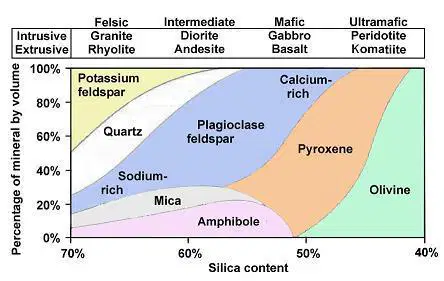
Which mineral content would be correct for a sample of basalt?
a)
20% Potassium Feldspar, 20% Quartz, 10% mica, 50% Olivine
b)
80% Olivine, 20% Pyroxene
c)
45% Plagioclase feldspar, 35% Pyroxene, 20% Amphibole
d)
10% Potassium Feldspar, 25% Quartz, 50% Plagioclase Feldspar, 5% Mica, 10% Amphibole
11.

Which sedimentary rock would be formed with sediments .5cm in diameter cemented together?

Use the sedimentary rock ID scheme.

a)
Conglomerate
b)
Sandstone
c)
Siltstone
d)
Limestone
12.

Rhyolite is classified as...

Use your igneous rock ID scheme.

a)
Felsic Intrusive Igneous
b)
Mafic Intrusive Igneous
c)
Felsic Extrusive Igneous
d)
Mafic Extrusive Igneous
e)
Foliated Quartz Metamorphic
13.
The classifying of rocks as igneous, sedimentary, and metamorphic is based primarily upon differences in
a)
hardness
b)
size
c)
origin
d)
age
14.

Which rock would form from the shells of sea organisms compacted and cemented together?

Use your sedimentary rock ID scheme.

a)
Bituminous Coal
b)
Limestone
c)
Basalt
d)
Sandstone
e)
Obsidian
15.
Sedimentary rocks formed by compaction and cementation of land-derived sediments are classified on the basis of... Hint: It says "land-derived" on your sedimentary rock ID scheme.
a)
grain size
b)
rate of formation
c)
composition
d)
type of cement
e)
heat and pressure
16.
Which statement best describes the percentage of pyroxene in a sample of diorite? *Hint: is there somewhere you can look for that?
a)
Pyroxene will always have less than 15% of the composition.
b)
There is more pyroxene than feldspars.
c)
The amount of Pyroxene equals the amount of quartz.
d)
Amphibole is always less than pyroxene.
17.

What describes the formation of marble?

Use your metamorphic rock ID scheme.
a)
evaporation of seawater
b)
metamorphism of limestone
c)
weathering of siltstone
d)
faulting and folding of shale
18.
The recrystallization of unmelted material under high temperature and pressure results in
a)
igneous rock
b)
magma
c)
sedimentary rock
d)
metamorphic rock
19.

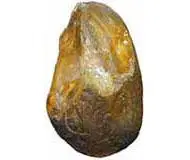
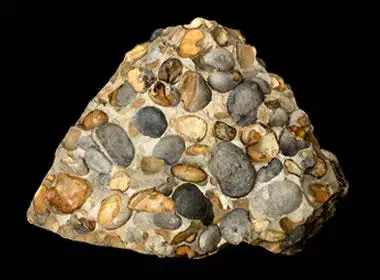
What conclusion can be drawn about this rock?

Use your sedimentary rock ID scheme.

a)
It contains a single type of mineral cemented together.
b)
The sediments pieces inside it formed at the same time.
c)
It formed volcanically.
d)
The sediments were tumbled in a river before being cemented together.
20.

Which type of sedimentary rock is formed by ancient plants?

Use your sedimentary rock ID scheme.

a)
Limestone
b)
Sandstone
c)
Bituminous Coal
d)
Coquina
21.

Compared to basalt, granite is ...

Use your igneous rock ID scheme.

a)
more fine grained
b)
lighter in color
c)
more mafic in composition
d)
made slower
22.
Large rock salt deposits in Utah indicate that the area once had
a)
many terrestrial animals
b)
a range of volcanic mountains
c)
large forests
d)
a warm, shallow sea
23.
Large crystal grains in igneous rock indicate that the rock was formed
a)
under low pressure
b)
over a long period of time
c)
near the surface
d)
at a low temperature
24.
A mineral that is commonly mistaken for gold is ________, or fool's gold.
a)
halite
b)
flourite
c)
galena
d)
pyrite
25.
A mineral used in food is
a)
halite
b)
basalt
c)
sulfur
d)
hematite
26.

The ability of slate and shale to split into thin sheets is attributed to its high content of the mineral _________.

Use your sedimentary and/metamorphic rock ID scheme.

a)
halite
b)
mica
c)
quartz
d)
sand
e)
calcite
27.
In an experiment Rudy grows crystals of borax from a solution cooling at different rates. Rudy places one cup of solution in the fridge and another in an insulated dish to hold the heat in. He compares the sizes of the crystals formed. What is Rudy's dependent variable? Hint: The hypothesis is "If I put the solutions in different temperatures, then the crystals will be different sizes."
a)
Cooling rate
b)
Solution type
c)
Crystal size
d)
Time cooled
28.
Larry finds a crystal that he suspects is a diamond. What test can Larry do determine it is a diamond and not a piece of quartz?
a)
Bite the crystal. Quartz bends when chewed.
b)
Drop acid to see if it reacts with acid. Diamonds don't react with acid, but quartz does.
c)
Scratch the crystal across a penny. Only diamonds scratch pennies.
d)
Scratch the crystal across a piece of quartz he has in his collection. Diamond would scratch quartz
29.
If the specific gravity of a mineral is 7.5, would it float or sink in water?
a)
float
b)
sink
30.

If Shale is subjected to heat and pressure, it can become?

Use your metamorphic rock ID scheme.

a)
granite
b)
slate
c)
quartzite
d)
marble
31.
The wavy color bands of this rock tell you it is...
a)
foliated metamorphic
b)
intrusive igneous
c)
clastic sedimentary
d)
nonfoliated metamorphic
e)
not a rock
32.
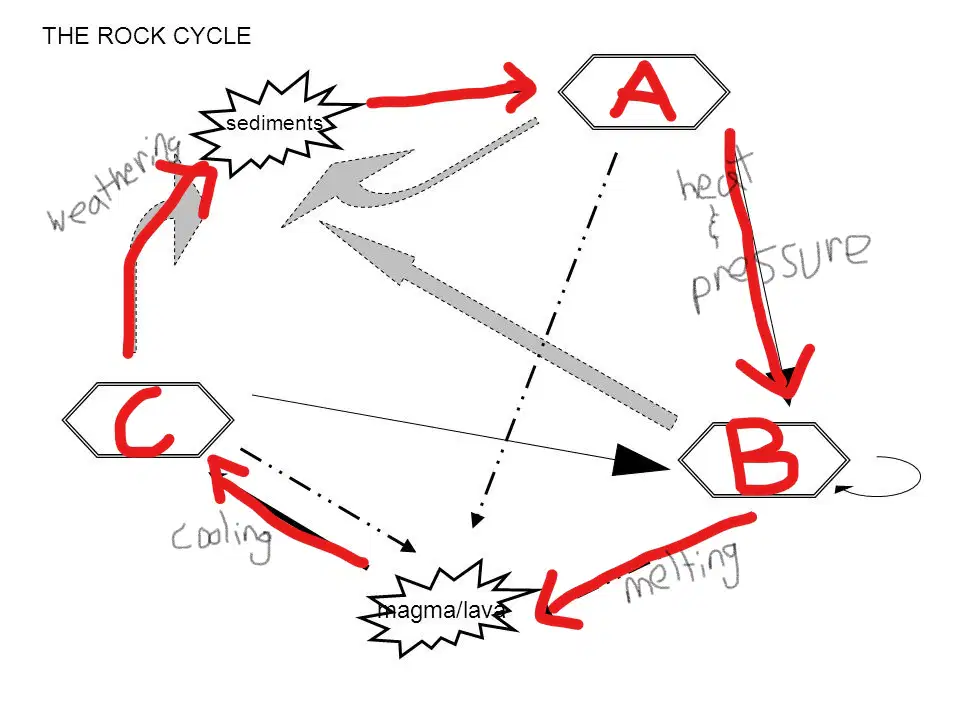
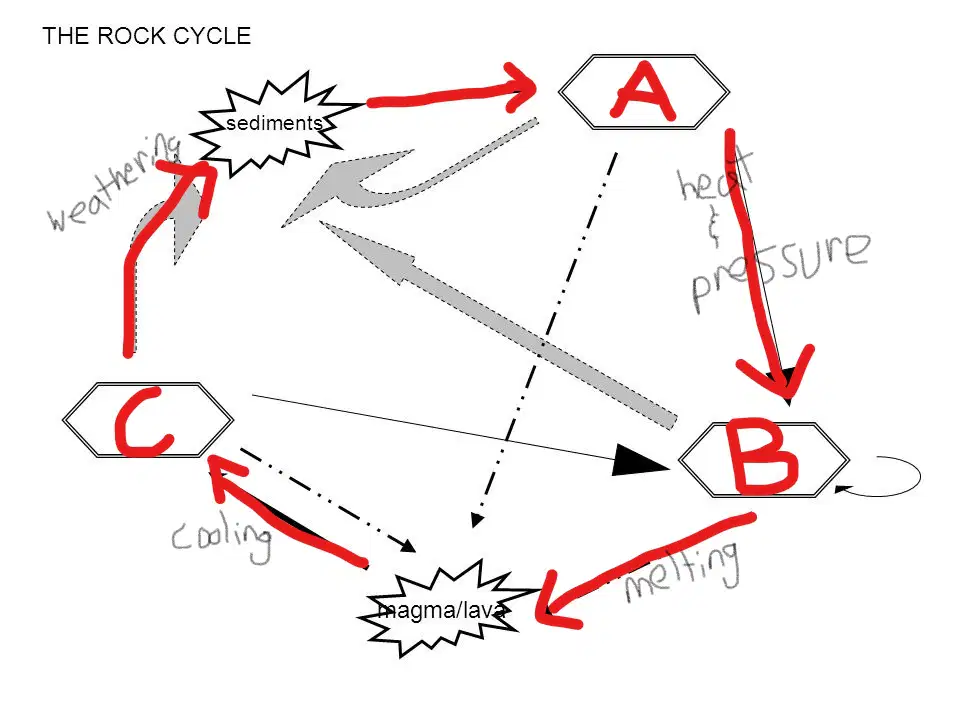
Which letter represents Igneous Rock?
a)
A
b)
B
c)
C
33.
Which letter represents metamorphic rock?
a)
A
b)
B
c)
C
34.
The black sand beaches of Hawaii can most easily be explained by
a)
the large amount of dark sea shells
b)
the basalt weathered on active volcanic areas
c)
the granite weathered on active volcanic areas
d)
the black pearls that was on shore.
35.

If schist is subjected to high heat and pressure and doesn't melt, what does it become?

Use your metamorphic rock ID scheme.
a)
slate
b)
phyllite
c)
gneiss
d)
basalt
36.
The most abundant mineral group is
a)
oxides
b)
silicates
c)
halides
d)
carbonates
37.
This rock would be classified as
a)
intrusive igneous
b)
extrusive igneous
c)
organic sedimentary
d)
clastic metamorphic
38.
Which of the following is TRUE about this mineral?
a)
Metallic luster
b)
Cleavage
c)
Fracture
d)
Double Refraction
39.
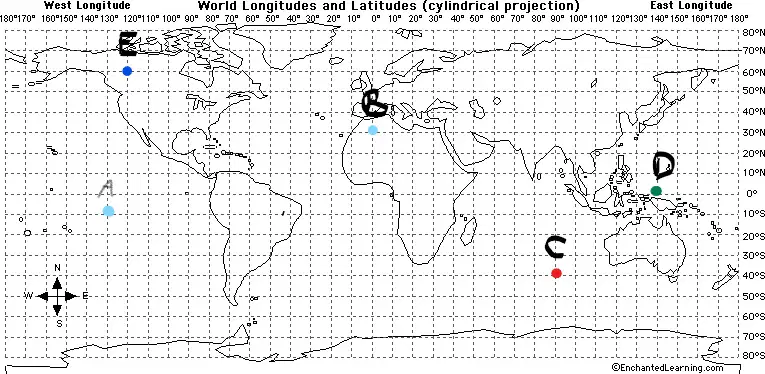
What is the latitude of B?
a)
30*N
b)
0*
c)
30*S
d)
30*E
e)
20*S