
 Worksheets
Openstax Government Chapter 2.4 & 2.5
Total questions: 27
Worksheet time: 14mins
According to the passage, what was required before the Constitution could become law and a new government could form?
The document had to be ratified by nine of the thirteen states.
The President had to sign the document into law.
All thirteen states had to approve the document unanimously.
The Supreme Court had to review and approve the document.
Which of the following was a major concern of the Anti-Federalists regarding the new Constitution?
The federal government would be too weak to maintain order
The president would have excessive power
The states would have too much power
The Constitution would not allow for amendments
The framers chose to have ratification conventions instead of asking state legislatures to approve the Constitution because:
they wanted the decision to reflect the will of the people rather than state governments.
state legislatures were too busy to consider the Constitution.
the Articles of Confederation required conventions for amendments.
conventions were less expensive than legislative sessions.
Fill in the blank: The greatest source of dissatisfaction with the Constitution was that it did not guarantee protection of _________
individual liberties
state boundaries
economic interests
foreign alliances
Some citizens feared the loss of their traditional rights under the new Constitution because:
they believed the new government might become too powerful and ignore individual freedoms.
they thought the Constitution would guarantee more rights than before.
they trusted the new government to protect all rights.
they felt the Constitution was too weak to enforce any laws.
According to Thomas Jefferson's letter, a major problem with not having a Declaration of Rights is:
The government may violate individual rights without consequence.
The country will not have a national anthem.
There will be no official language for the nation.
The government will not be able to collect taxes.
What helped to sway delegates to ratification conventions in many states, according to the passage?
Federalist essays and explicit guarantees that amendments would be added to protect individual liberties.
Promises of economic aid from foreign nations.
Threats of military intervention by the federal government.
The immediate abolition of all state taxes.
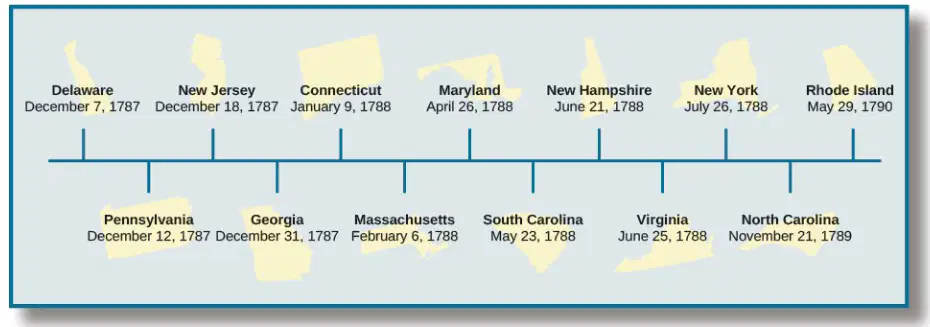
According to the timeline in Figure 2.12, which two states ratified the Constitution in June 1788?
New Hampshire and Virginia
New York and North Carolina
Massachusetts and Maryland
Georgia and South Carolina
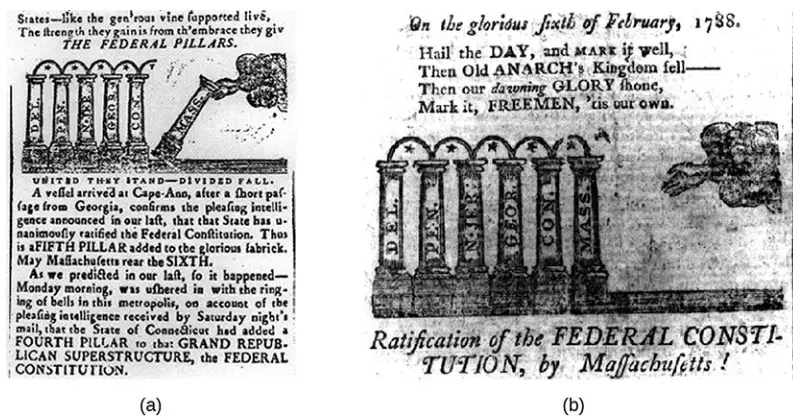
The Massachusetts Sentinel cartoon conveys the message that the ratification of the Constitution was a process involving the cooperation and support of different states. What message does the cartoon convey to its viewers regarding the ratification of the Constitution?
The ratification of the Constitution was a process involving the cooperation and support of different states.
The ratification of the Constitution was opposed by all states equally.
The cartoon suggests that the Constitution was already ratified by every state.
The cartoon shows that the Constitution was not important to the states.
According to the text, smaller, less populous states favored the Constitution and the protection of a strong federal government because:
they wanted equal representation and protection from larger states.
they wanted to avoid paying taxes to the federal government.
they preferred to have no federal government at all.
they believed states should have all the power.
According to the passage, which two populous states initially remained outside the newly formed union after the Constitution went into effect?
Virginia and New York
Massachusetts and Pennsylvania
Georgia and South Carolina
Maryland and Delaware
Who were the three authors of the essays later compiled as The Federalist Papers?
Alexander Hamilton, James Madison, and John Jay
Thomas Jefferson, Benjamin Franklin, and John Adams
George Washington, Patrick Henry, and Samuel Adams
James Monroe, John Hancock, and Thomas Paine
What was the main purpose of The Federalist Papers as described in the passage?
To oppose the new Constitution
To convince Americans, especially New Yorkers, to support the new Constitution
To declare independence from Britain
To create a new government
According to Federalist No. 51, what was one way the federal system would prevent any one part of the government from becoming too strong?
By dividing authority within the federal government into separate branches.
By allowing the president to appoint all members of Congress.
By giving all power to the Supreme Court.
By eliminating state governments entirely.
According to the passage, why did James Madison write a Bill of Rights even though he did not believe it was necessary?
To allay the fears of those who believed the federal government was too powerful.
To increase the power of the federal government.
Because he wanted to limit individual freedoms.
To comply with a request from foreign governments.
In Federalist No. 10, what did Madison argue was too big and diverse to allow the development of large, powerful political parties?
The republic and the interests of its people.
The military and its leaders.
The judiciary and its decisions.
The executive branch and its powers.
According to Hamilton in Federalist No. 70, why should Americans not fear that the president would become a tyrant?
Because it was easier to control one person than to control many.
Because the president would have unlimited power.
Because the president would serve for life.
Because the president could ignore the Constitution.
Describe how the Constitution can be formally amended.
The Constitution can be formally amended by being proposed either by Congress with a two-thirds majority in both the House and the Senate or by a convention called for by two-thirds of state legislatures. The amendment must then be ratified by three-quarters of the state legislatures or by conventions in three-quarters of the states.
The Constitution can be formally amended by a simple majority vote in both the House and the Senate, followed by approval from the President.
The Constitution can be formally amended by a national referendum in which a majority of citizens vote in favor of the amendment.
The Constitution can be formally amended by the Supreme Court issuing a ruling that changes the text of the Constitution.
Fill in the blank: The first ten amendments to the Constitution, known as the ________, were added in 1791.
Bill of Rights
Federalist Papers
Articles of Confederation
Emancipation Proclamation
According to the passage, what was the main purpose of the Bill of Rights?
To quiet the fears of Anti-Federalists that the Constitution did not adequately protect individual liberties and to encourage their support of the new national government.
To establish the first political parties in the United States.
To outline the process for amending the Constitution.
To grant voting rights to all citizens regardless of race or gender.
Which amendment repealed the Eighteenth Amendment, which had prohibited the manufacture, import, export, distribution, transportation, and sale of alcoholic beverages?
The Twenty-First Amendment
The Nineteenth Amendment
The Fifteenth Amendment
The Twenty-Second Amendment
What right did the Seventeenth Amendment, ratified in 1913, give to voters?
The right to directly elect U.S. senators
The right to vote for the President directly
The right to abolish slavery
The right to free speech
Which amendment moved the date of the presidential inauguration from March to January?
The Twentieth Amendment
The Nineteenth Amendment
The Twenty-First Amendment
The Eighteenth Amendment
According to the passage, which amendment gave women the right to vote in the United States?
Fifteenth Amendment
Nineteenth Amendment
Twenty-Third Amendment
Twenty-Sixth Amendment
Fill in the blank: The Fifteenth Amendment gave men the right to vote regardless of ____ or color, but women were still prohibited from voting in most states.
race
age
religion
wealth
Which amendment abolished the use of poll taxes in the United States?
Twenty-Third Amendment
Twenty-Fourth Amendment
Nineteenth Amendment
Fifteenth Amendment
The last great extension of the suffrage that occurred in 1971, according to the passage, was:
the lowering of the voting age to 18
the granting of women the right to vote
the abolition of property requirements for voting
the introduction of secret ballots

