
Font size
 Worksheets
Lions and Tapirs Quiz
Total questions: 50
Worksheet time: 46mins

Lisa thought the lions were … the tigers.
smaller than
bigger than
the most dangerous
less interesting

For Lisa, the elephants were … animals in the zoo.
the most interesting
more interesting than the giraffes
not as interesting as the monkeys
bigger than the lions
What can we learn about cubs from the passage?
They are strong and independent hunters from birth.
They are protected only by their mothers.
They are cared for by their mothers and other females.
They usually stay with the father only.
Which statement best explains why lions are called social animals?
They live together in groups called prides.
They always share their food with other animals.
They travel with zebras and buffalo.
They live in the same place as other predators.
What does the word "ungulates" in the text most likely mean?
Animals that eat plants
Animals with hooves
Animals with sharp claws
Animals living in trees
Why is the mane an important feature of male lions?
It helps them see at night.
It protects them from the heat.
It helps them run faster.
It makes them look stronger and more dominant.
Why do lions need sharp claws and teeth?
To tear the flesh of their prey
To dig holes for resting
To climb tall trees
To protect their cubs from sunlight
Which conclusion can be drawn from the text about the lifespan of lions?
Lions live longer in the wild than in captivity.
Lions can live up to 30 years naturally.
Lions rarely survive more than 5 years in nature.
Lions live for about a decade or slightly more in the wild.
Why is communication important for lions, according to the passage?
It helps them build nests.
It helps them recognize different species.
It makes them more attractive to other animals.
It allows them to coordinate in their prides.
Which of the following best summarizes the text?
Lions are dangerous animals that attack humans.
Lions are solitary hunters that live mostly in Asia.
Lions are social, powerful carnivores with special physical features and behaviors.
Lions are herbivores that survive by eating plants in Africa.

According to Dan, which subject is the most difficult?
English
Math
Science
History
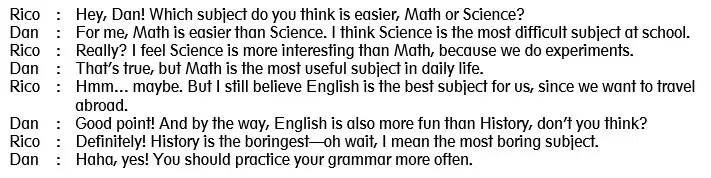
Both brothers agree that History is … English.
more fun than
more boring than
the funniest
better than
Why do young tapirs have a dappled coat pattern?
It helps them blend into the forest undergrowth.
It keeps them warm in colder regions.
It shows which species they belong to.
It attracts the attention of adults.
What conclusion can be drawn about the Malayan tapir from the text?
It has a unique coat pattern compared to other species.
It is the smallest of all tapirs.
It lives only in South America.
It eats meat as well as plants.
When do tapirs usually look for food?
During the middle of the day
During the night or cooler times of the day
Only in the early morning
Only in winter
Which sentence best summarizes tapirs' diet?
Tapirs are omnivores that eat meat and plants.
Tapirs survive mainly on insects and small animals.
Tapirs are herbivores that eat leaves, fruits, and aquatic plants.
Tapirs eat only fruits and roots.
Why is water important for tapirs, according to the passage?
It provides a place to hide and a source of food.
It is where they give birth to their young.
It keeps their bodies cool during the day.
It helps them communicate with other animals.
Which of the following is a serious problem for tapirs today?
Cold weather in forests
Attacks from horses and rhinoceroses
Habitat loss and hunting
Lack of food in rivers
What does the word "nocturnal" most likely mean in the text?
Active during the day
Active at night
Able to live in water
Living in forests only
Which statement best reflects the writer's opinion about tapirs?
Tapirs are dangerous and should be avoided.
Tapirs are unique and ecologically important animals that need protection.
Tapirs are similar to pigs and do not need conservation.
Tapirs are easy to breed and are not in danger.
What family do lions belong to? (felidae, panthera, mane, africa, gir, pride, ungulates, females, blind, roar)
(a)
What genus do lions belong to? (felidae, panthera, mane, africa, gir, pride, ungulates, females, blind, roar)
(a)
What is the special feature of male lions? (felidae, panthera, mane, africa, gir, pride, ungulates, females, blind, roar)
(a)
Where do lions mainly live? (felidae, panthera, mane, africa, gir, pride, ungulates, females, blind, roar)
(a)
In which forest of India can lions be found? (felidae, panthera, mane, africa, gir, pride, ungulates, females, blind, roar)
(a)
What do we call a group of lions? (felidae, panthera, mane, africa, gir, pride, ungulates, females, blind, roar)
(a)
What type of animals are usually hunted by lions? (felidae, panthera, mane, africa, gir, pride, ungulates, females, blind, roar)
(a)
Who usually does most of the hunting? (felidae, panthera, mane, africa, gir, pride, ungulates, females, blind, roar)
(a)
How are lion cubs at birth? (felidae, panthera, mane, africa, gir, pride, ungulates, females, blind, roar)
(a)
How do lions communicate? (felidae, panthera, mane, africa, gir, pride, ungulates, females, blind, roar)
(a)
What type of diet do tapirs have? (herbivorous, perissodactyla, four, america, proboscis, dappled, nocturnal, swimming, deforestation, conservation)
(a)
To which order do tapirs belong? (herbivorous, perissodactyla, four, america, proboscis, dappled, nocturnal, swimming, deforestation, conservation)
(a)
How many species of tapirs are there? (herbivorous, perissodactyla, four, america, proboscis, dappled, nocturnal, swimming, deforestation, conservation)
(a)
In which continent are South American tapirs found? (herbivorous, perissodactyla, four, america, proboscis, dappled, nocturnal, swimming, deforestation, conservation)
(a)
What kind of nose do tapirs have? (herbivorous, perissodactyla, four, america, proboscis, dappled, nocturnal, swimming, deforestation, conservation)
(a)
What is the coat pattern of young tapirs called? (herbivorous, perissodactyla, four, america, proboscis, dappled, nocturnal, swimming, deforestation, conservation)
(a)
What time of day are tapirs most active? (herbivorous, perissodactyla, four, america, proboscis, dappled, nocturnal, swimming, deforestation, conservation)
(a)
What are tapirs excellent at doing? (herbivorous, perissodactyla, four, america, proboscis, dappled, nocturnal, swimming, deforestation, conservation)
(a)
What is the main threat to tapirs? (herbivorous, perissodactyla, four, america, proboscis, dappled, nocturnal, swimming, deforestation, conservation)
(a)
What is being done to help tapirs? (herbivorous, perissodactyla, four, america, proboscis, dappled, nocturnal, swimming, deforestation, conservation)
(a)
You want to know when the museum opens. What do you ask?
Where is the museum?
What time does the museum open?
Who works in the museum?
How much do you like the museum?
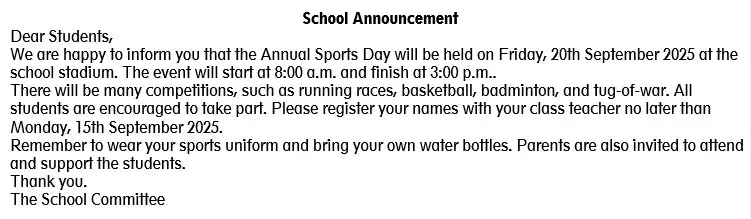
What is the main purpose of the announcement?
To invite students to join Sports Day
To tell students about a new sports lesson
To announce the winners of Sports Day
To cancel Sports Day
Which of the following is the most polite way to ask for information?
Tell me the way.
How do I get there?
Could you tell me how to get there, please?
Where go?
Someone asks: “Do you know where the library is?” Which answer is appropriate?
Yes, I read many books.
Yes, it’s next to the cafeteria.
Yes, I know.
No, but I like libraries.
You’re at the airport. You want to know the gate number. What should you ask?
What is the price of the ticket?
Do you like flying?
Why is the plane late?
Where is the boarding gate for this flight?
Your friend says: “I met a famous actor at the supermarket!” You reply:
That’s impossible!
That’s nothing.
I don’t care.
I’m very tired.
Which phrase shows disbelief?
You must be joking!
That’s a good idea.
I think so too.
Please sit down.
Someone tells you: “I won the lottery!” What is the most natural response?
Okay, goodbye.
I don’t like money.
Seriously? You’re kidding me!
That’s very cheap.
Which of these expressions shows mild surprise?
No way!
Really?
You’ve got to be kidding me!
That’s impossible!
Your classmate says: “I finished the project in only one night.” You reply:
Wow, that’s amazing!
That’s very boring.
I already knew that.
That’s not good.

