
Font size
 Worksheets
REMEDIAL UTS GANJIL BING XII
Total questions: 25
Worksheet time: 16mins

According to the text, what is the main reason why TikTok is considered so addictive?
It is constantly updated with new, trending challenges.
It provides a satisfying user experience
Its recommendation system curates content to a user's specific interests
The videos are short and easy to consume
It allows users to connect with many new people
Based on the text, what are the two main issues that TikTok takes seriously regarding its algorithm?
There is more than one correct answer. Click on every correct answer!
The app is too addictive for teenagers.
Creating a "filter bubble" for users
Not surfacing dangerous content
The possibility of creators being "shadow banned."
The high volume of videos uploaded.
What can be inferred about the reason some creators re-upload their videos or feel "shadow-banned"?
The TikTok recommendation engine has no flaws
The content they are uploading is shocking to a general audience.
They believe their content was not surfaced by the recommendation algorithm due to its nature
They want to make their content more homogeneous
They want to get into the "filter bubble" of a specific audience
Based on the text, what can be inferred about how TikTok's algorithm balances personalization with other concerns?
(There is more than one correct answer. Click on every correct answer!)
The algorithm prioritizes personalization, which can lead to a "filter bubble."
The company is aware that over-personalization is a problem and is trying to address it.
The algorithm is designed to exclusively promote content with the legal consumption of regulated goods
The company is not concerned about the type of content it recommends.
TikTok's algorithm has to balance showing relevant content with the need to avoid showing potentially shocking or dangerous material.
Based on the text, what are the key takeaways about the challenges of content recommendation on platforms like TikTok?
(There is more than one correct answer. Click on every correct answer!)
The app needs to manage the risk of presenting a very similar stream of videos to users
The main challenge is getting users to spend more time on the app.
TikTok must consider the type of content and whether it is appropriate for a general audience
The algorithm is failing to filter out fake or edited content.
Creators may be discouraged when they feel their content is being held back from the recommendation system.

According to the text, what is the cause of feline chlamydial conjunctivitis?
A bacterial organism called Chlamydophila felis.
A virus that infects the conjunctiva.
Exposure to other infected cats in the environment.
An infection that spreads to the lungs.
A fever and loss of appetite.
Based on the text, what can be inferred about the transmission and incubation of feline chlamydial conjunctivitis?
(There is more than one correct answer. Click on every correct answer!)
The bacteria do not survive for long outside of a host cell.
A cat can become infected by being in the same room as an infected cat, even without direct contact.
The symptoms of the disease appear less than two weeks after infection.
A cat can only get infected through close or direct contact with another infected cat.
The incubation period is longer than two weeks.
According to the text, what are the primary symptoms of feline chlamydial conjunctivitis in the eyes?
(There is more than one correct answer. Click on every correct answer!)
Swollen and red conjunctive
A watery discharge that becomes thicker and changes color.
A protruding nictitating membrane or third eyelid.
Sniffles and sneezing.
A fever.
Based on the text, what is a key difference in the symptoms of the infection between kittens and adult cats?
Kittens are more likely to have a fever than adult cats
Adult cats are more likely to get pneumonia than kittens.
Only kittens lose their appetite, while adult cats do not
The infection in adult cats can cause fatal pneumonia, but it is not mentioned for kittens.
In kittens, the infection may spread to the lungs and cause fatal pneumonia.
Which of the following describes the characteristics of the conjunctiva in a healthy cat, as mentioned in the text?
(There is more than one correct answer. Click on every correct answer!)
It is not readily visible.
It has a pale, salmon pink color.
It is a delicate membrane.
It becomes swollen and red.
It has a yellow or greenish discharge

According to the text, what was the primary finding of the researchers' study?
Gas-powered vehicles have the highest raw material cost risks.
Self-charging and plug-in hybrid vehicles have twice the raw material cost risks.
The prices of rare metals for batteries are stable and predictable.
The supply chain for conventional gas vehicles is more vulnerable than that of hybrid vehicles.
The main contributor to cost risks is the electronics in all vehicle types.
Based on the text, which of the following were used by the researchers to calculate the materials cost vulnerability?
(There is more than one correct answer. Click on every correct answer!)
The average price of each component between 1998 and 2015.
The weight of each component.
The number of parts in each car.
The price volatility of each component between 1998 and 2015.
The specific type of vehicle (sedan or SUV).
What is the primary reason for the increase in raw material cost risks for hybrid vehicles?
The high cost of steel and other conventional materials
The challenges of the global supply chain after the COVID-19 pandemic.
The difficulty in finding long-term supplier contracts.
The reliance on expensive and volatile battery-related elements.
The shifting consumer values towards more eco-friendly cars.
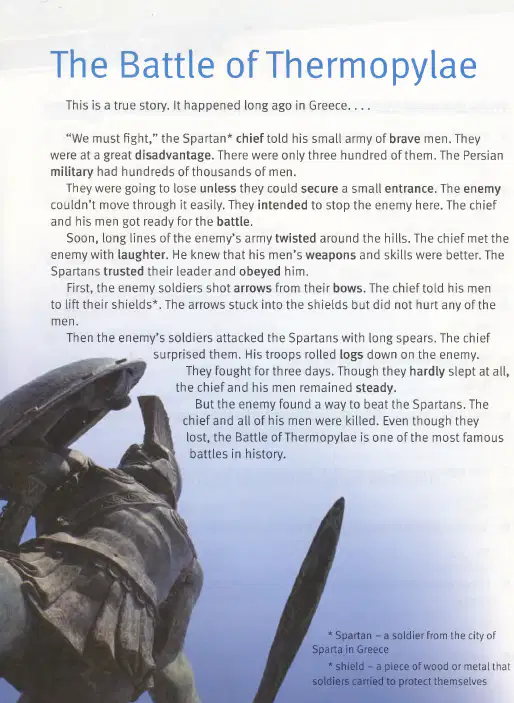
What can we infer about the Spartan soldiers' fighting strategy based on the text?
They relied heavily on surprise attacks.
They preferred fighting in open fields
Their main advantage was their large number
They used the landscape to their advantage
They were afraid of fighting the Persian army
What is the most likely reason the Persian army couldn't easily defeat the Spartans at first?
The Spartans had better weapons and skills
The Persian army was disorganized and lacked a leader
The Spartans were in a more advantageous position
The Persian army was much smaller than the Spartan army
The Spartans were able to hide from the Persians
What can we conclude about the character and nature of the Spartans in this battle?
(Choose more than one correct answers)
They were brave and loyal
They were well-rested and prepared
They were highly disciplined
They were cunning and strategic
They lacked courage
Based on the text, what were the primary challenges faced by the Spartans during the battle?
(Choose more than one correct answers)
Being outnumbered by the enemy
The Persians' use of spears
The lack of sleep for three days
The arrows shot by the enemy
The superior weapons of the Persians
Which statements best describe the ending of the story?
(Choose more than one correct answers)
The Spartans were able to win the battle
The Spartans fought until the very end
A new way was found to beat the Spartans
The Spartans' leader was the only survivor
The Spartans were eventually defeated
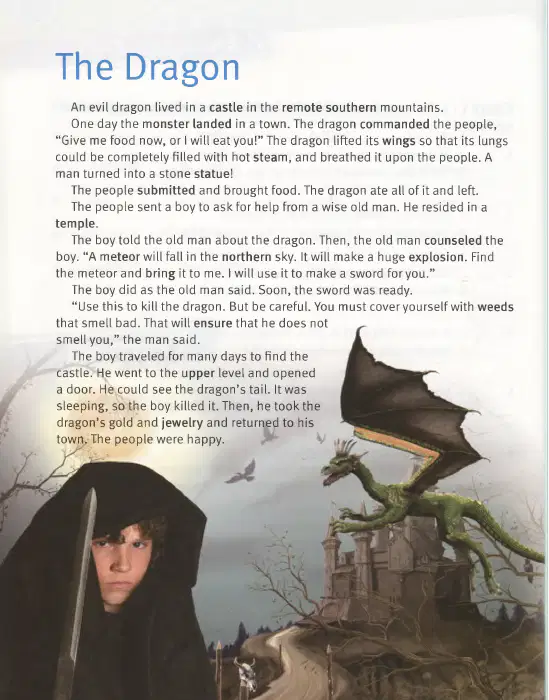
Based on his actions, compare the boy's mindset to that of the townspeople.
The boy was passive and waited for a hero, while the townspeople bravely fought the dragon
The boy gave up on the dragon, while the townspeople looked for a way to defeat it
The boy proactively sought a solution, while the townspeople remained submissive and fearful
The boy was afraid of the dragon, while the townspeople were confident they could defeat it.
The boy collaborated with the dragon, while the townspeople resisted
Why did the old man advise the boy to cover himself with foul-smelling weeds?
Because the weeds would mask the boy's scent, preventing the dragon from smelling him
Because the bad smell would drive the dragon away
Because the weeds contained a magical potion that would make the boy invisible
Because it was part of a magical ritual to create the sword
Because the dragon was allergic to the smell of those weeds
What are the similarities between the boy's tactics for defeating the dragon and the old man's advice?
(Choose more than one correct answers)
Both involved the direct use of physical strength
Both focused on exploiting the dragon's weaknesses (smell and sleep)
Both utilized a unique and specially-made tool
Both avoided direct and dangerous confrontation
Both were based solely on courage without any strategy
Based on the text, what were the main differences between the Spartan and Persian armies?
(Choose more than one correct answers)
The Spartans had a much larger army, while the Persians had a smaller one
The Spartans relied on strategy, while the Persians relied on sheer numbers
The Spartans had superior weapons, while the Persians' weapons were simpler
The Spartans used the terrain to their advantage, while the Persians fought in open fields
The Spartans were led by a king, while the Persians had no leader.
Why were the much smaller Spartan forces able to hold off the massive Persian army for three days?
Because the Persian army was afraid of the Spartans' bravery
Because the Spartans had better weapons and combat skills
Because the Persian army was undisciplined and easily gave up
Because the Spartans chose a strategic fighting position at a narrow entrance
Because the Persian army was hungry and exhausted
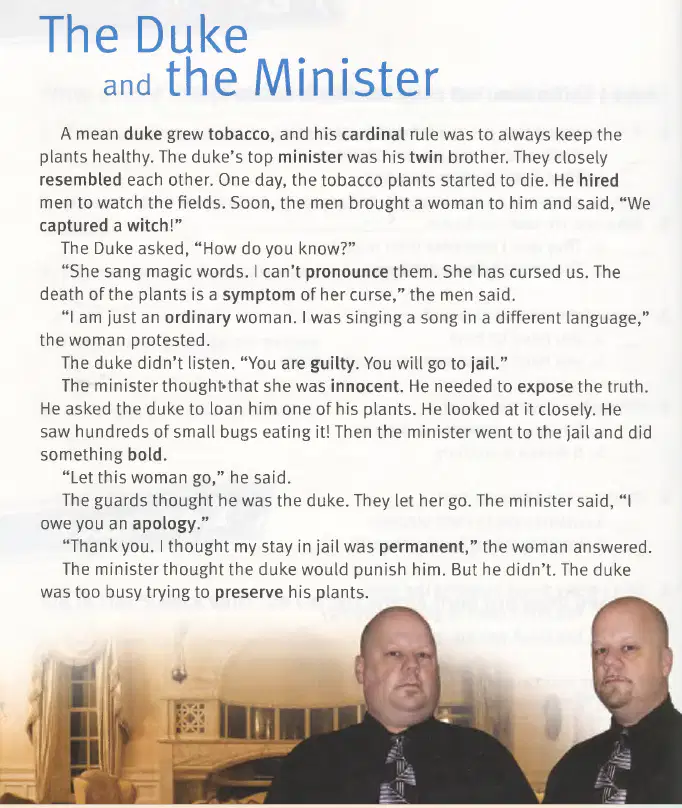
Compare and contrast the characters of the Duke and the Minister. What is the main difference in their approach to solving the problem of the dying tobacco plants?
The Duke relies on superstition and blame, while the Minister seeks a logical explanation.
The Duke is kind and forgiving, while the Minister is harsh and punitive
The Duke is a good leader who listens to advice, while the Minister is reckless
The Duke is brave and bold, while the Minister is cowardly
The Duke is innocent, while the Minister is guilty
The woman was released from jail because the guards thought the Minister was the Duke. What does this event reveal about the Duke's reputation or character?
(Choose more than correct answers)
The Duke was known for being unpredictable and often went against his own rules
The Duke had a very similar appearance to his brother, the Minister
The Duke's orders were absolute and unquestioned by the guards
The Duke was widely feared for being a harsh and unjust ruler.
The guards would only obey the Duke's orders.

