
 Worksheets
Module 1 Matter and It's Properties Assessment
Total questions: 17
Worksheet time: 9mins
Name
Class
Date
1.

1. The two beakers below contain pure water. Which of the following properties is the same for both of these samples?
a)
Mass
b)
Weight
c)
Volume
d)
Boiling point
2.
2. Sulfur (S), oxygen (O2), water (H2O), and sodium chloride (NaCl) are all examples of pure substances. Which of the following describes all pure substances?
a)
A pure substance consists of only one type of element
b)
A pure substance is made up of only one type of atom or molecule
c)
A pure substance cannot be broken down into simpler substances
d)
A pure substance is normally found as a liquid at room temperature
3.
3. The elements fluorine, chlorine, bromine, and iodine are all found in the same group (17) on the periodic table. These elements are grouped together because they:
a)
are metals.
b)
have similar chemical properties
c)
have the same atomic mass
d)
are noble gases.
4.
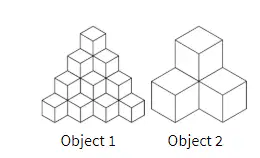
4. A toy company was producing blocks for a new game. They use plastic that is generated using natural carbon-based compounds like cellulose, coal, and crude oil. Two different shapes are each made from cubes stuck together as shown. If all the cubes are composed of the exact same , how do the objects compare in mass, volume, and density?
a)
Object 1 has a greater mass and density, but both have the same volume.
b)
Object 1 has a greater volume and mass, but both have the same density.
c)
There is not enough information to compare mass and volume, but both have the same density.
d)
Object 1 has a greater volume and density, but both have the same mass.
5.
5. Which of the following is the best model and description of what one individual grain of salt looks like at the molecular level?
a)
The salt grain is composed of multiple copies of Na and Cl atoms bonded together and organized into a crystal lattice
b)
The salt grain is composed of one atom of NaCl.
c)
The salt grain is composed of multiple copies of Na and Cal atoms bonded together that are not organized in any particular way
d)
The salt grain is composed of one atom of Na and one atom of Cl bonded together.
6.

6. Using the information about the five liquids in the table below, which of the following liquids could be the same substance?
a)
Liquids 1 and 2
b)
Liquids 1 and 3
c)
Liquids 1 and 4
d)
Liquids 1 and 5
7.
1a. The sun shines brightly through a window in the room, causing the temperature of the room to increase. Which of these statements best describes how this would affect the atoms and the molecules in the rooms air.
a)
Thermal energy is being added, increasing the particle motion.
b)
Thermal energy is being removed, increasing the collisions of the particles.
c)
Thermal energy is being removed decreasing the particle motion.
d)
Thermal energy is being added, decreasing the gas pressure.
8.
1c. Which diagram best shows the results of removing heat from the original sample until it freezes?
a)
A
b)
B
c)
C
d)
D
9.
2a. Kendra puts water on the stove she can make spaghetti. She turns the stove on high and notices that the water level is getting higher. Eventually the water starts to boil.
a)
Gravity pushes it up.
b)
Air bubbles are released.
c)
Adding thermal energy increases the volume of the liquid.
d)
Air pressure above the water pulls it up.
10.
2b. Which of the following models represents the phase change described in the scenario above.
a)
A
b)
B
c)
C
d)
D
11.
3. How do liquid water, ice, and water vapor differ from each other?
a)
They are made of different kinds of atoms.
b)
They are are made of the same molecule moving in different ways.
c)
They have different chemical properties.
d)
They are made of different kinds of molecules.
12.
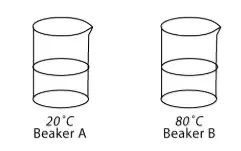
4. Two beakers were prepared with 100 milliliters of water at two different temperatures, as shown above. Two drops of food coloring were then added carefully at the surface of each beaker of water. Which of the following best explains what would happen in this scenario and why?
a)
The food coloring would disperse the fastest in Beaker A because the molecules are widely spaced leaving space without matter for the dye to go.
b)
The food coloring would disperse the fastest in Beaker B because the dye acts like a catalyst, speeding up the movement of the water molecules.
c)
The food coloring would take the same amount of time to disperse in Beaker A and Beaker B because both contain water that behaves the same under the given conditions.
d)
The food coloring would disperse the fastest in Beaker B because the heat causes the water and dye molecules to move faster, increasing the number of molecular collisions that disperses the dye through the container.
13.
5. Approximately when does active boiling of the contents of the beaker occur?
a)
From the beginning of the process
b)
Between 2 and 6 minutes after the heating begins
c)
Between 6 and 16 minutes after the heating begins
d)
After approximately 16 minutes of heating
14.
2. Two white powders were mixed together. A chemical reaction occurred, and a yellow powder was formed. What is the relationship between the yellow powder and the white powders?
a)
The yellow powder is made up of the same kinds of atoms as the white powders, but the atoms are combined into different molecules.
b)
The yellow powder is made up of the same kinds of molecules as the white powders, but the molecules are a different color.
c)
The yellow powder was released from inside the atoms of the white powders.
d)
There is no relationship between the yellow powder and white powders.
15.
3. In the diagrams below, sulfur atoms are represented by gray circles, carbon atoms are represented by black circles, and oxygen atoms are represented by white circles.Which of the following could be a product of the chemical reaction between sulfur and oxygen?
a)
A
b)
B
c)
C
d)
D
16.
A description of how close a measurement is to the true value of the quantity measured.
a)
accuracy
b)
average
c)
density
d)
interaction
17.
A solid lacking a definite form or shape
a)
composition
b)
amorphous solid
c)
crystalline solid
d)
change of state
100 %

