
 Worksheets
Quick Check! States of Matter & Phase Changes - Missed Questions
Total questions: 9
Worksheet time: 5mins

What is the relationship between the internal energy of a substance and its state of matter?
As a gas loses internal energy it becomes a plasma.
Closer packed atoms generally have more internal energy.
As the internal energy decreases a substance will spread further apart.
As the internal energy increases a substance would go from solid to a liquid.
The amount of energy needed to change a substance from the solid phase to the liquid phase is the substance's
heat of vaporization
heat of transformation
melting point
heat of fusion

According to the provided graph, which element has the lowest melting and boiling points?
Flourine
Chlorine
Bromine
Astatine

This is the molecule ______ and the state of matter is a ________
solid
gas
water
neon
oxygen

The three main phases of matter (not including plasma) are solids, liquids, and gases. They have different properties concerning the arrangement of particles. Choose the two FALSE statements.
liquids are closely-packed but with no regular arrangement
gases are loosely-packed and have no regular arrangement
Solids are made of macroscopic particles while the others are microscopic
There is no regular pattern in solids
solids have the most tightly-packed particle arrangement

Plasma is a state of matter used in neon signs and plasma TVs. According to the model, what question should be asked in the formation (creation) of plasma?
At what temperature will a substance undergo sublimation?
How will a decrease in energy result in plasma formation?
At what energy level will the substance take the shape of its container?
At what temperature will particles move so fast that electrons are stripped from the substance?
Change from Gas to Solid is called........
Sublimation
Fusion
precipitation
Deposition
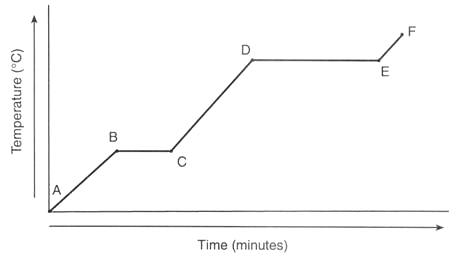
What is happening to the particles in the substance between points A and B?
Melting
Freezing
Speeding Up
Slowing Down
What is the melting point of ice in CELSIUS?
100 degrees
0 degrees
212 degrees
32 degrees

