
 Worksheets
Module 2 Lesson 3- Energy in Chemical Reactions
Total questions: 26
Worksheet time: 51mins
Some reactions give off thermal energy and some absorb thermal energy because:
the energy required to break bonds and the energy released when new bonds form are different.
all reactions always release energy.
thermal energy is only absorbed in chemical reactions.
reactions do not involve energy changes.
What does the scientific vocabulary word 'dependent' mean?
determined by something else
not related to anything else
always independent
a type of energy
What is the main difference between endothermic and exothermic reactions as described in the passage?
Endothermic reactions absorb energy, while exothermic reactions release energy.
Endothermic reactions release energy, while exothermic reactions absorb energy.
Both endothermic and exothermic reactions absorb energy.
Both endothermic and exothermic reactions release energy.
According to the passage, which of the following is true about energy in chemical reactions?
All chemical reactions absorb the same amount of energy.
Some chemical reactions release more energy than they absorb.
All chemical reactions require energy to break apart compounds.
No chemical reactions release energy.
Fill in the blank: Chemical reactions where more energy is required to break the bonds of the reactants than is released when products form are called ________ reactions.
endothermic
exothermic
combustion
decomposition
Fill in the blank: In an ________ reaction, more energy is released when the products form than is required to break the bonds in the reactants.
exothermic
endothermic
neutralization
combustion
A hot pack becomes hot and a cold pack becomes cold because:
chemical reactions inside the packs either release or absorb heat
the packs are made of different materials
they are placed in hot or cold water before use
the packs contain batteries that heat or cool them
What does the word 'exothermic' mean according to the word origin provided in the passage?
Exothermic means 'outside heat' (from Greek exo-, meaning 'outside', and therm, meaning 'heat').
Exothermic means 'inside cold' (from Greek endo-, meaning 'inside', and therm, meaning 'cold').
Exothermic means 'without energy' (from Greek a-, meaning 'without', and energia, meaning 'energy').
Exothermic means 'light producer' (from Greek photo-, meaning 'light', and gen, meaning 'producer').
What is an organism?
a living thing, such as an animal or plant
a type of gas
a chemical reaction
a source of energy
What does the verb 'harness' mean?
to eat something
to use something for a particular purpose
to break something
to create energy
What does the adjective 'gaseous' mean?
having the form of gas
being a living thing
using energy
breaking bonds
During photosynthesis, plant cells use the energy from sunlight to split water into _______ and oxygen atoms.
hydrogen atoms
carbon atoms
nitrogen atoms
sulfur atoms
The sugar glucose, a molecule with 6 carbon atoms, 12 hydrogen atoms, and 6 oxygen atoms (C6H12O6), is formed during _______.
photosynthesis
respiration
fermentation
digestion
What is the process called when the chemical bonds of glucose molecules break and energy is released in cells?
Photosynthesis
Cellular respiration
Concentration
Diffusion
Increasing the concentration of one or more reactants increases _______ between particles, resulting in a faster reaction rate.
collisions
distances
temperatures
pressures
What does the word 'overall' mean as used in the passage?
In detail
As a whole; in general
Separately
Specifically
Fill in the blank: The law of conservation of energy states that even though energy is always transferring, energy is not _______ and energy is not destroyed.
created
measured
increased
multiplied
According to the passage, what happens to energy in a cold pack?
Energy is released to the environment
Energy is absorbed from the environment
Energy is destroyed
Energy is created
Fill in the blank: Plants store glucose molecules in their _______.
tissues
roots
flowers
leaves

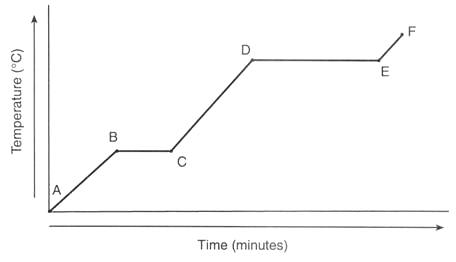
Match each line segment to its description.
AB
solid
BC
melting
CD
liquid
DE
boiling
FG
gas

The diagram represents two solids and the temperature of each. What occurs when the two solids are placed in contact with each other?
Heat energy flows from solid A to solid B. Solid A decreases in temperature
Heat energy flows from solid A to solid B. Solid A increases in temperature
Heat energy flows from solid B to solid A. Solid B decreases in temperature.
Heat energy flows from solid B to solid A. Solid B increases in temperature.


Heat flows from _______ to ______ objects
cooler to warmer
warmer to warmer
warmer to cooler
cooler to cooler

Which statement about the figure is correct?
Pot A has a higher temperature than Pot B.
Pot B has a higher temperature than Pot A.
Pot A has more thermal energy than Pot B.
Pot B has more thermal energy than Pot A.

