
 Worksheets
IED Pre Assessment Engineering
Total questions: 25
Worksheet time: 2hrs 5mins
The first step in the Engineering Design Process is:
Construct and Test a Prototype
Define the Problem
Develop a Solution
Present the Solution
A student team is designing a device to reduce water waste. They brainstorm ideas and create rough sketches. Which design process step are they in?
Define the Problem
Generate Concepts
Evaluate Solution
Present the Solution
True or False: Iteration (repeating steps of the design process) is common and encouraged in engineering.
TRUE
FALSE
Which of the following is NOT part of a good problem statement?
Identifies the need or problem
Lists who is affected
Includes specific solutions
States the criteria and constraints
A prototype is best described as:
A final market-ready product
A test model built to evaluate a design
A list of criteria and constraints
A finished drawing
In a design team, one member dominates all discussions. What is the best strategy to ensure effective teamwork?
Let the member lead since they are confident
Encourage equal participation from all members
Ignore them and move on with your own work
Vote them off the team
Which of the following is a benefit of teamwork in engineering design?
Faster solutions without mistakes
More diverse ideas and perspectives
Everyone always agrees
Fewer design iterations
True or False: Conflict in a design team is always negative and should be avoided.
TRUE
FALSE
When team members record meeting notes, assign roles, and follow deadlines, they are practicing:
Team Norms
Brainstorming
Iteration
Documentation
Scenario: A team disagrees on which concept to prototype. What would be the best next step?
Choose randomly to save time
Use a decision matrix to evaluate options
Let the leader decide alone
Drop the project
How many millimeters are in one centimeter?
1
10
100
1000
A metric ruler shows a length of 4.7 cm. How many millimeters is this?
4.7 mm
47 mm
470 mm
0.47 mm
True or False: On an inch ruler, the smallest common division is 1/16 of an inch.
TRUE
FALSE
A student measures a block as 3 ¼ inches. How should this be written in decimal form?
3.125 in
3.25 in
3.20 in
3.40 in
Which measurement is the longest?
50 mm
5 cm
0.05 m
They are all equal
Scenario: A student needs to measure a piece of metal to the nearest millimeter. Which tool is most appropriate?
Yardstick
Dial Caliper
Tape Measure (inches)
Protractor
If a part measures 7/8 inch, which decimal value is closest?
0.50
0.50
0.875
1.00
A design requires a hole exactly 12.5 mm in diameter. What is this in centimeters?
0.125 cm
1.25 cm
12.5 cm
0.0125 cm
True or False: 1 inch equals exactly 2.54 cm.
TRUE
FALSE
A metric measurement reads 0.032 m. How many millimeters is this?
3.2 mm
32 mm
320 mm
0.32 mm
A bridge prototype fails during testing. What should the team do next according to the design process?
Scrap the design completely
Pretend it worked and move on
Redraw the same design without changes
Evaluate why it failed and redesign
A student is asked to define the difference between criteria and constraints. Which response is correct?
Criteria are limitations, constraints are desired features
Criteria are desired features, constraints are limitations
Both mean the same
Neither is important in design
Which of the following best describes an isometric sketch?
A 2D drawing that shows the true shape of each face
A 3D drawing where edges are drawn at 30° angles
A top view of the object only
A perspective sketch with vanishing points
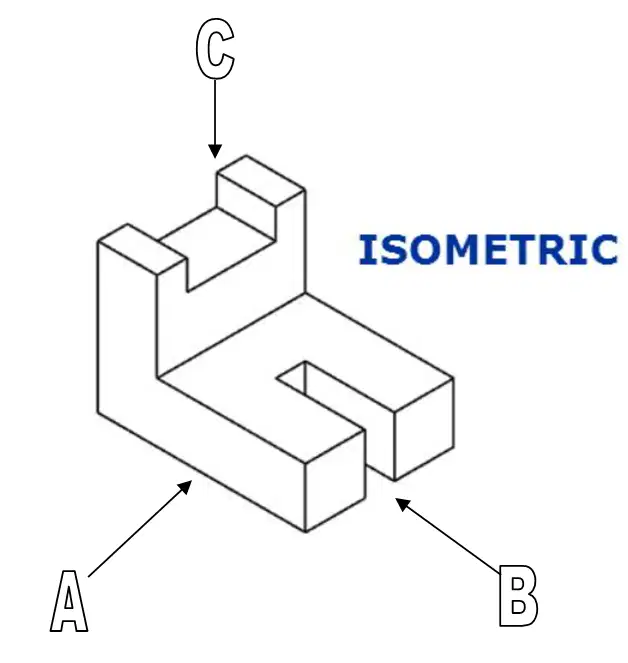
Look at the figure. Which view is the front view in a multiview drawing?
A
B
C
None
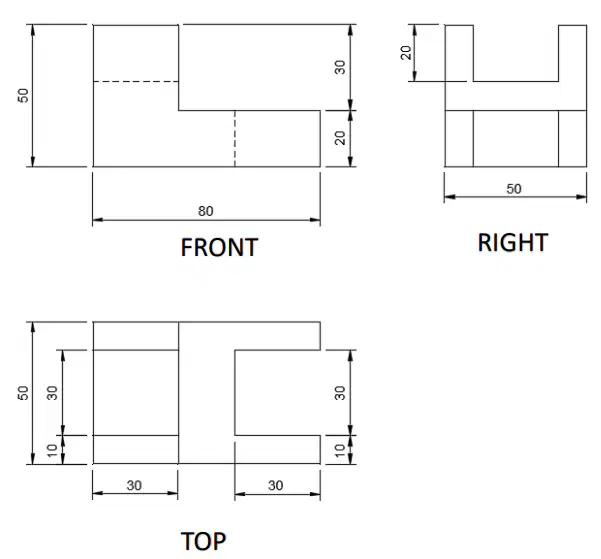
The drawing shows three views of a part. Which type of drawing is this?
Isometric Drawing
Perspective Drawing
Section View
Multiview Drawing

